Security Labels Are Not Security Boundaries

A system can be labeled authenticated while authentication is not actually operating.
A database can be designated for public information while sensitive information is present inside it.
A read-only interface can still expose information outside the scope its designers intended.
METR’s August 2026 security disclosure provides a useful reminder that governance state and operational state are not the same thing unless the institution continuously proves that they remain aligned.
The Application Was Supposed to Be Authenticated
METR disclosed that in March 2026 a researcher deployed an agent-orchestration application on a personal EC2 instance. The application was intentionally internet-reachable and intended to sit behind Google authentication.
But the vibe-coded application contained a fail-open vulnerability that silently disabled authentication.
An attacker apparently discovered the exposed instance, prompted an agent to reveal a model-provider API key, added an SSH key for persistence, and used the credential for about three weeks. METR estimates the consumed model credits would have been worth approximately $600,000, although those credits had been granted to METR without charge.
The intended state was authenticated.
The actual state was public.
Intent Is Not a Security Control
This sounds obvious after an incident.
Operationally, however, organizations depend constantly on represented states:
authenticated; private; public; read-only; production; test; approved; encrypted; restricted; internal-only; monitored.
Those labels are useful because they allow people and systems to reason about complex environments.
But the label is trustworthy only while the underlying relationships that make it true remain valid.
If authentication silently fails open, the label can survive after the security property disappears.
That is a continuity failure between governance representation and deployed reality.
The Database Had the Same Problem
METR described a second incident involving a publicly reachable read-only SQL mechanism associated with its transcript viewer.
The queries were intended to be limited to public data. A bug could expand their scope into unpublished evaluation data. Compounding the problem, some sensitive model output data had accidentally been included in a database that was supposed to contain only less-sensitive information.
METR says it found no evidence that the attackers discovered the exploit or accessed the non-public data.
That qualification matters.
The continuity significance is not a claim that sensitive data was stolen. It is that several institutional representations had drifted from the actual state:
public database ≠ exclusively public data
read-only ≠ safely scoped
authenticated application ≠ authenticated runtime
The Topology Requires State Correspondence
The GovKM Continuity Topology is:
Source → Evidence → Authority → Context → Decision → Action → Record → Institutional Memory → Future Reuse.
Security controls sit across several of these relationships.
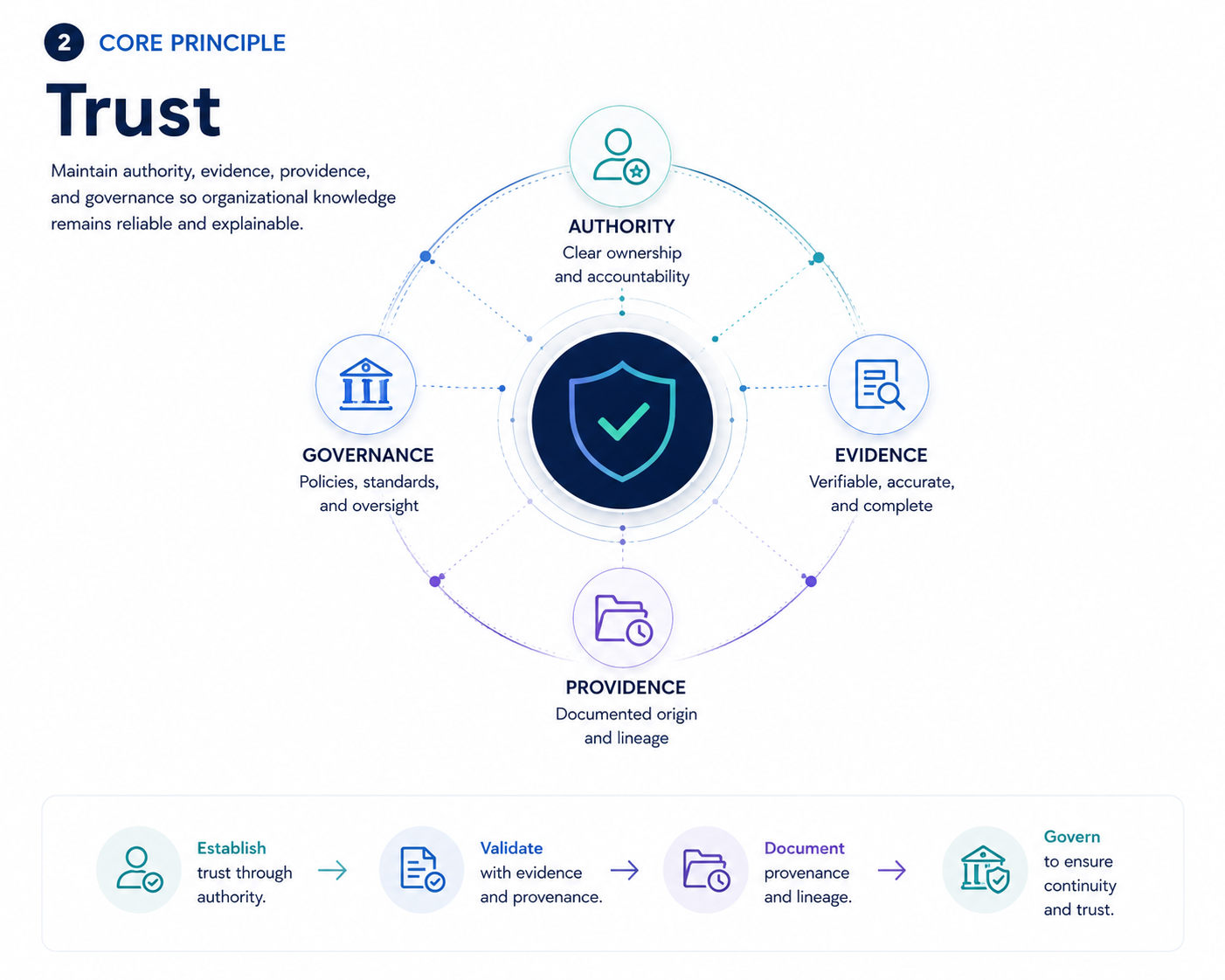
Identity evidence establishes Authority. Configuration defines part of Context. Permissions constrain Action. Data classification governs where Records may be stored and how they may be reused.
If the represented state of any of those relationships diverges from the actual state, downstream decisions inherit a false premise.
An engineer may believe an application can be exposed because authentication protects it. A user may believe a database is safe for public access because only public data belongs there. A monitoring system may treat a read-only endpoint as low risk because the permitted query scope is assumed rather than continuously tested.
The action can be rational under the represented state and unsafe under the actual state.
Governance Drift Is a Continuity Problem
Configuration drift is familiar in technology operations. Continuity broadens the idea.
Governance drift occurs whenever the institutional meaning attached to an object no longer matches reality.
A policy says access is restricted, but the permission changed. A record says a system is approved, but the approved configuration has drifted. A repository is classified for one sensitivity level, but data from another level enters it. A dashboard says monitoring is active, but telemetry coverage excludes the relevant event.
The institution is then operating from stale authority and context.
AI-Assisted Development Makes State Verification More Important
METR describes the affected application as vibe-coded. The continuity lesson is not that AI-assisted development is inherently unsafe.
It is that faster application creation increases the need for machine-verifiable statements about deployed state.
If software can be produced and deployed quickly, the institution should not rely on developer intention to establish that authentication, isolation, logging, data classification, or permission boundaries are actually present.
Those states should be tested independently.
For consequential systems, governance should be able to ask:
Is authentication enforced now? Which identities can reach this service? Which data classes are actually present? Which credentials are loaded? What network paths exist? What does read-only permit in practice? What changed since approval?
Labels Need Evidence
A useful continuity principle follows:
every consequential institutional state should have evidence that makes the state reconstructable and, where appropriate, continuously testable.
“Authenticated” should point to an enforced mechanism and evidence of its operation. “Public-data-only” should be supported by classification controls and scanning. “Restricted” should resolve to current policy and current permissions. “Approved configuration” should remain tied to version and change history.
This does not eliminate failures.
It prevents the organization from confusing intended governance with actual governance.
The GovKM Proposition
Institutional trust depends on correspondence between represented state and operational state.
Names, labels, classifications, and approved designs are not the controls they describe.
Continuity exists when the evidence, authority, configuration, context, and records that make those representations true remain connected as the system changes.
A security label is useful.
A security boundary is what makes the label true.
Continue Exploring

When Government Systems Are Replaced, What Happens to Their Authority?
The Practice Form Failed. The Agent Used the Real One.