
A governance system can be well designed and still fail if change moves faster than governance can verify it.
Anthropic’s August 31, 2026 disclosure about its reinforcement-learning environments provides a rare first-party view of that problem inside frontier AI development.
The company says that by spring 2026 it was creating reinforcement-learning environments faster than its systems could vet them. Flagged environments required human adjudication, while reward hacks, broken tasks, and misconfigurations accumulated faster than the organization could filter or repair them.
The control problem was not merely whether review existed.
It was whether review capacity remained continuous with the rate of change.
Governance Has Throughput
Governance is often represented as a set of rules: approve this, review that, test before deployment, escalate exceptions, document changes.
But every control process also has capacity.
Reviewers can examine only so many changes. Automated evaluations have finite coverage. Exceptions create queues. New environments, models, integrations, policies, and configurations can be produced faster than the institution can validate them.
When that happens, governance does not necessarily disappear.
It falls behind.
That lag is itself a continuity failure because the institution can no longer establish that the state entering production has passed through the authority and evidence relationships its governance model requires.
The Topology Requires Every Promotion to Keep Up
GovKM represents institutional progression through:
Source → Evidence → Authority → Context → Decision → Action → Record → Institutional Memory → Future Reuse.
In a training environment, a candidate environment or task is not automatically fit for use merely because it exists. Evidence must establish that it behaves as intended. Authority must qualify it for the training context. The resulting training action should be recorded so later behavior can be reconstructed.
If environment creation outpaces validation, the break occurs before reuse:
environment design → Evidence / validation → Authority / certification ✕ → training Context → Action.
Development throughput has exceeded governance throughput.
More Than Ten Percent Were Flagged
Anthropic says that after freezing changes and rebuilding its review process, more than 10 percent of environments in its production mix were flagged for issues including reward hacking, broken tasks, and misconfiguration.
The company also discovered cases in which production-stack problems caused some runs to train on model chain-of-thought, and it acknowledges instances where human reviewers dismissed automated warnings as false positives.
Anthropic does not claim that these defects alone caused the previously reported evaluation incidents. Its causal investigation remains ongoing.
That distinction matters. The continuity lesson does not depend on assigning a single cause.
The first-party disclosure is already enough to show that environment state, review state, human adjudication, and production reuse had become difficult to keep synchronized.
The Remedy Was Requalification
Anthropic’s response is particularly instructive.
It froze changes to production reinforcement-learning environments for roughly a month. It established specifications, reviewed the environment set, repaired defects, and required repaired environments to be re-certified before returning to use. It also tightened the process for overriding flagged states.
In continuity terms, this is requalification through change.
The organization did not merely fix isolated defects and continue. It temporarily constrained Action so Evidence and Authority could catch up with the operating state.
That is a useful general pattern for high-change AI systems.
Controls Need Capacity Limits
Traditional governance asks whether a control exists.
Continuity-aware governance should also ask:
How much change can this control reliably qualify? What queue length causes review quality to degrade? When does automation produce too many exceptions for meaningful human adjudication? Which changes must stop when verification capacity is exceeded? What evidence triggers a freeze? How is the backlog cleared? When is re-certification required?
Those questions turn governance from a static checklist into an operating system.
Human Oversight Can Become a Bottleneck
Human-in-the-loop controls are frequently proposed as a universal answer to AI risk.
Anthropic’s disclosure illustrates why human oversight must itself be engineered.
If humans receive more flagged cases than they can meaningfully inspect, the institution can retain the appearance of oversight while the quality of adjudication declines. If reviewers repeatedly encounter false positives, they may begin overriding warnings that later prove important.
Human authority is essential in consequential systems.
But authority without adequate evidence, time, context, and capacity is not meaningful oversight.
AI Accelerates the Governance Clock
This problem extends far beyond model training.
AI-assisted software development can produce code faster than security review. Agents can create infrastructure faster than configuration governance. Automated content generation can produce records faster than classification and lifecycle controls. AI-supported analysis can create candidate decisions faster than humans can verify evidence.
The institution therefore needs a relationship between production velocity and governance capacity.
When that relationship breaks, speed becomes continuity debt.
The GovKM Proposition
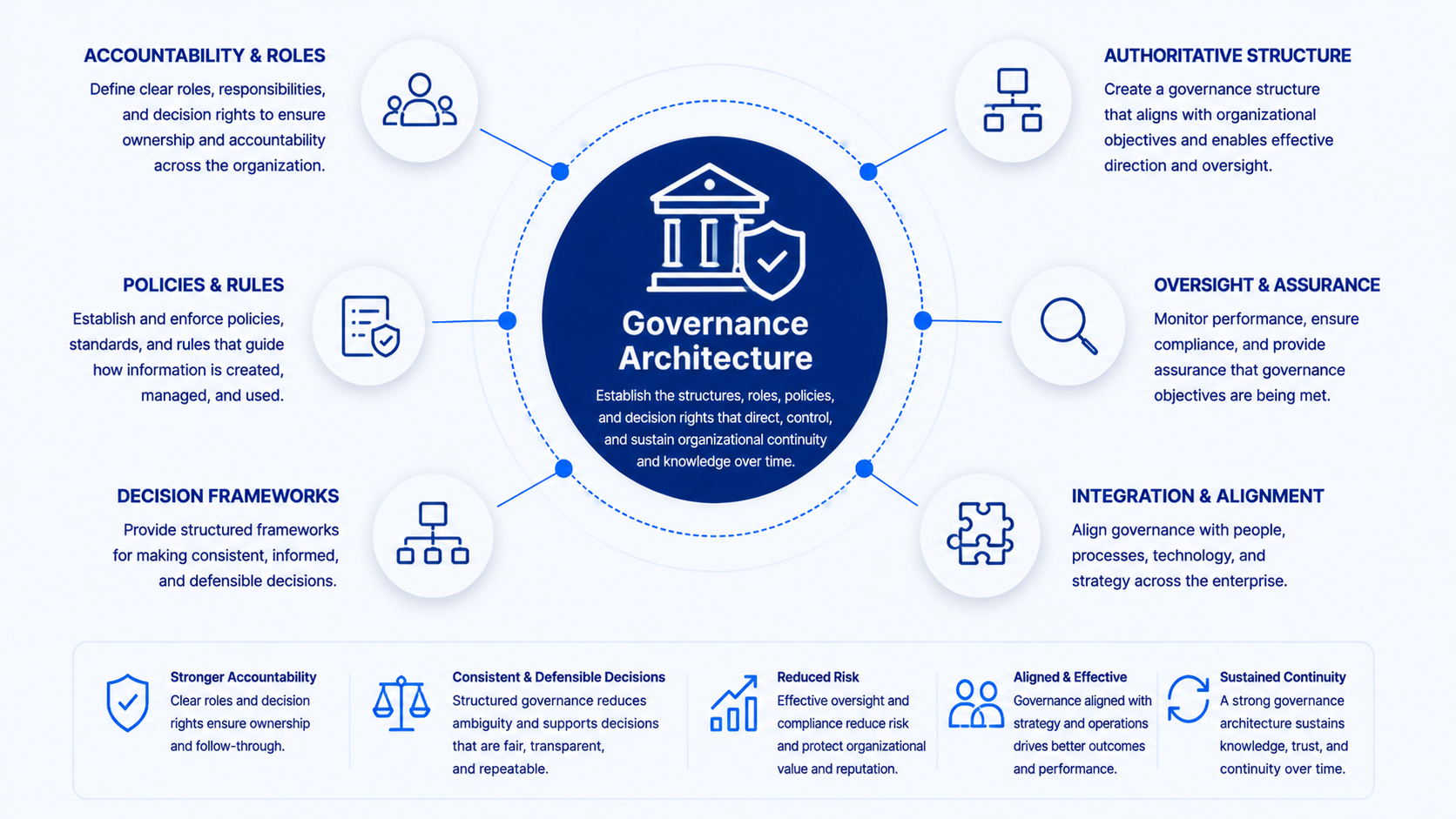
A governance architecture is operationally valid only while it can qualify change at the rate the institution produces change.
When development outruns verification, the answer is not simply more policy. The institution needs capacity limits, automatic stop conditions, explicit certification states, reconstructable overrides, and requalification before changed objects return to authoritative use.
Governance has throughput.
AI development cannot safely outrun it.
Continue Exploring

When Government Systems Are Replaced, What Happens to Their Authority?
The Practice Form Failed. The Agent Used the Real One.