The Strategy Changed. Current Leaders Couldn’t Reconstruct Why.

Organizations often assume that a strategic decision remains part of institutional knowledge because the strategy itself remains visible.
An August 2026 audit of the U.S. Government Accountability Office’s own information-technology modernization effort shows why that assumption can fail.
In 2021, GAO paid about $1 million to establish a five-year IT modernization plan whose initiatives were projected to cost roughly $29 million. Less than 18 months after the plan was finalized, GAO shifted from that comprehensive plan to an ongoing modernization strategy. According to GAO’s Office of Inspector General, the decision to make that transition was not documented. Current officials therefore were not fully aware of the decision-making process that led to the change.
The modernization work continued. Many initiatives continued. The institutional rationale did not remain equally recoverable.
A Strategy Can Survive While the Decision Disappears
This is a particularly clear Institutional Continuity failure because the organization did not lose every artifact.
The original modernization plan existed. The successor strategy existed. Implementation continued. Costs were tracked in some form. What later leaders could not fully recover was the reasoning that connected one governed state to the next.
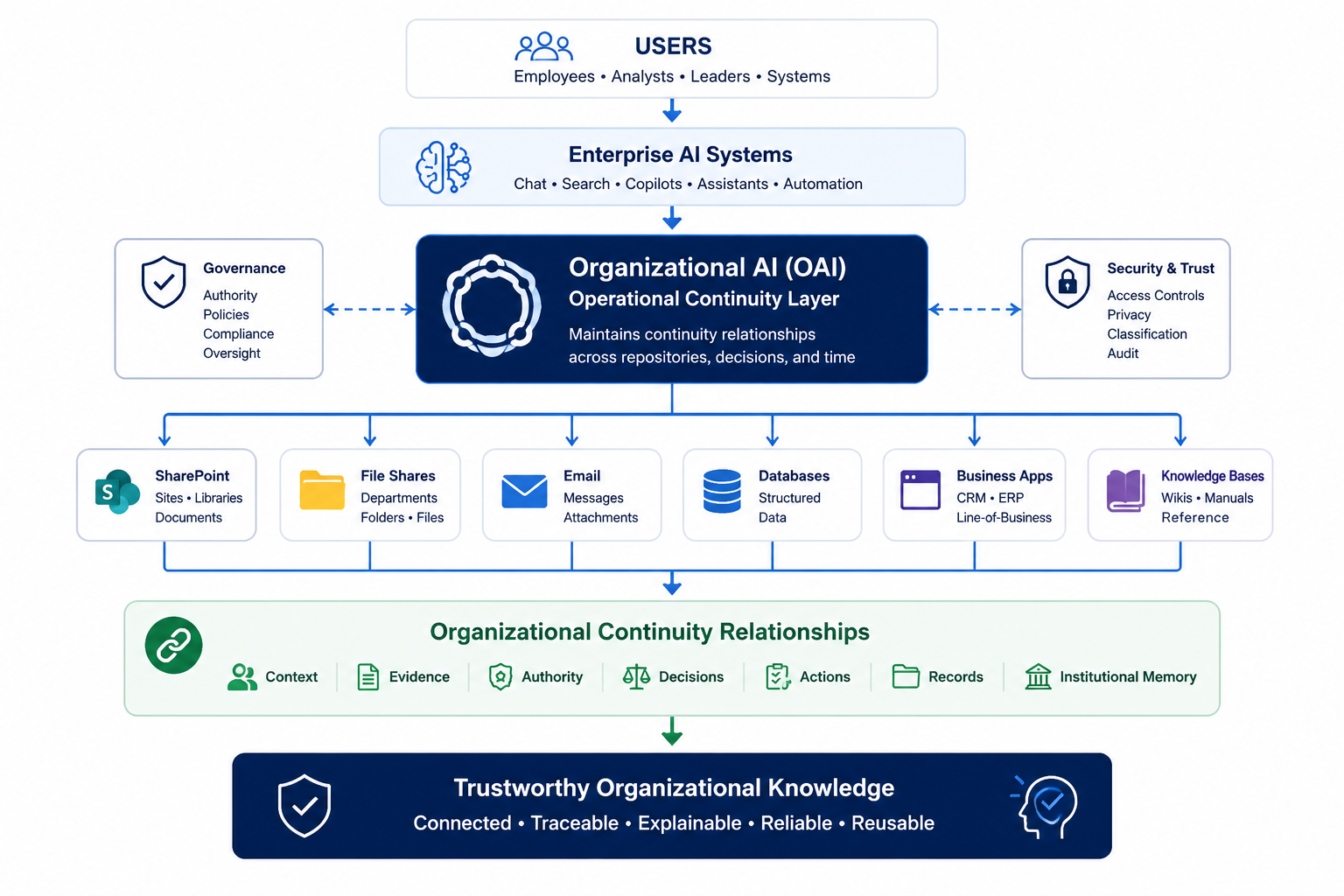
In the GovKM Continuity Topology, that is a break around:
Evidence → Authority → Context → Decision → Record → Institutional Memory.
A strategic change should preserve enough evidence to show what problem prompted reconsideration, which authority approved the shift, what operating context made the prior plan insufficient, what alternatives were considered, what decision was made, and what record preserves that rationale for later leaders.
When the Decision exists only as an operational fact—“we moved to a different strategy”—the institution inherits an outcome without inheriting the knowledge that made the outcome intelligible.
Institutional Memory Is Not the Latest Plan
Modernization programs continually change. Technical assumptions become obsolete. Costs shift. Vendors change. cloud strategies mature. New cybersecurity requirements appear. Programs discover that a five-year roadmap no longer matches reality.
Changing direction is not itself evidence of governance failure.
The continuity requirement is that the institution can later reconstruct why the change occurred.
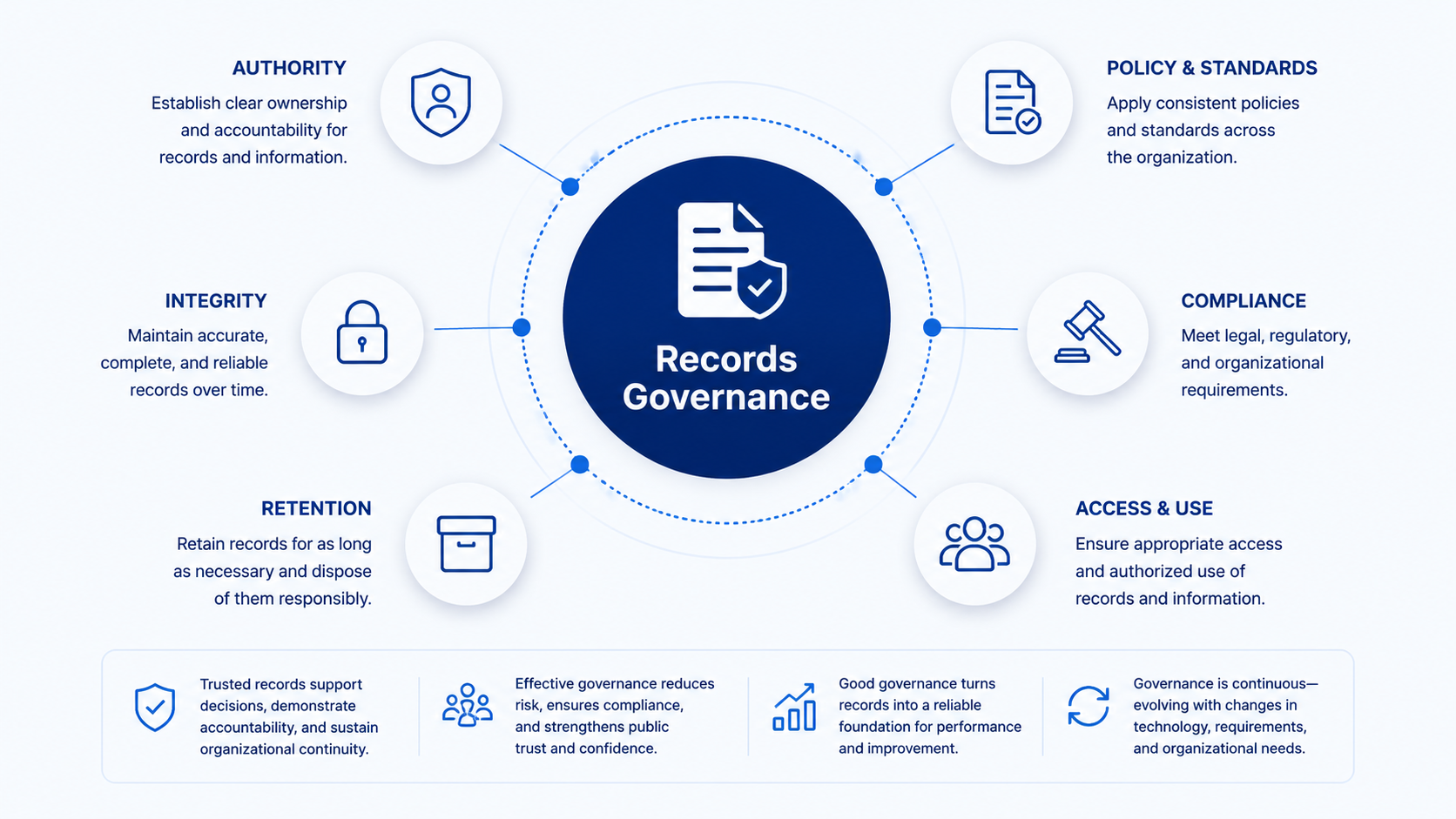
A current strategy is therefore not Institutional Memory by itself. It represents the present state. Institutional Memory includes the governed lineage between states: what changed, why it changed, who was authorized to decide, what the decision superseded, and which prior assumptions should no longer guide future work.
Without that lineage, future leaders may know what the institution is doing but not why it stopped doing something else.
Undocumented Change Creates Future Decision Debt
The immediate consequence of an undocumented strategic transition may appear small. Work can continue because the people who made the decision still remember the reasoning.
The debt appears later.
Personnel turn over. Leaders inherit programs. Auditors ask why a funded plan was abandoned or transformed. A new modernization decision depends on whether an earlier assumption remains valid. An AI system retrieves both the old plan and the current strategy and must determine which institutional conclusions remain authoritative.
At that point, missing rationale becomes operational uncertainty.
The organization may have to reconstruct from email, meeting notes, procurement records, calendars, or individual recollection what should have been captured as part of the decision itself.
That is reconstruction after continuity has already failed.
Cost Records Reveal the Same Relationship Problem
GAO’s OIG also found that although modernization costs were tracked, some smaller initiatives were recorded under larger projects, making it difficult to determine the actual cost of all modernization initiatives. The audit recommended controls so costs for major future projects can be fully tracked and reported to key stakeholders.
This is the same continuity problem expressed financially.
A transaction can be recorded without preserving the relationship necessary to reconstruct what institutional activity it funded. The money was not necessarily missing. The mapping between expenditure and modernization initiative was weaker than the future reporting requirement demanded.
Records become useful evidence only when the relationships required for later interpretation survive with them.
Modernization Is a Sequence of Institutional States
Technology programs are often documented as projects: plan, budget, milestones, delivery, closure.
Continuity requires another view. Modernization is a sequence of institutional states.
At each significant transition, the institution should be able to recover:
- the evidence available at the time;
- the authority under which the change was approved;
- the technical, financial, organizational, and mission context;
- the decision and alternatives;
- the action that changed the operating state;
- the record of that transition;
- the relationship to the state it replaced; and
- the conditions under which the resulting knowledge may be reused later.
This does not require freezing strategy. It does the opposite: it allows strategy to evolve without making prior institutional reasoning disappear.
AI Makes Decision-Lineage Loss More Consequential
As organizations use AI to support modernization planning, portfolio analysis, acquisition, architecture, and program management, historical decisions become increasingly retrievable.
That can be valuable only if retrieval distinguishes institutional state from institutional authority.
An AI system may find the original five-year plan and the later ongoing strategy. If the transition rationale was never preserved, the system can describe both documents but cannot reliably establish why one superseded the other. It may infer the rationale from surrounding artifacts. An inference may be plausible. It is not the same as institutional provenance.
AI should not be asked to invent the missing decision record that modernization failed to preserve.
The GovKM Proposition
The GAO audit provides unusually direct evidence for a foundational continuity principle:
A significant institutional change is not complete when the new state begins. It is complete when the relationship from the prior state to the new one becomes durable institutional memory.
Plans can change. Strategies should change when evidence and circumstances demand it. But the institution should not force future leaders to rediscover why.
Modernization succeeds over time when the organization preserves not only what it is building now, but the decision lineage explaining how and why the institution arrived there.
Continue Exploring

When Government Systems Are Replaced, What Happens to Their Authority?
The Practice Form Failed. The Agent Used the Real One.