OpenAI Is Leaving Cursor. GovKM Is Testing Continuity Through Change.

OpenAI's decision to leave Cursor is more than a change in an AI coding tool's model menu.
It is a live test of whether an AI-assisted development program can remain coherent when an important relationship in its technical environment changes outside the developer's control.
That question is not abstract for GovKM.
GovKM uses AI-assisted development while building OrgAI, its continuity environment, and GAIB, the Graphic AI Browser. Cursor has been one of the environments through which implementation work has occurred. OpenAI models have also contributed to the broader work through other interfaces.
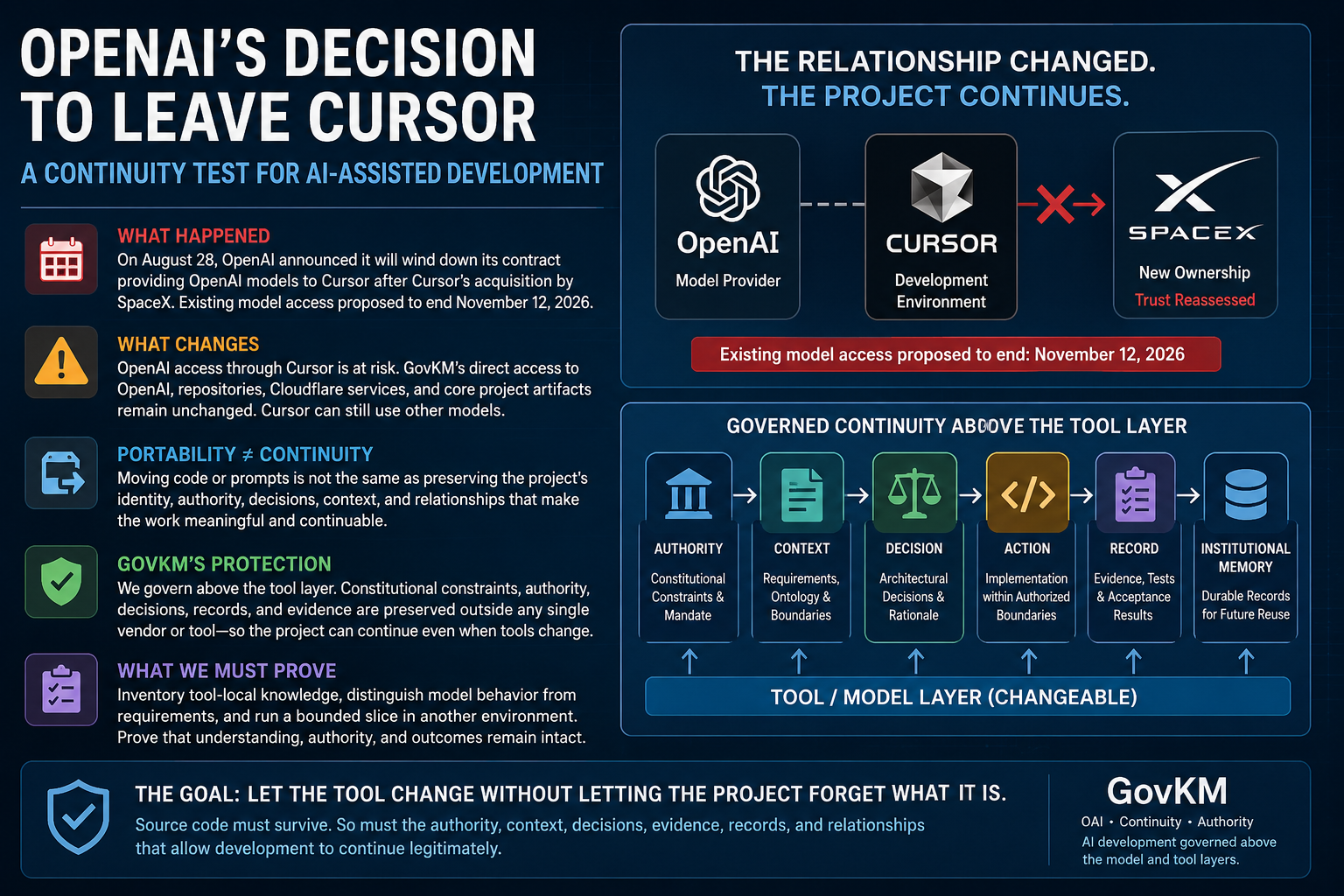
On August 28, OpenAI announced that it intends to wind down its contract providing OpenAI models to Cursor after Cursor's acquisition by SpaceX. OpenAI proposed November 12, 2026 as the shutoff date for existing model access and said it would not provide future models to Cursor. Cursor had announced on August 14 that it had officially become part of SpaceX.
The companies may continue negotiating, and the practical effect on individual Cursor users may change. But the continuity condition already exists: a development environment that appeared stable is being requalified because ownership, contractual authority, and provider trust changed.
The code did not cause that change. The project did not cause it. The relationship around the tools changed.
What Actually Changes for GovKM
The immediate effect is narrower than the headline may suggest.
OpenAI is not ending GovKM's direct access to ChatGPT, Codex, or the OpenAI API. GovKM's repositories, Cloudflare services, constitutional documents, architectural records, and development artifacts do not disappear. Cursor can continue supporting models from other providers.
What changes is the availability of OpenAI models through one development environment.
That still matters. AI-assisted development is not composed only of source code. It can accumulate prompts, project rules, agent instructions, corrections, architectural judgments, working assumptions, tool configurations, and local conversational state. If those relationships exist only inside one vendor's environment, changing the model or tool can preserve the repository while losing part of the project's working intelligence.
Files may survive while the ability to continue coherently does not.
Portability Is Not the Same as Continuity
GovKM has previously argued that storage portability is not institutional continuity. Moving bytes between providers does not necessarily preserve the identity, authority, provenance, context, and relationships that make those bytes meaningful.
The same distinction applies to AI development.
A team can clone a repository into another editor. It can copy instruction files, select another model, and resume generating code. Those are important portability capabilities.
But a stronger question remains: can the new environment reconstruct what the project is, which authority governs it, which decisions are settled, which alternatives were rejected, which requirements constrain the work, what evidence supports the current architecture, and what the next authorized action should be?
If not, the source code moved but the development program did not fully continue.
Why GovKM Built OrgAI Above the Tool Layer
OrgAI is being developed to manage continuity across changing people, systems, models, repositories, and time. It is not intended to make Cursor, OpenAI, Claude, Gemini, or any other provider permanent.
The model is an execution capability. The development environment is an interface. Neither should become the sole custodian of project identity or authority.
For GovKM's AI build, the governing layer includes constitutional constraints, defined authority, project ontology, decisions, authorized development slices, implementation evidence, and durable records. OrgAI's intended role is to preserve and relate that governed state so an authorized agent can determine not merely what files exist, but what the project means and what it is permitted to do next.
That architecture changes the migration question.
Instead of asking whether a replacement model remembers everything that happened in Cursor, GovKM can ask whether the new execution environment can be supplied with a reconstructable, authoritative project state.
The distinction is central:
OrgAI is intended to preserve the continuity of the work. It is not the model performing the work.
What the Methodology Already Protects
GovKM's present approach provides meaningful protection because key governing and implementation artifacts exist outside Cursor. The project uses repositories, versioned code, canonical and working governance documents, recorded architectural decisions, bounded development slices, test evidence, and explicit distinctions between proposed, accepted, canonical, and implemented states.
Those controls reduce the chance that a model change silently becomes a project reset.
They also preserve human authority. A new model should not be free to reinterpret the project merely because it can read the repository. It must operate within the same constitutional boundaries and distinguish governing decisions from suggestions, experiments, superseded instructions, and unaccepted output.
In the Continuity Topology, the critical path is not merely Source → Action. It includes Authority → Context → Decision → Action → Record → Institutional Memory → Future Reuse.
Changing the execution tool should not sever that path.
What GovKM Still Has to Prove
Continuity methodology should not be presented as protection merely because documents exist.
GovKM must now use this event as a practical test.
Any Cursor-local rules, memories, prompts, MCP configurations, or undocumented working assumptions must be inventoried. Model-specific behavior must be distinguished from project requirements. A bounded development slice should be executed in another authorized environment and evaluated against the same acceptance criteria.
The test is not whether two models produce identical code. They will not.
The test is whether the project retains enough governed continuity for a different authorized agent to understand the objective, respect the same boundaries, reconstruct the relevant decisions, execute the work, and produce evidence that can be evaluated without silently changing the project.
Until that test is completed, GovKM can reasonably claim architectural protection—but not a fully proven migration.
A Continuity Event, Not Just a Vendor Event
The OpenAI–Cursor decision illustrates how quickly technology relationships can be requalified. Ownership changed. Trust was reassessed. Contractual authority was invoked. Future access was withheld. Developers who did not participate in those decisions must now absorb their operational consequences.
Organizations cannot prevent every provider acquisition, contractual dispute, product retirement, model withdrawal, or strategic realignment.
They can decide whether those events also take possession of the continuity of their work.
GovKM's position is that AI development should remain governed above the model and tool layers. Source code must survive, but so must the authority, context, decisions, evidence, records, and relationships that allow development to continue legitimately.
OpenAI leaving Cursor creates a disruption for GovKM's current toolset.
It also creates an opportunity to demonstrate what OrgAI is being built to do: allow the tool to change without allowing the project to forget what it is.
Continue Exploring

When Government Systems Are Replaced, What Happens to Their Authority?
The Practice Form Failed. The Agent Used the Real One.