Knowledge an AI Agent Can Retrieve Is Not Yet Institutional Knowledge
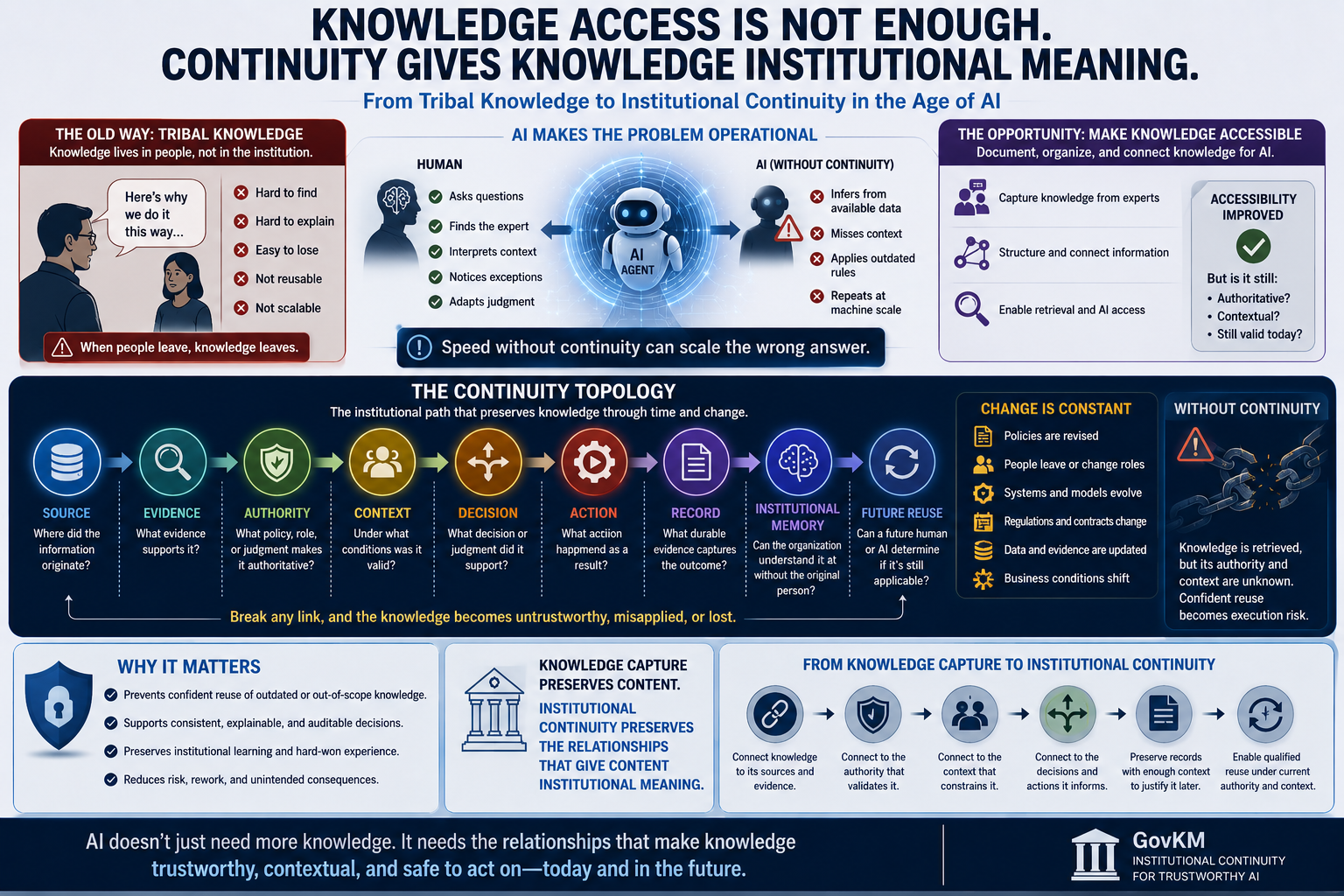

Organizations have always depended on knowledge that lives inside people rather than inside durable institutional structures.
A recent LinkedIn article and post from Luis Mago describes the problem plainly: someone on the team knows why a decision was made, why a client relationship works the way it does, or why a process contains an unusual step that nobody questions. The knowledge is real, but other people cannot reliably use it.
AI agents make that old organizational weakness operationally urgent.
A human employee confronted with an ambiguous instruction can pause, find the person who knows, ask a question, interpret tone, recognize an exception, or notice that a rule no longer fits. An AI agent may instead infer an answer from whatever information is available and repeat that inference at machine scale.
That makes the emerging focus on enterprise knowledge readiness important. But it also exposes a distinction organizations need to make.
Making knowledge accessible to AI is not the same as preserving Institutional Continuity.
AI Is Exposing Knowledge That Was Never Institutionalized
The phrase 'tribal knowledge' often makes the problem sound like an employee-documentation issue. It is larger than that.
When only one employee can explain why a process exists, the organization has not preserved merely a fact. It has failed to preserve one or more relationships: the source of the information, the evidence behind it, the authority that made it applicable, the context in which it was interpreted, the decision it supported, or the action and record that followed.
Humans have historically compensated for those missing relationships through conversation and experience. AI removes much of that informal repair mechanism.
This is one reason current enterprise research continues to associate stronger data readiness with better AI outcomes. Info-Tech's June 2026 AI in the Enterprise study, based on 551 senior leaders, reports that organizations seeing department-wide AI adoption with measurable results are more likely to rate their data quality highly. Importantly, the report also notes that data has value through the insights, decisions, and actions it enables.
That last point matters. Data readiness is a prerequisite. It is not the complete institutional architecture.
A Knowledge Base Can Preserve the Answer and Lose the Reason
Suppose an organization interviews an experienced employee and documents every procedure she can remember. It indexes those documents, adds a semantic layer, builds retrieval-augmented generation over them, and gives an AI agent access.
The organization has solved an accessibility problem.
It has not necessarily solved the continuity problem.
The agent may retrieve a procedure without knowing whether the employee was describing official policy or a local workaround. It may retrieve a decision without knowing what evidence justified it. It may find an exception without knowing who possessed authority to approve it. It may reproduce a lesson learned without recognizing that the conditions that made the lesson valid have changed.
The content survived. The institutional relationships may not have.
The Continuity Topology Shows What Knowledge Must Remain Connected To
GovKM represents the institutional path as:
Source → Evidence → Authority → Context → Decision → Action → Record → Institutional Memory → Future Reuse.
Mago's observation begins near Institutional Memory: knowledge trapped inside a person cannot be reliably reused by the organization or its AI systems.
But the full topology reveals why simply extracting that knowledge is insufficient.
Source: Where did the claimed knowledge originate?
Evidence: What supports it?
Authority: Is it policy, delegated judgment, expert interpretation, convention, or merely habit?
Context: Under what conditions was it valid?
Decision: What judgment did it support?
Action: What happened because of that judgment?
Record: What durable evidence preserves the outcome?
Institutional Memory: Can the organization understand it without depending on the original person?
Future Reuse: Can a future human or AI determine whether the knowledge remains applicable?
Institutional knowledge is trustworthy when those relationships remain available—not merely when the text can be retrieved.
The Dangerous AI Failure Is Confident Reuse Without Qualification
AI changes the risk because retrieval and reuse are becoming cheap.
Historically, inaccessible institutional knowledge often produced delay. Someone had to find the experienced employee, locate an old file, or reconstruct the reasoning.
An AI agent can eliminate that delay while introducing a different failure: rapid reuse of information whose authority or context has not been established.
A procedure may have been superseded. A customer exception may have been unique. A lesson learned may depend on technology that no longer exists. A decision may have been appropriate under a former regulation, contract, risk threshold, market condition, or organizational structure.
The AI can retrieve all of it accurately and still apply it incorrectly.
That is why retrieval accuracy is not enough. Future Reuse requires qualification against current authority and context.
AI Turns Tacit-Knowledge Debt Into Execution Risk
Organizations have accumulated tacit-knowledge debt for decades. Experienced employees remember exceptions, history, informal dependencies, failed approaches, political realities, customer expectations, and the reasons processes evolved.
The debt becomes visible when people retire, resign, reorganize, or stop being available.
Agentic AI adds another trigger. It forces organizations to make implicit knowledge explicit because software cannot reliably absorb institutional judgment through participation in organizational life.
This is an opportunity. But if the response is only to capture more documents, create larger knowledge bases, or improve enterprise search, organizations may simply turn inaccessible knowledge into unqualified machine-accessible memory.
That is better access, not necessarily better continuity.
From Knowledge Capture to Institutional Continuity
Mago's central observation is valuable because it identifies a prerequisite for scaled AI: knowledge that cannot be understood or used beyond the individual who holds it is a liability.
GovKM extends that insight one step further.
The goal should not merely be to transfer what an individual knows into a repository that an AI agent can retrieve. The institution must preserve why the information is trustworthy, what authority governs it, what context qualifies it, which decisions and actions resulted, and whether future users should still rely on it.
Knowledge capture preserves content. Institutional Continuity preserves the relationships that give the content institutional meaning.
That distinction matters across every industry deploying AI. A manufacturer may call the problem tribal knowledge. A hospital may call it clinical context. A bank may call it decision lineage. A software company may call it agent memory. A government agency may call it records and authority. A consulting firm may call it organizational knowledge.
Different industries are encountering different portions of the same architecture.
The solution is not any one element alone. It is continuity across them.
Continue Exploring
The Answer Was Correct. The Evidence Could Not Prove It.
The Model Hadn't Answered Yet. Its Memory Was Already Wrong.