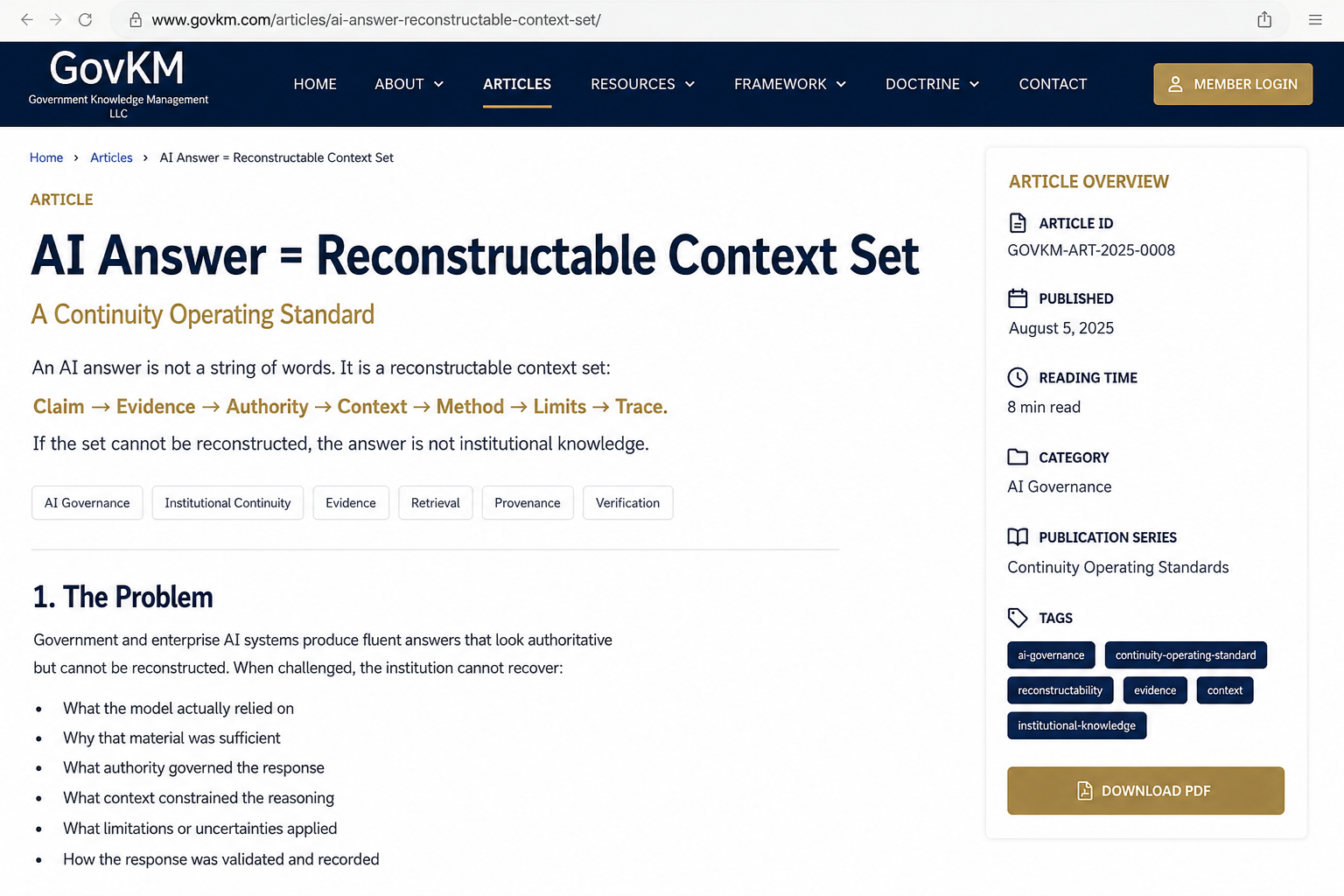

Organizations increasingly preserve AI prompts, outputs, model versions, and audit logs in the name of accountability. Those records are useful. They can still leave one of the most important questions unanswered: What exact institutional context did the AI have available when it produced the consequential output?
For retrieval-augmented generation and agentic systems, that question cannot be answered merely by pointing to the repository that existed at the time. Retrieval may have selected only a small subset. Versions may have changed. Eligibility rules may have excluded sources. A later search may return a different set.
If the institution cannot recover the actual evidence set supplied to the system, it cannot fully reconstruct the decision environment in which the output was produced.
Retrieval Produces a Context State
Recent research on governed context systems makes this problem concrete. The 2026 ContextNest preprint argues that ordinary retrieval pipelines emphasize relevance while providing weaker guarantees around provenance, version identity, integrity, traceability, and point-in-time reconstruction. Its authors report that deterministic retrieval approaches returned stable document sets in their experiment, while a dense-vector baseline returned different sets for many repeated identical queries.
The important GovKM implication is not that one retrieval method should replace another. It is that retrieval is itself an institutional transformation. A large body of available information becomes a smaller body actually presented to the AI. That selected body is the system's working context for the task.
Prompt, Model, and Output Are Not the Whole Record
An organization may preserve a user's question, the model identifier, the final answer, and a list of connected repositories. Years later, the repositories still exist, but documents have been revised, an old policy superseded, the index rebuilt, access rules changed, or records lawfully disposed.
The auditor can reproduce the prompt and perhaps the model, but not necessarily what the model knew for that task. This is a Context continuity failure.
The Continuity Topology Shows What Must Survive
Source → Evidence: Which source objects were eligible, including their versions and provenance?
Evidence → Authority: Why was particular material acceptable for this purpose?
Authority → Context: Which selected, authorized evidence became the working context presented to the AI?
Context → Decision: Which context actually informed the consequential output?
Decision → Record: Does the institutional record preserve enough lineage to identify the evidence state underlying the decision?
Record → Institutional Memory: Can the historical AI-supported decision remain understandable after repositories, models, policies, and personnel change?
Relevance Is Not Reconstructability
A retrieval system can perform well by conventional relevance measures while remaining difficult to audit historically. Relevance asks whether useful information was found. Reconstructability asks whether the institution can later establish which information was found, which versions were used, what governing conditions applied, and how that context related to the resulting judgment.
A future rerun that retrieves a different evidence set may produce a different answer without clearly showing that the institutional basis changed. The organization can then mistake reproducibility of the prompt for reproducibility of the decision.
The Context Set Is Part of Institutional Evidence
For consequential AI use, the evidence package consumed at decision time should be treated as part of decision lineage. This does not necessarily require preserving a permanent duplicate of every source object. Implementations can preserve sufficient references, versions, identifiers, eligibility state, and integrity information according to applicable legal and lifecycle requirements.
The governance principle is more important than any single technical method: an institution should be able to establish what evidence its AI was actually allowed to see and what evidence it actually consumed when a consequential output was produced.
An AI answer is not fully reconstructable unless the institutional context that produced it is reconstructable too.
Continue Exploring
The Answer Was Correct. The Evidence Could Not Prove It.
The Model Hadn't Answered Yet. Its Memory Was Already Wrong.