The AI Industry Is Rebuilding Institutional Continuity One Piece at a Time
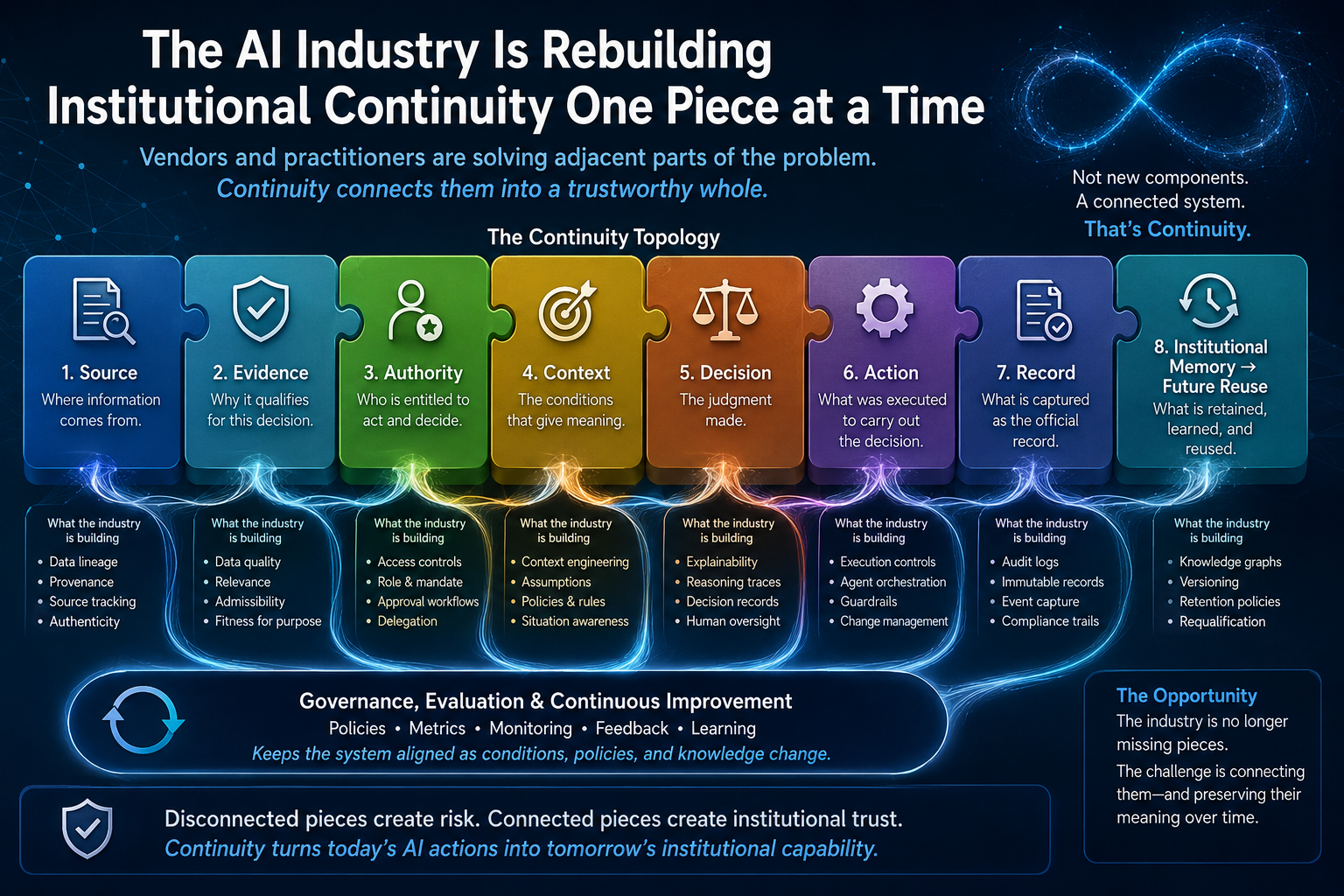

Enterprise AI has produced a rapidly expanding market of solutions for provenance, context, authorization, explainability, auditability, memory, knowledge graphs, data quality, human oversight, and agent execution.
Each addresses a real problem.
GovKM's recent continuity-discovery work suggests something more interesting is happening across these conversations: practitioners working from different technical and professional starting points are repeatedly discovering adjacent parts of the same institutional architecture.
A provenance specialist asks where information came from. A governance architect asks who was allowed to act. A context engineer asks which information should shape the current task. An explainability specialist asks why the model reached an output. An agent-security architect asks whether a specific action remained within an authorized mandate. A records practitioner asks what evidence must survive after execution. A memory architect asks what an agent should retain for the future.
Viewed separately, these appear to be different AI implementation problems.
Viewed together, they increasingly resemble portions of one continuity path:
Source → Evidence → Authority → Context → Decision → Action → Record → Institutional Memory → Future Reuse.
This does not mean these disciplines are interchangeable, or that every AI problem is a continuity problem. It means that reliable institutional AI increasingly depends on relationships that cross the boundaries between them.
Practitioners Are Solving the Part They Can See
The pattern is visible in very different sources.
In a user-supplied LinkedIn post, Betty C. Chen framed the problem of consequential AI agents around organizational authority: who can approve, who has the relevant context, which policy applies, whether approval is still valid when action occurs, and whether the organization can later prove why the decision was made. An independent July 2026 Internet-Draft on verifiable human mandates identifies the same temporal gap in technical terms: an agent may hold valid credentials at execution without proving that a specific later action remains inside the constraints originally authorized by the human principal.
That work concentrates on Authority → Context → Decision → Action.
Elsewhere, Dataiku describes explainability as the ability to understand how and why an AI system produced an output, supported by methods such as SHAP, LIME, reasoning inspection, documentation, lineage, and audit trails. That strengthens visibility around the relationship between model inputs, model behavior, and decisions.
That work concentrates on portions of Evidence → Context → Decision.
K2view argues that traditional design-time data governance is insufficient for agentic systems because governed data must become governed runtime context. Its proposed controls include access, masking, lineage, retention, freshness, traceability, and limits on what an AI receives, remembers, and acts upon.
That work extends from Source and Evidence into Context and Action.
In the NCS and Microsoft paper Architecting AI for the Enterprise, Dimitri Bintein, Sunil Sivadas, and Vito Chin describe four interlocking roles: long-term institutional memory through Knowledge Management, task-specific working memory through Context Engineering, accountability through Human-in-the-Loop, and measurable control through Evaluation and Governance. Their architecture explicitly operates as a closed loop rather than as isolated layers.
That work connects substantial portions of Source → Authority → Context → Institutional Memory.
Other practitioner discussions encountered during GovKM discovery focus on durable graph memory, organizational knowledge trapped inside individuals, decision lineage, provenance layers, audit trails, execution boundaries, policy freshness, and shared sources of truth. The terminology varies. The recurring concern is that AI cannot safely infer institutional relationships that were never made explicit or preserved.
Point Solutions Are Not Wrong
It would be a mistake to interpret this pattern as evidence that provenance, context engineering, knowledge management, explainability, records management, authorization, or agent memory are inadequate disciplines.
They are necessary.
The continuity problem appears when one of them is treated as sufficient for the whole institutional path.
A shared source of truth can make agents consistent while leaving unresolved whether the shared information is sufficient evidence for the present decision.
Provenance can prove origin without proving evidentiary fitness.
Context engineering can assemble the right material for a task without establishing whether the actor has institutional authority to act on it.
Explainability can reveal why a model generated an output without proving that the institution was justified in adopting the output as its decision.
Authorization can establish permission at one moment while failing to preserve whether the mandate remained valid at execution.
An audit log can prove that an action occurred without reconstructing the evidence, authority, and context that made the action legitimate.
Persistent memory can preserve a historical conclusion perfectly after the conditions that made the conclusion valid have changed.
Each capability protects part of the institutional chain. The failure emerges at the boundary to the next part.
The Market Is Moving Toward Relationships
One of the more significant observations is that newer architectures are no longer confined to isolated nodes.
Context platforms increasingly include provenance and authority. Governance platforms increasingly include execution controls and evidence capture. Memory systems increasingly include temporal state, invalidation, and provenance. Agent-security work increasingly distinguishes general identity and permission from action-specific authority. Explainability platforms increasingly include lifecycle documentation and auditability.
The market is therefore moving from individual continuity elements toward adjacent relationships.
That is important because the central proposition of the GovKM Continuity Topology is that institutional meaning resides not only in the objects that survive, but in the relationships among them.
An organization can possess the source, policy, approval, model output, action log, and historical record and still be unable to reconstruct why the action was institutionally valid if their relationships have been lost.
The continuity requirement is connective.
AI Is Exposing Relationships Humans Previously Repaired Informally
Many of these problems are not new.
Experienced employees have always compensated for incomplete institutional architecture. They know which policy is obsolete. They remember which manager approved an exception. They can tell when a procedure describes official policy rather than a local workaround. They know that a previous decision applied only under unusual circumstances.
AI systems cannot safely be assumed to possess those informal repair mechanisms.
When organizational knowledge is incomplete, a human may stop and ask. An agent may infer.
When two policies conflict, an experienced employee may know which authority governs. A retrieval system may rank whichever text appears more relevant.
When a historical decision is found, a human may remember that conditions later changed. A memory system may interpret persistence as continued usefulness.
AI therefore makes previously implicit institutional relationships operational requirements.
The Same Architecture Appears Under Different Industry Names
The continuity-discovery pattern is also cross-sector.
Banking may encounter it as decision lineage, explainability, model governance, or examination evidence.
Healthcare may encounter it as clinical context, provenance, applicability, human oversight, or patient-record integrity.
Manufacturing may call it tribal knowledge, work-instruction authority, engineering history, or lessons learned.
Legal and compliance functions may frame it as applicable authority, auditability, evidence, and traceability.
Software and AI infrastructure companies may call it context engineering, agent memory, knowledge graphs, authorization, or runtime governance.
The differences matter because each sector has distinct authorities, risks, and consequences. But the repeated structural question remains: can information remain connected to the evidence, authority, context, decisions, actions, and records that make it institutionally meaningful?
Future Reuse Is Where the Partial Solutions Converge
The least visible part of many AI architectures remains the last relationship in the topology: Institutional Memory → Future Reuse.
Modern AI systems are becoming exceptionally good at preserving and retrieving history. That makes a new failure possible: an organization may reuse historical knowledge more efficiently than it can determine whether the knowledge remains valid.
A prior approval may have been legitimate under an authority that later expired. A successful workflow may have operated under a policy that was superseded. A clinical conclusion may have depended on evidence that no longer reflects current practice. An exception may be remembered without the constraint that made it exceptional.
Future reuse therefore requires more than retrieval. It requires the institution to retain enough lineage to requalify the historical knowledge against present evidence, authority, context, and purpose.
This is one reason the individual point solutions increasingly need one another.
Continuity Is the Architecture Above the Components
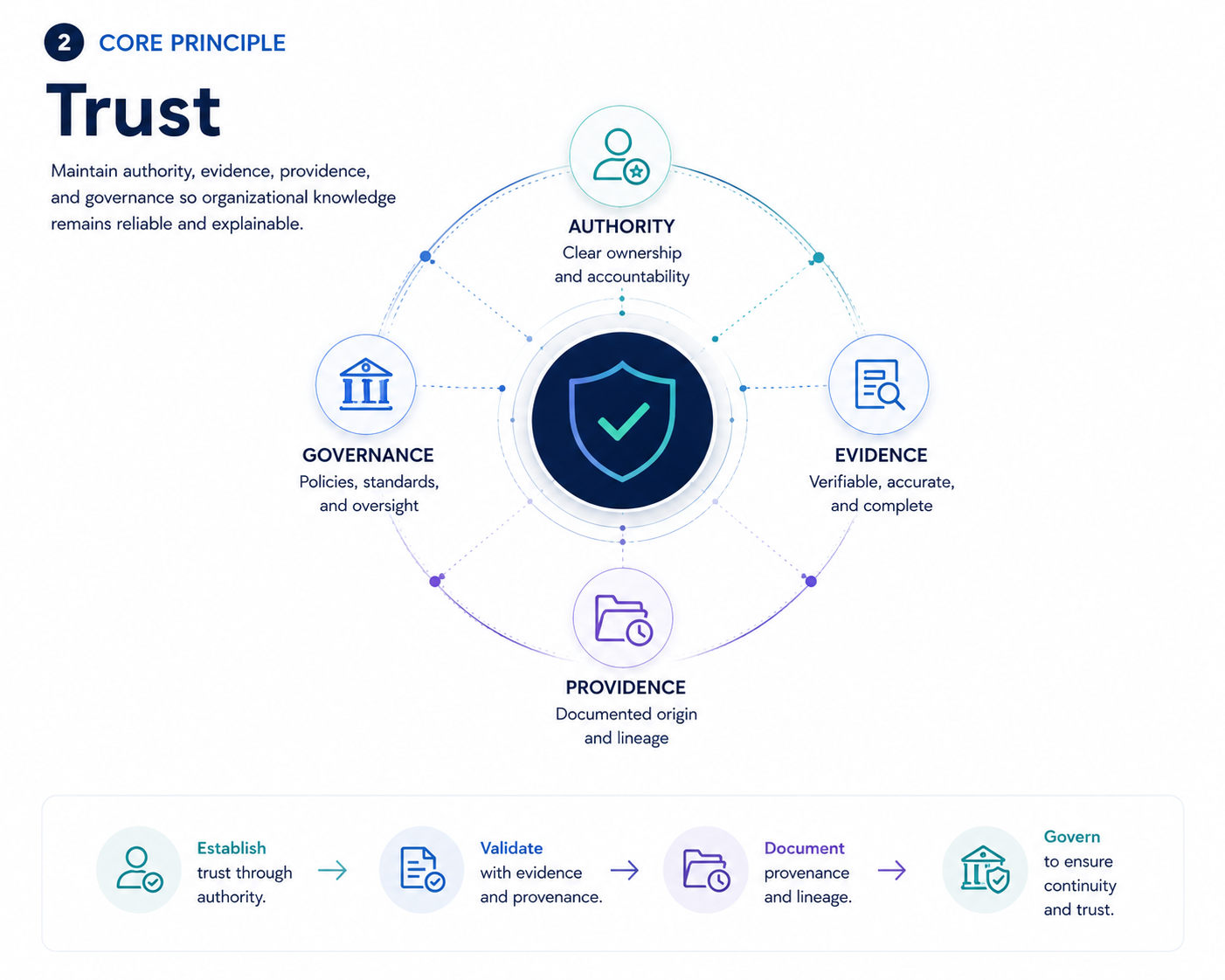
GovKM does not propose Institutional Continuity as a replacement for provenance, data governance, knowledge management, records management, explainability, context engineering, authorization, auditability, or memory systems.
The emerging evidence suggests the opposite conclusion: all of them remain necessary because they protect different portions of the same institutional path.
Continuity supplies the architecture that asks whether their contributions remain connected.
Source → Evidence → Authority → Context → Decision → Action → Record → Institutional Memory → Future Reuse
That architecture also creates a more useful way to evaluate AI implementation claims. Instead of asking whether a proposed technology solves 'the AI problem,' an institution can ask which continuity relationship it strengthens, which relationships it assumes already exist, and what happens at the boundaries it does not govern.
This reframes the market's apparent fragmentation.
The many emerging AI governance, context, memory, provenance, and authorization solutions may not be competing explanations of one problem. They may be independent responses to different observable failures within a larger institutional continuity architecture.
An Evidence Pattern, Not Yet a Market Census
This GovKM analysis is based on a growing body of practitioner discussions, public technical material, enterprise architecture papers, and continuity-discovery observations. It should not be read as a quantitative claim about the prevalence of any particular architecture across the AI market.
The stronger conclusion is structural and testable:
When practitioners describe why institutional AI fails or what it needs to become reliable, their proposed solutions repeatedly map to different elements and adjacent relationships of the Continuity Topology.
As that evidence base grows, GovKM will continue testing the proposition across industries and against competing architectural explanations.
If the pattern persists, the significance is larger than any one AI implementation technique.
It suggests that organizations are already building the components of Institutional Continuity.
What remains is to recognize—and preserve—the architecture that connects them.
Continue Exploring
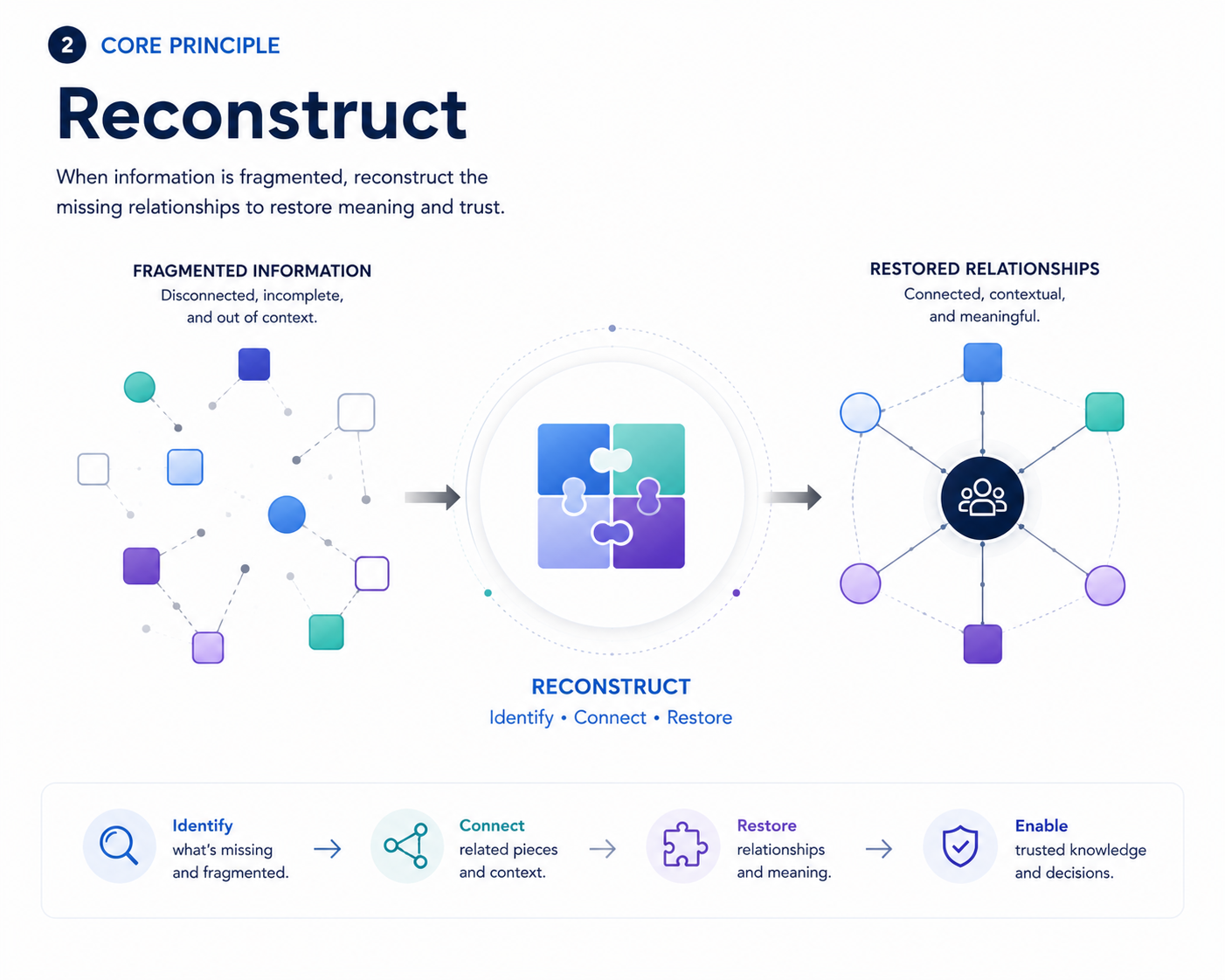
The Answer Was Correct. The Evidence Could Not Prove It.
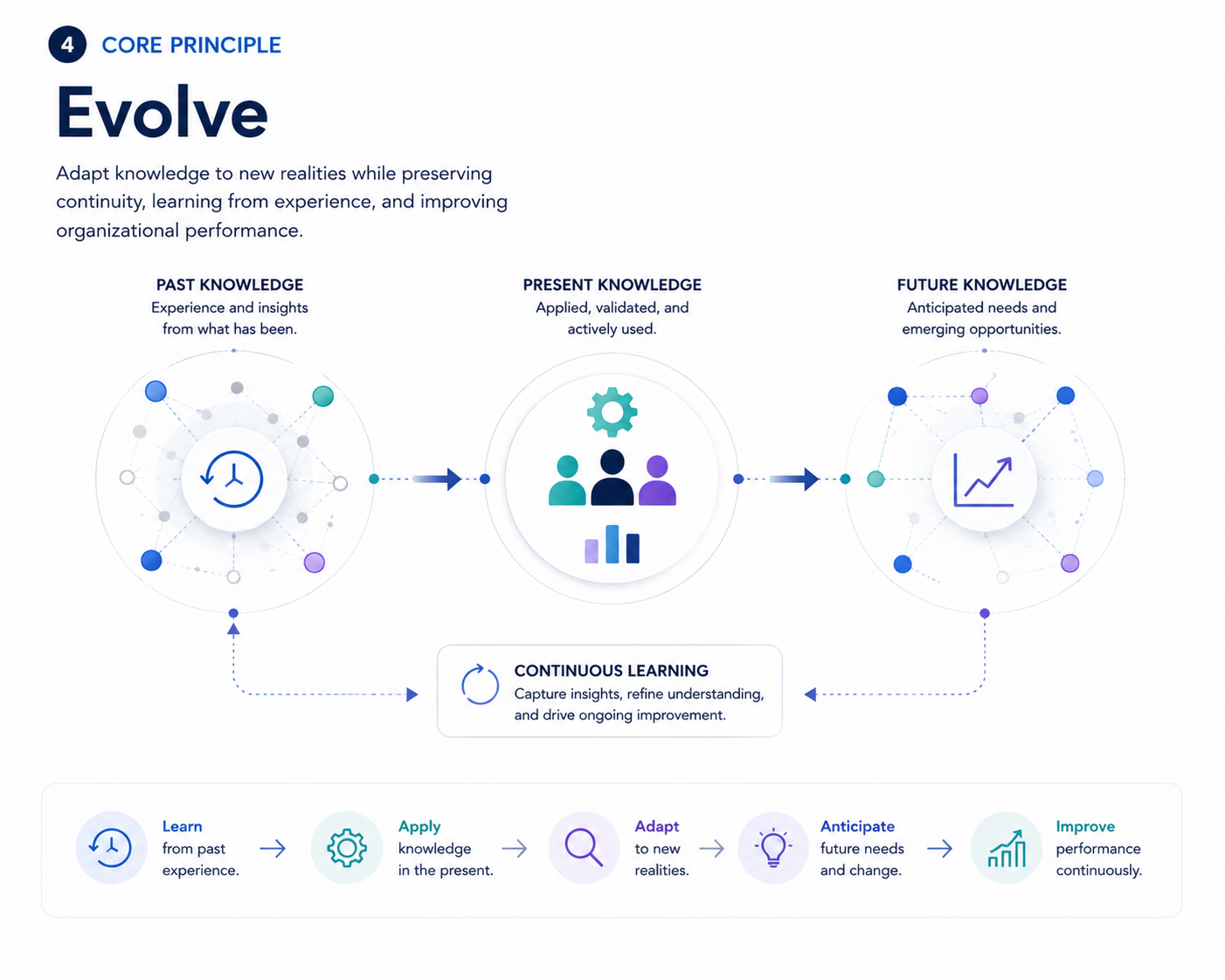
The Model Hadn't Answered Yet. Its Memory Was Already Wrong.