AI Procurement Is Not Complete Until the Institution Keeps What It Learned

Government AI acquisition is often treated as a sequence that ends when a contract is awarded, a system is deployed, or a capability is retired.
That view misses a durable institutional asset created by every acquisition: what the government learned.
In April 2026, the U.S. Government Accountability Office reported that selected federal agencies were not systematically collecting lessons learned from AI acquisitions. GAO concluded that this weakened agencies' ability to share knowledge, apply best practices, and avoid repeating mistakes as AI procurement expands.
This is a direct Institutional Continuity problem.
Every Acquisition Produces More Than a Deliverable
An AI acquisition generates knowledge about requirements, vendor capabilities, data rights, testing, model limitations, cost, sustainment, contract terms, integration, technical expertise, and operational fit.
Some of that knowledge appears in formal contract files. Much of it emerges through implementation: what failed, what had to be corrected, which clauses proved useful, which evaluation methods were inadequate, and which assumptions turned out to be wrong.
If those lessons remain with the acquisition team, contractor, or departing personnel, the institution pays for the learning but does not retain it.
GAO Identified Concrete Lost Learning
GAO's review describes examples where AI acquisition experience was not systematically documented. In one case, officials supporting a solution later retired because it did not improve enough on existing approaches to justify its additional cost did not document lessons learned, even though other related AI acquisitions could have benefited from that experience.
In another, officials identified model-performance limitations involving distinctions among dwelling types and anticipated regional accuracy issues, but did not document the input they provided to the vendor. Later personnel using the same contract could therefore miss early institutional learning about reliability.
These are not merely documentation defects. They are breaks between Action, Record, Institutional Memory, and Future Reuse.
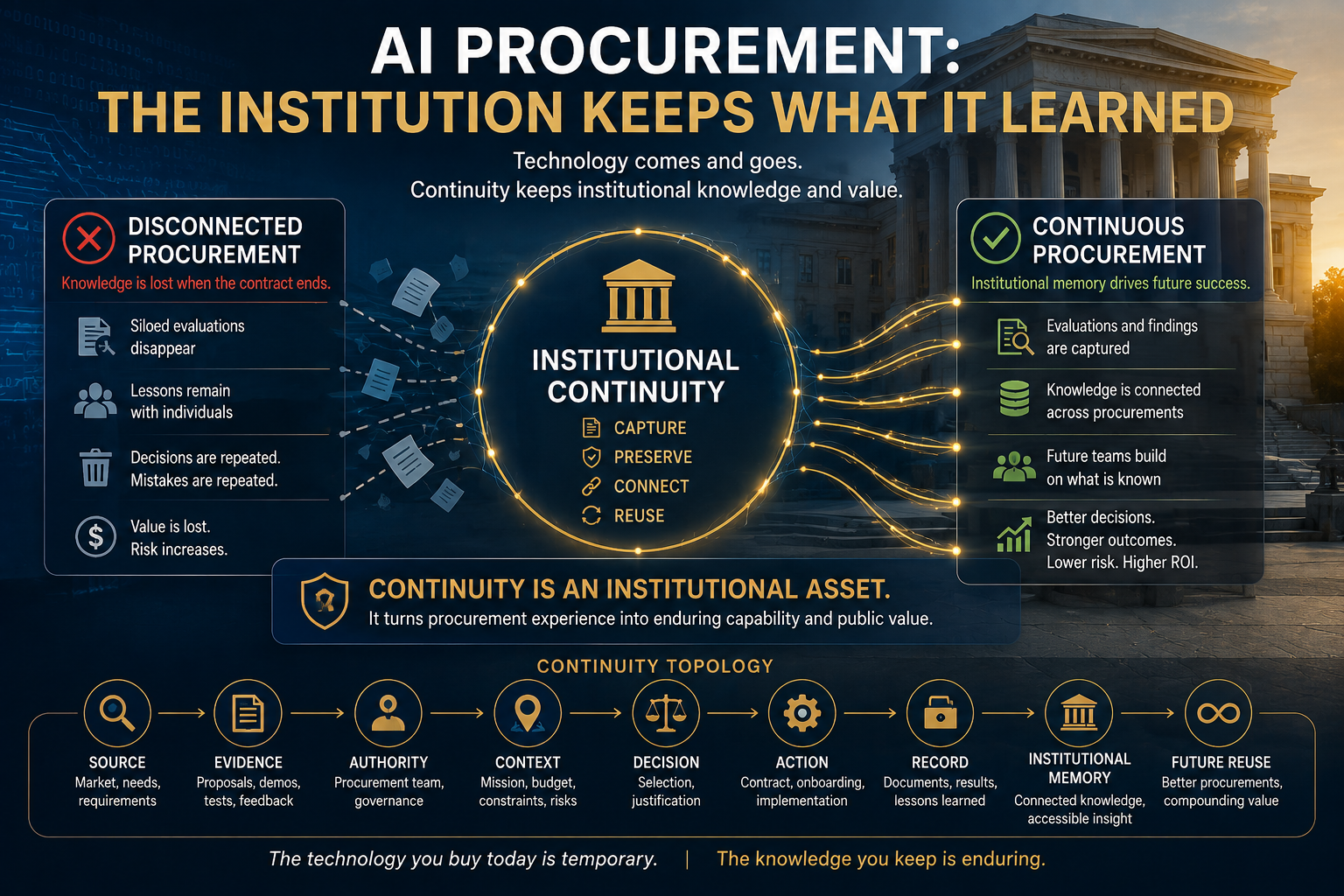
The Continuity Topology Shows the Procurement Learning Path
Source → Evidence: Proposal evaluations, tests, performance observations, contract artifacts, user feedback, and implementation results become evidence about the acquisition.
Evidence → Authority: Contracting officials, program owners, legal authorities, technical experts, and policy establish what can be required, accepted, modified, or rejected.
Authority → Context: Mission need, technology maturity, pricing structure, data rights, available expertise, deployment environment, and risk conditions qualify the lessons.
Context → Decision: The agency selects vendors, revises requirements, changes clauses, continues or terminates capabilities, and establishes future acquisition approaches.
Decision → Action: Contracts are awarded, modified, exercised, tested, extended, or ended.
Action → Record: The institution captures not only the transaction but the implementation knowledge necessary to understand why later choices were made.
Record → Institutional Memory: Lessons become available beyond the original team.
Institutional Memory → Future Reuse: Later acquisitions can reuse proven clauses, avoid known weaknesses, and requalify prior experience against new technology and mission context.
A Repository Cannot Receive Lessons That Were Never Captured
OMB guidance envisioned government-wide knowledge sharing through a GSA-managed repository. GAO found a more basic problem: several agency policies did not require systematic collection of the lessons in the first place.
This demonstrates an important continuity principle. Centralized knowledge sharing cannot compensate for missing institutional capture. A sophisticated repository has little value if operational learning never crosses the boundary into a durable record.
Lessons Learned Need Lineage, Not Just a List
A lesson such as “use stronger testing language” is more useful when future personnel can determine which acquisition exposed the weakness, what evidence supported the lesson, which clause changed, what outcome followed, and under what conditions the lesson should be reused.
Otherwise lessons learned can become another form of decontextualized institutional memory.
Continuity therefore requires not only collection, but preserved relationship to the evidence and conditions that made the lesson valid.
AI Procurement Should Build Institutional Capability
An acquisition that succeeds should leave behind reusable knowledge about why it succeeded. An acquisition that disappoints or fails should leave behind equally valuable knowledge about what the institution discovered.
The government should not have to purchase the same lesson twice.
AI acquisition is complete only when the institution preserves enough evidence, context, decisions, outcomes, and lessons for future acquisition teams to understand and responsibly reuse what the earlier effort taught.
Continue Exploring
The Answer Was Correct. The Evidence Could Not Prove It.
The Model Hadn't Answered Yet. Its Memory Was Already Wrong.