
Public consultation creates a difficult information problem. Thousands of responses may contain recurring themes, isolated concerns, expert recommendations, local experiences, and minority positions that matter even when they are not frequent.
Generative AI can help institutions process that volume. But the governance objective cannot be reduced to producing a concise summary.
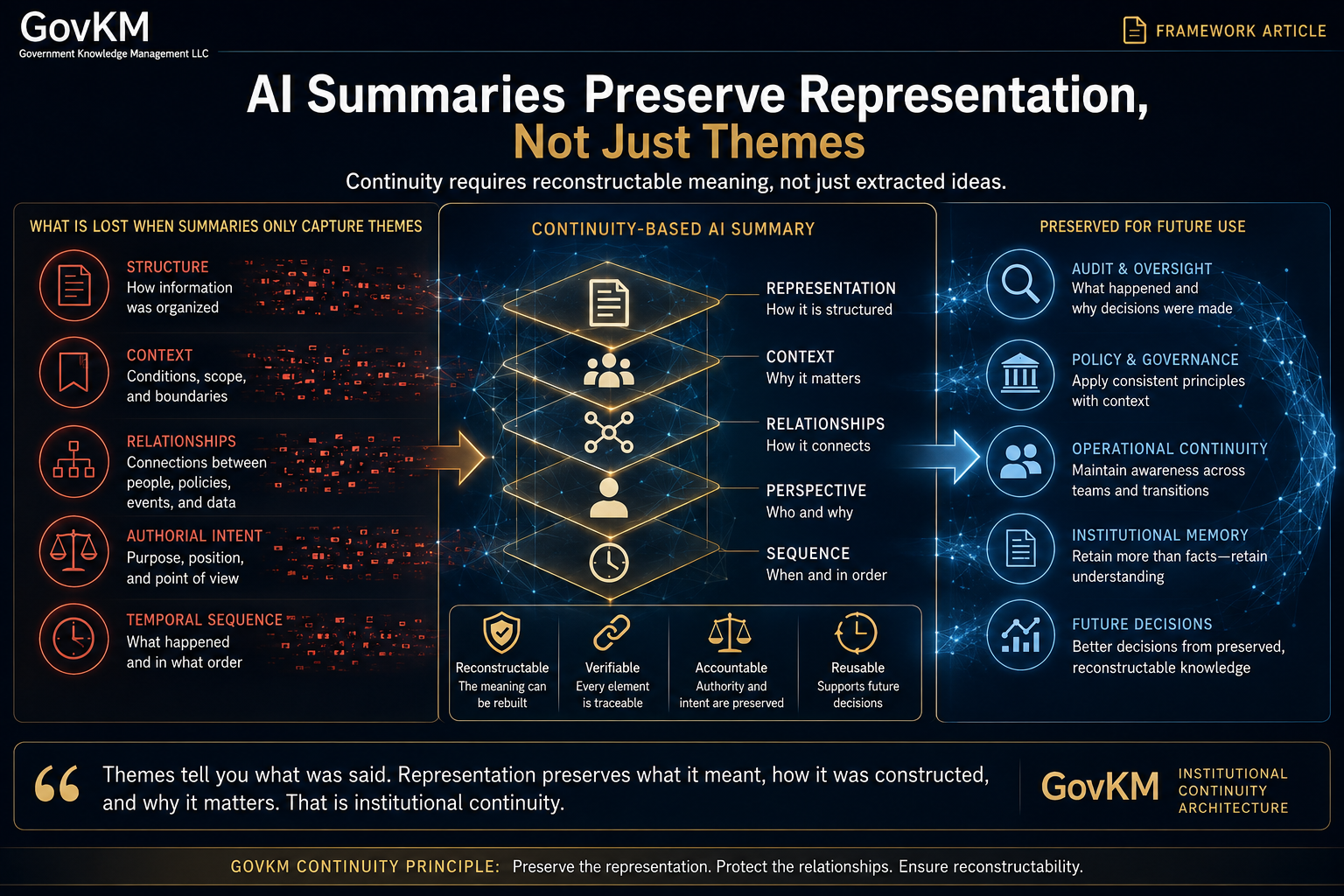
The institution must preserve representation.
Compression Changes Institutional Evidence
A consultation response begins as Source. When government accepts it as part of the engagement record, it becomes evidence of public input. Analysis then transforms thousands of individual submissions into themes, findings, and eventually policy-relevant summaries.
Every transformation creates a continuity question: what survived, what was aggregated, what was omitted, and can the institution still trace the summary back to the evidence it claims to represent?
This is especially important for low-frequency, high-significance observations. Frequency may be useful for identifying common concerns. It is not the same as institutional importance.
A Current Government Example Shows the Control Problem
Canada's 2026 engagement process for its next AI strategy used a generative-AI-enabled classification pipeline to clean survey responses and organize them into themes and subthemes. The government reports that human review occurred at several stages, that the categorization workflow achieved at least a 90 percent success rate for assigning responses to specific intents, and that external Canadian research experts suggested methods for refining the search for meaningful minority opinions.
This is significant because it shows a public institution recognizing that large-scale AI summarization needs more than automation. Taxonomy, human review, methodological scrutiny, and deliberate attention to minority opinions become continuity controls.
The Continuity Topology Shows What Representation Requires
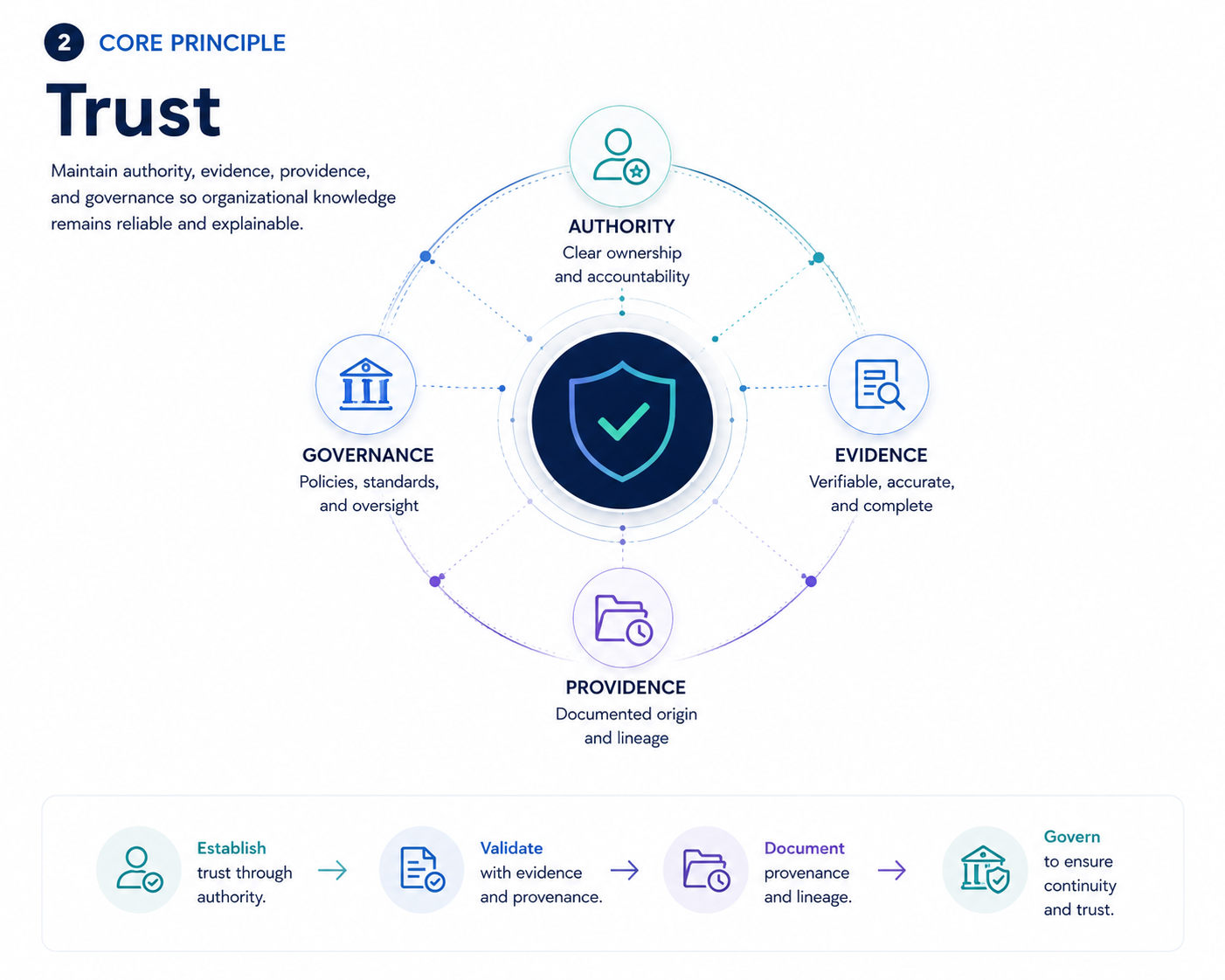
Source → Evidence: Individual responses must remain attributable to the consultation record rather than disappearing into a synthetic summary.
Evidence → Authority: The institution must establish which analytical methods are permitted to characterize public input and what human review governs the transformation.
Authority → Context: Theme frequency, stakeholder type, question asked, demographic or regional context where appropriate, and known methodological limits qualify interpretation.
Context → Decision: Policy officials should be able to distinguish a dominant theme from a minority concern whose significance is not captured by volume.
Decision → Record: The published analysis should preserve enough methodology and provenance to explain how public evidence was converted into institutional findings.
Theme Accuracy Is Not Representational Completeness
An AI system may classify most responses correctly and still underrepresent important viewpoints. It may summarize the modal position well while compressing uncommon but materially different experiences into a broad category. A technically accurate taxonomy can therefore produce an institutionally incomplete picture.
This is not simply a model-bias question. It is a continuity question about whether the relationship between original evidence and institutional representation survives compression.
Minority Opinions Are a Continuity Test
A useful governance test is whether later reviewers can determine how a minority position entered—or failed to enter—the official synthesis. If the final report contains only aggregate themes and the pathway back to underlying evidence is lost, the institution may no longer be able to show whether uncommon views were considered, collapsed, or omitted.
This matters in public administration because consultation is not merely a data-collection exercise. The resulting record can influence decisions, justify policy choices, and become part of institutional memory.
AI-Assisted Consultation Needs Representational Provenance
GovKM describes the requirement as representational provenance: preserving enough lineage to determine how source contributions became analytical categories, summaries, findings, and later decisions.
The purpose is not to force every public comment into every final report. Compression is necessary. The purpose is to make the compression governable.
AI should help institutions understand public evidence without erasing the relationships necessary to show whose evidence was represented, how it was transformed, and what significance the institution assigned to it.
Continue Exploring
The Answer Was Correct. The Evidence Could Not Prove It.
The Model Hadn't Answered Yet. Its Memory Was Already Wrong.