Authority Laundering: How a Bad Citation Becomes “Real” Through Retrieval


A fabricated citation can become more dangerous after it enters an authoritative record.
In September 2026, reporting on a federal court decision described references in U.S. Department of Health and Human Services funding materials that appeared either not to exist or not to support the propositions for which they were cited. The judge described the pattern as characteristic of AI-generated citations. The record did not establish that AI necessarily created every defective reference, but the provenance problem was already serious: policy material relied on evidence that could not be defended as cited.
The continuity problem became more revealing when downstream AI retrieval reportedly treated the federal document itself as evidence that one of the questionable studies was real.
Authority can launder weak provenance
Most retrieval systems ask whether a source is relevant and whether it appears authoritative. A federal document scores well on both. But institutional authority and evidentiary validity are not the same property.
If a government document cites a nonexistent study, then a later system that retrieves the government document may infer that the study has independent existence. The authority of the record begins to substitute for the provenance of the underlying evidence.
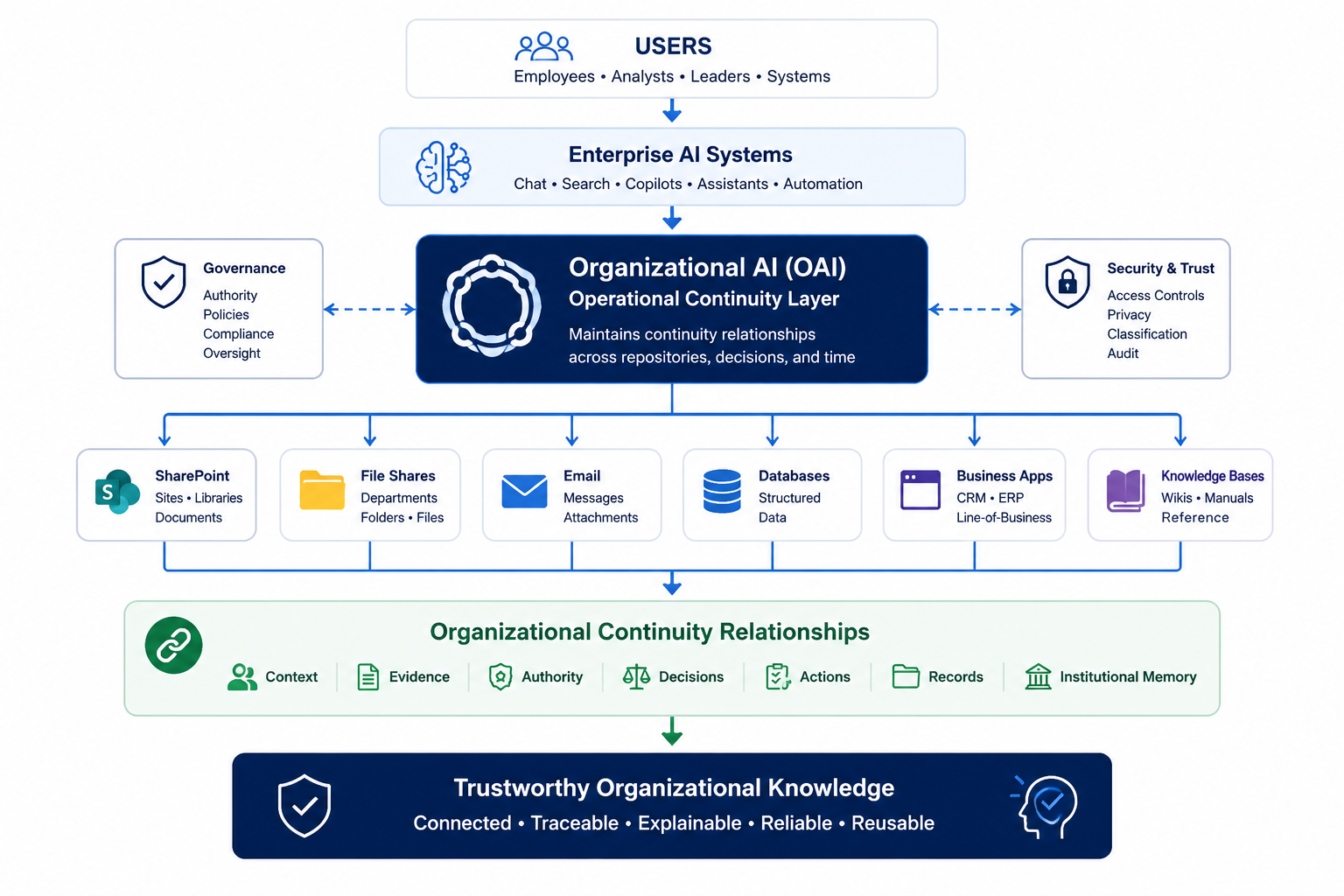
GovKM maps the expected relationship as Source → Evidence → Authority → Context → Decision → Record → Future Reuse.
In this case the first relationship is the vulnerable one. If the source cannot be established, the chain should not continue as though evidence has been validated. Once it does, the authoritative record can feed backward into future retrieval and falsely re-establish the missing source.
This is not ordinary hallucination
A model inventing a citation is one failure. An institution publishing that citation is a second. A retrieval system later using the institution’s publication to validate the invention is a third.
At that point the problem has become an institutional memory loop. The false claim no longer survives because one model generated it. It survives because the institution converted it into a durable record that later systems interpret as evidence.
That distinction matters because conventional hallucination controls are often local: check the answer, verify the citation, ask for the source. Continuity architecture asks what happens after an unsupported assertion has already crossed into an authoritative artifact.
Future reuse must preserve the evidence boundary
A continuity-aware retrieval layer should not treat “contained in an authoritative record” as equivalent to “independently verified.” It should preserve the difference between an institution’s assertion and the external evidence the assertion claims to rely on.
That means retaining source identity, citation lineage, validation state, correction history, and supersession. If a citation is later shown to be defective, the correction should propagate to every dependent record and future retrieval path.
The GovKM interpretation
This case illustrates authority laundering through retrieval: weak or nonexistent evidence becomes more credible because it is embedded in an authoritative document, then that authoritative document is reused as if it validates the original evidence.
The control objective is not merely “prevent hallucinations.” It is: do not allow institutional authority to substitute for missing provenance.
Sources
Caitlin Gilbert, The Washington Post, “Judge rebukes HHS over AI use in cutting teen pregnancy prevention grants,” September 1, 2026. https://www.washingtonpost.com/health/2026/09/01/judge-rebukes-hhs-over-ai-use-cutting-teen-pregnancy-prevention-grants/
Continue Exploring
When the Memory Becomes the Attack Surface
When the Safety Valve Disappears: Lessons From Australia’s Aged Care Algorithm