The Cleanup Cost Was Recorded. EPA Could Not Determine Which Recovery Efforts Worked.
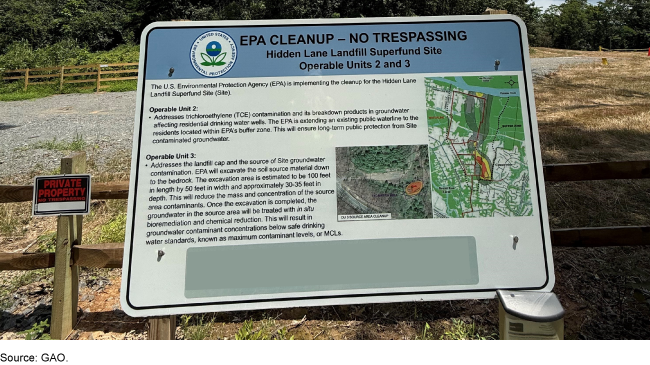

The federal government has spent billions cleaning up contaminated properties through EPA's Superfund program. EPA documents expenditures, identifies potentially responsible parties, and pursues reimbursement for eligible cleanup costs. But recording how much money was spent or recovered is not the same as establishing whether a recovery effort was effective.
The records existed. The performance question remained.
In GAO-27-107925, issued November 5, 2026, the Government Accountability Office estimated that EPA spent approximately $25.8 billion at nonfederal National Priorities List sites in fiscal years 1996–2024 and recovered less than half. The estimate covered 1,622 sites and was a point-in-time assessment because cost-recovery activities continue.
GAO's more significant institutional finding concerned evaluation. EPA had measures addressing timely cost-recovery steps, but lacked goals and measures to assess cost-recovery effectiveness across these sites. Performance measures could help the agency understand results, identify effective practices and direct enforcement resources.
What GAO found
GAO reviewed Superfund funding, cleanup expenditures, identification of potentially responsible parties, recoveries, and EPA's evaluation of recovery work. According to EPA data, the agency had identified at least one potentially responsible party for most nonfederal NPL sites. Challenges included a decline in experienced potentially responsible-party search personnel over the preceding 10 to 15 years and limits on potential liability.
GAO recommended that EPA establish effectiveness goals, systematically collect relevant performance information, and use that information to assess progress and guide future decisions. EPA agreed with the three recommendations. All three remain open; concurrence is not implementation.
The difference between records and organizational understanding
An expenditure record establishes that a cost was incurred. A collection record shows that money was recovered. An enforcement record documents an action under applicable authority. But none, by itself, establishes the effectiveness of a recovery strategy.
EPA's cost-recovery guidance requires documentation of direct and indirect costs, including authorization and completion of contractor work. EPA considers liability evidence, the financial capacity of potentially responsible parties, and the amount to be recovered. Claims can evolve as cleanup, legal costs, and interest accrue.
A reliable comparison may therefore depend on the site, legally recoverable costs, responsible parties, governing requirements, applicable time limits, agreement terms, unresolved proceedings, and common performance measures. An amount not yet collected is not necessarily an unsuccessful recovery. Two sites' recovery percentages are not necessarily comparable.
GovKM interpretation: GAO did not label its findings a continuity failure. GovKM separately infers that an organization can retain transaction records while lacking the relationships and performance measures needed to reconstruct and evaluate decisions consistently over time.
A government-operational example
Imagine a fictional EPA regional office reviewing recovery activities at Site A and Site B. Site A shows a larger recovered percentage. Site B shows a smaller amount collected, but enforcement proceedings remain active. An enterprise AI asked which strategy worked better could incorrectly rank Site A if it examines only totals. The evidence may not support that comparison because proceedings, liabilities, timing, and measurement criteria differ.
The problem is not necessarily inaccurate accounting. It is whether the evidence supports the question the agency is asking.
Illustrative Text–Graph–Text–Graph demonstration
All scenario details below are fictional: EPA-SYN-001 is an educational illustration, not an actual EPA incident, executed model test, or deployed GAIB component.
Text 1 — The initial answer
User: Which of our two fictional Superfund recovery strategies was more effective?
Illustrative incomplete AI: Site A recovered a larger share of recorded expenditures. Its recovery strategy was therefore more effective.
Graph 1 — The incomplete relationship
Cleanup expenditure → amount recovered → performance conclusion. This route omits governing authority, responsible-party circumstances, unsettled proceedings, and consistent effectiveness measures. It demonstrates an unsupported inference, not a finding that either fictional recovery effort failed.
Text 2 — The evidence challenge
User: Identify the governing authority, the status of each recovery, and the measures supporting your comparison.
Illustrative qualified AI: Available records establish expenditures and certain amounts collected. They do not establish that both recoveries are complete or that comparable effectiveness measures exist. I cannot reliably rank the strategies without further evidence.
Graph 2 — The qualified relationship
Cleanup site → expenditure evidence → responsible party → governing recovery authority → recovery action → time-qualified status → performance evidence → qualified decision → retained record. Unresolved relationships remain visible rather than being silently treated as complete evidence.
A bounded, falsifiable requirement
Given a fictional closed recovery and a pending recovery, a system must distinguish costs, amounts collected, potential legal limits, current status, and absent common performance measures. It must not label a pending recovery a failure or infer that a higher collected percentage alone proves superior effectiveness. This is a proposed evaluation requirement; no product test is claimed.
Preparing government information for enterprise AI
Enterprise AI increasingly analyzes financial records, contracts, enforcement files, correspondence, and historical decisions. Retrieval alone cannot prove that retrieved information is complete for a consequential conclusion.
Government organizations can preserve source authority, stable artifact identities, applicable dates, record-to-decision relationships, status histories, and explicit markers for missing evidence. They can distinguish activity counts from effectiveness measures and preserve unresolved context through personnel and system changes.
Making records searchable is useful. Making decisions reconstructable, challengeable, and properly qualified is the more consequential objective.
Official sources and limits
U.S. GAO, Superfund: EPA Should Collect and Use Information on the Effectiveness of Its Recovery of Cleanup Costs, GAO-27-107925 (November 5, 2026), What GAO Found and Recommendations 1–3.
U.S. EPA, Superfund Cost Recovery, detailing expense documentation and recovery considerations.
GAO's findings and EPA's procedures are attributed to those agencies. GovKM's continuity interpretation, fictional examples, and illustrative responses are independent commentary. Neither agency tested OrgAI, GAIB, or EPA-SYN-001.
Continue Exploring
The Inspection Schedule Changed. Who Verified That Oversight Still Worked?
The Patent Backlog Shrunk. The Evidence Problem Remained.
