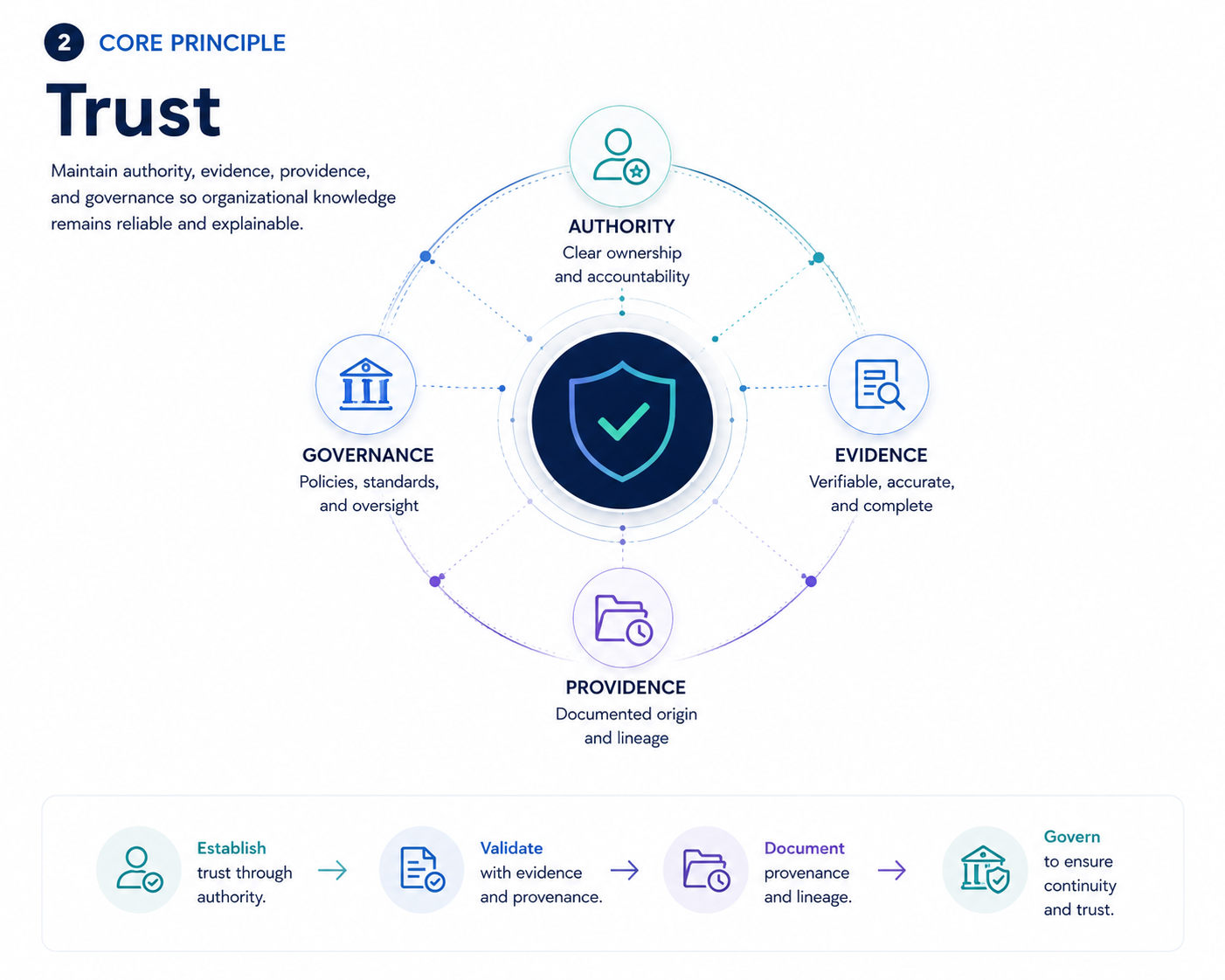
Provenance Is Necessary, but Clinical AI Needs Continuity

Healthcare AI discussions often begin with model accuracy. Increasingly, they are moving upstream to a more basic question: can the institution establish where the underlying data came from and whether it is fit for the purpose for which the model is being used?
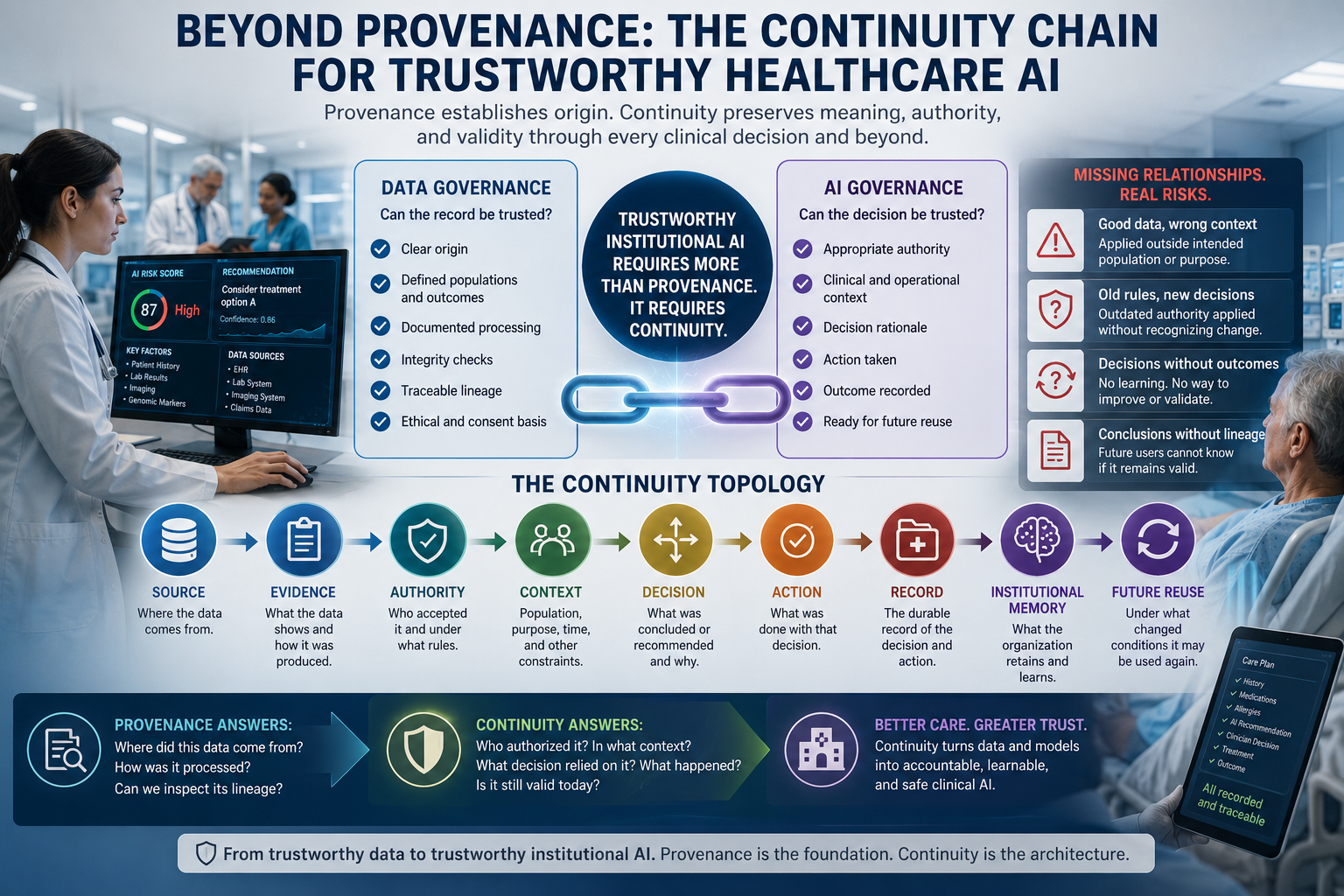
In a LinkedIn discussion on healthcare AI governance, Shannon McWeeney makes a useful distinction. Data governance asks whether the record can be trusted; AI governance asks whether the decision built on that record can be trusted. Her proposed minimum includes clear origin, defined populations and outcomes, documented processing, integrity checks, traceable lineage, and an ethical and consent basis before a model is allowed to influence patient care.
That is a strong governance position. It also exposes a larger continuity problem.
Provenance Establishes Origin, Not Complete Institutional Validity
Provenance can establish where information originated, how it was processed, and whether a model's training or evaluation data can be examined. Those capabilities are indispensable. The TRIPOD+AI reporting guidance similarly emphasizes complete, accurate, and transparent reporting so prediction-model research can be appraised, evaluated, and understood.
But institutional use creates additional questions that provenance alone cannot answer. Which evidence was accepted for the specific patient population or operational purpose? Which clinical, legal, ethical, or organizational authority governed its use? What circumstances constrained interpretation? Who or what made the consequential decision? What action followed? What durable record preserves the result? Under what changed conditions may a later clinician, analyst, or AI system rely on that history again?
These are not separate documentation chores. They are continuity relationships.
Viewed Through the Continuity Topology
GovKM's Continuity Topology represents the institutional path as Source → Evidence → Authority → Context → Decision → Action → Record → Institutional Memory → Future Reuse.
Dataset provenance is concentrated at the beginning of that path. It strengthens Source → Evidence by making origin, lineage, transformation, and limitations inspectable. Clinical deployment, however, extends the chain through authority and context into consequential decisions and actions.
A dataset can be genuine yet inappropriate for a specific population. Evidence can be relevant yet superseded by newer guidance. A model can be technically validated while operating outside the authority or purpose under which its evidence was originally accepted. A correct recommendation can later become unsafe precedent if a future system retrieves the conclusion without recovering the conditions that once made it valid.
The deeper requirement is therefore not simply provenance. It is continuity of provenance into institutional action.
Clinical AI Turns Missing Relationships Into Operational Risk
Human professionals often compensate for incomplete information by asking questions, recognizing unusual circumstances, consulting current guidance, or knowing that a local policy changed. AI systems can scale decisions and recommendations far faster than those informal safeguards can compensate.
That changes the significance of a missing relationship. If source lineage is present but authority is missing, the system may treat available evidence as institutionally acceptable evidence. If authority is present but context is missing, a rule may be applied outside the population, purpose, or circumstances for which it was intended. If a decision is preserved without its resulting action and outcome, institutional memory can retain a conclusion without learning whether that conclusion actually worked.
In healthcare, trustworthy AI therefore depends on more than making data traceable. It depends on maintaining the chain that allows future users and systems to determine why information was accepted, how it was used, and whether the same reasoning remains valid.
Reporting Standards and Continuity Serve Different Purposes
Transparent reporting standards are essential because they improve the ability to understand and evaluate clinical prediction research. Organizational Continuity addresses the institutional problem that begins when research, models, records, policies, people, and operational systems interact over time.
A hospital may possess excellent model documentation and still lose continuity when a policy changes without being connected to deployed decision logic. A model can retain its original provenance while the organizational authority governing its use changes. Records can document prior outcomes while failing to preserve the reasoning and context necessary for future reuse.
The institution may preserve the object while losing the relationship.
GovKM extends provenance-based AI governance by treating those relationships as part of the architecture itself. Source and evidence must remain connected to authority and context; decisions must remain connected to actions and records; institutional memory must preserve enough lineage to requalify knowledge before future reuse.
From Trustworthy Data to Trustworthy Institutional AI
The healthcare AI conversation is right to make provenance non-negotiable. The next step is to recognize that provenance is a necessary element of a larger continuity requirement.
Reliable institutional AI must be able to answer not only where its information came from, but why that information was authoritative for the particular purpose, what decision it informed, what happened afterward, and whether the resulting knowledge remains valid today.
That is the difference between preserving trustworthy data and preserving the institutional continuity required for trustworthy AI.
Continue Exploring
The Answer Was Correct. The Evidence Could Not Prove It.
The Model Hadn't Answered Yet. Its Memory Was Already Wrong.