The Continuity of Execution: When AI Decisions Become Institutional Actions
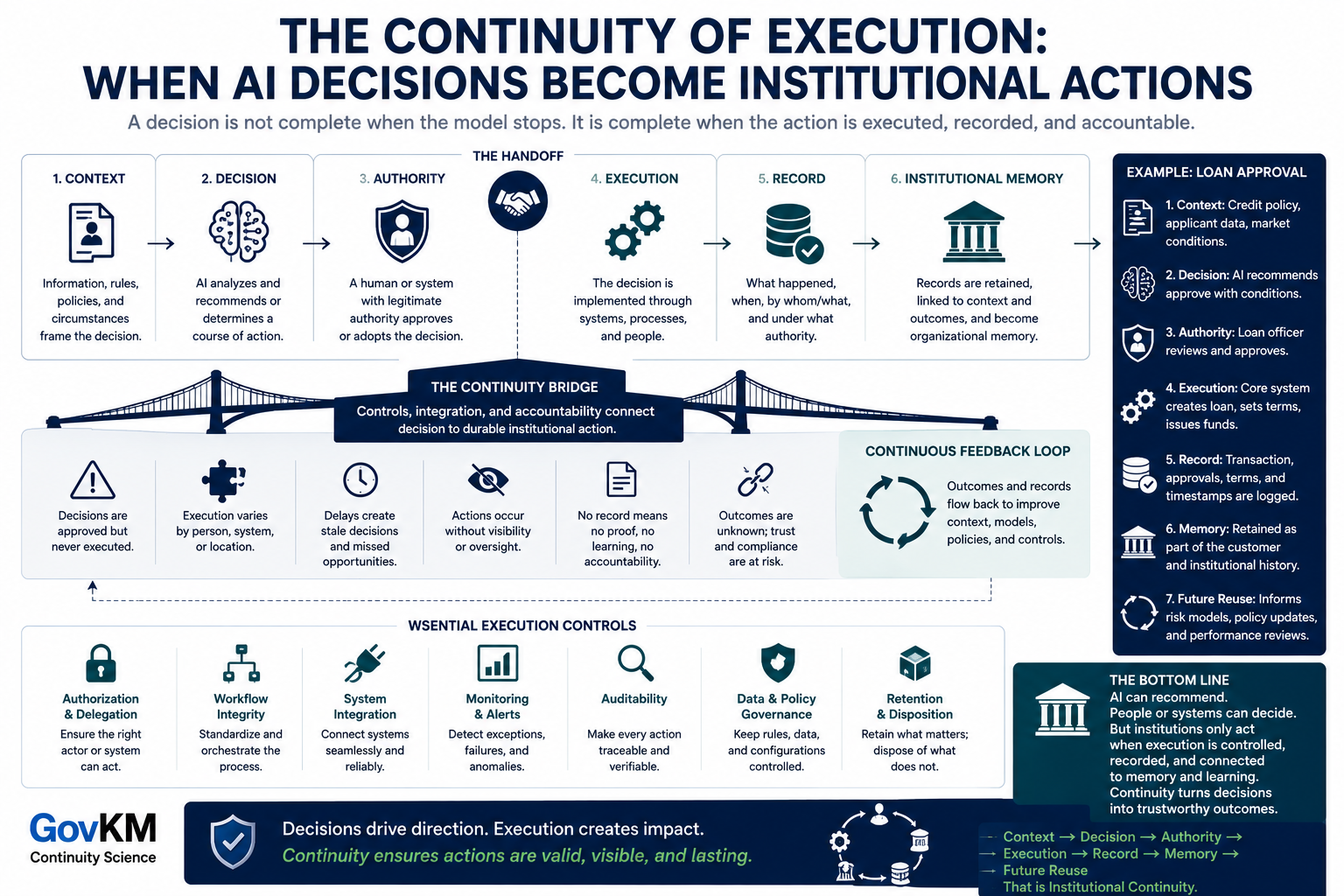

Artificial intelligence governance is changing because AI systems are no longer limited to producing answers. Agents can approve, route, submit, modify, release, purchase, communicate, configure, and otherwise alter the state of real systems.
That shift creates a governance problem that is easy to describe but difficult to solve: a correct decision is not the same thing as a valid institutional action.
A model may reason correctly. A policy may authorize a class of activity. A human may approve a recommendation. Yet by the time an agent actually acts, the conditions that made the action permissible may have changed.
GovKM identifies this as a continuity problem at the point where Decision becomes Action.
The Governance Boundary Is Becoming an Execution Boundary
Recent AI-governance discussions increasingly focus on the moment a system crosses from reasoning into execution. Kamilla Harcej has argued that governance fails when an AI system can act before proving that it was allowed to act. This framing is important because it moves governance from documentation toward runtime control.
Policies, risk registers, committees, model cards, audit logs, and approval workflows can describe what should happen. They do not necessarily establish that the same authority, evidence, context, and constraints remained valid at the instant an action changed institutional state.
The important question is therefore not only, Was this action authorized?
It is also: Was the authorization still valid when execution occurred, did the executed action remain within that authority, and did the institution preserve evidence of what actually happened?
Decision Continuity Does Not End at Approval
The GovKM Continuity Topology represents the institutional path as Source → Evidence → Authority → Context → Decision → Action → Record → Institutional Memory → Future Reuse.
AI governance frequently concentrates on the left side of this chain. Organizations ask whether the model used acceptable data, whether its reasoning was explainable, whether a policy permitted the decision, and whether a human approved the recommendation.
But a decision is still an institutional intention until something acts on it.
At execution, new failure conditions appear. A delegation may have expired. A policy may have changed. The account performing the action may possess broader permissions than the decision allowed. A tool call may mutate a different object than the one that was reviewed. A retry may execute twice. A downstream system may interpret the command differently. The action may succeed only partially.
These failures are not defects in the original reasoning. They are breaks in continuity between Decision and Action.
Authorization Must Survive the Handoff
Organizations often treat authorization as a point-in-time event: a person approves, a policy matches, or a control returns allow. Agentic systems make that assumption increasingly fragile because planning, delegation, tool selection, and execution may occur across multiple components and at different times.
Execution continuity requires the institution to preserve the relationship between what was approved and what was actually committed.
That means retaining enough evidence to establish the identity of the actor or agent, the applicable authority, the relevant policy version, the decision being executed, the target system or object, the action parameters, the execution time, the result, and any exception, retry, fallback, or human intervention.
If those relationships cannot be reconstructed, the institution may know that an action happened without being able to prove that it remained authorized when it happened.
Logs Are Not the Same as Continuity
Modern systems can produce enormous volumes of telemetry. API traces, agent logs, security events, workflow histories, and model observability data are valuable. But a log is not automatically an institutional record, and a sequence of logs is not automatically a continuity chain.
Telemetry may show that a payment API returned success. It may not establish which decision authorized the payment, which policy permitted it, which evidence supported the amount, whether a human approval remained applicable, or whether the resulting transaction was later reversed.
Execution continuity requires the institution to connect operational traces to institutional meaning.
The required outcome is not simply observability. It is reconstructability.
Action Must Become Record
The next transition in the Continuity Topology is therefore just as important: Action → Record.
When an AI system produces consequential institutional effects, the institution needs durable evidence that preserves more than the fact of execution. The resulting record should make it possible to recover what was attempted, what completed, under whose authority, against which conditions, with what result, and how the action related to the governing decision.
This is especially important for autonomous or semi-autonomous systems because the traditional human memory surrounding an action may be absent. A person cannot later explain the unstated context if the system never captured it.
The record becomes the bridge between operational execution and institutional memory.
Exactly-Once Execution Is a Continuity Concern
Execution integrity also includes state. Agent systems can retry, re-plan, operate asynchronously, or receive incomplete confirmation from external tools. A technically valid action can become institutionally wrong when it occurs twice, occurs after conditions changed, or occurs against a different state than the one originally evaluated.
Emerging execution-layer systems explicitly address this problem by blocking unsafe repeats or requiring prior actions to be revalidated before reuse. That is a useful technical expression of a larger continuity principle: past authorization cannot be treated as permanently transferable to future execution.
Each consequential execution must remain connected to the conditions that make it valid.
From Runtime Governance to Institutional Continuity
Runtime controls are necessary. Deterministic guardrails, policy checks, human escalation, scoped permissions, tool restrictions, and transaction integrity can prevent many failures before they occur.
But GovKM extends the problem beyond the execution boundary itself.
The institution must preserve continuity across the entire path. The decision must remain connected to the authority that permitted it. The action must remain connected to the decision it implemented. The record must preserve what happened. Institutional memory must retain enough lineage to distinguish valid precedent from obsolete or anomalous execution.
The execution boundary is where institutional intent becomes institutional consequence. Continuity is what allows the institution to prove that the consequence remained connected to the intent.
As AI systems gain the ability to act, governance will increasingly be judged not by how thoroughly organizations document their policies, but by whether they can demonstrate that authority, context, decision, execution, and record remained connected at the moment of consequence.
Continue Exploring
The Answer Was Correct. The Evidence Could Not Prove It.
The Model Hadn't Answered Yet. Its Memory Was Already Wrong.