Explainable AI Can Still Make an Institutionally Invalid Decision
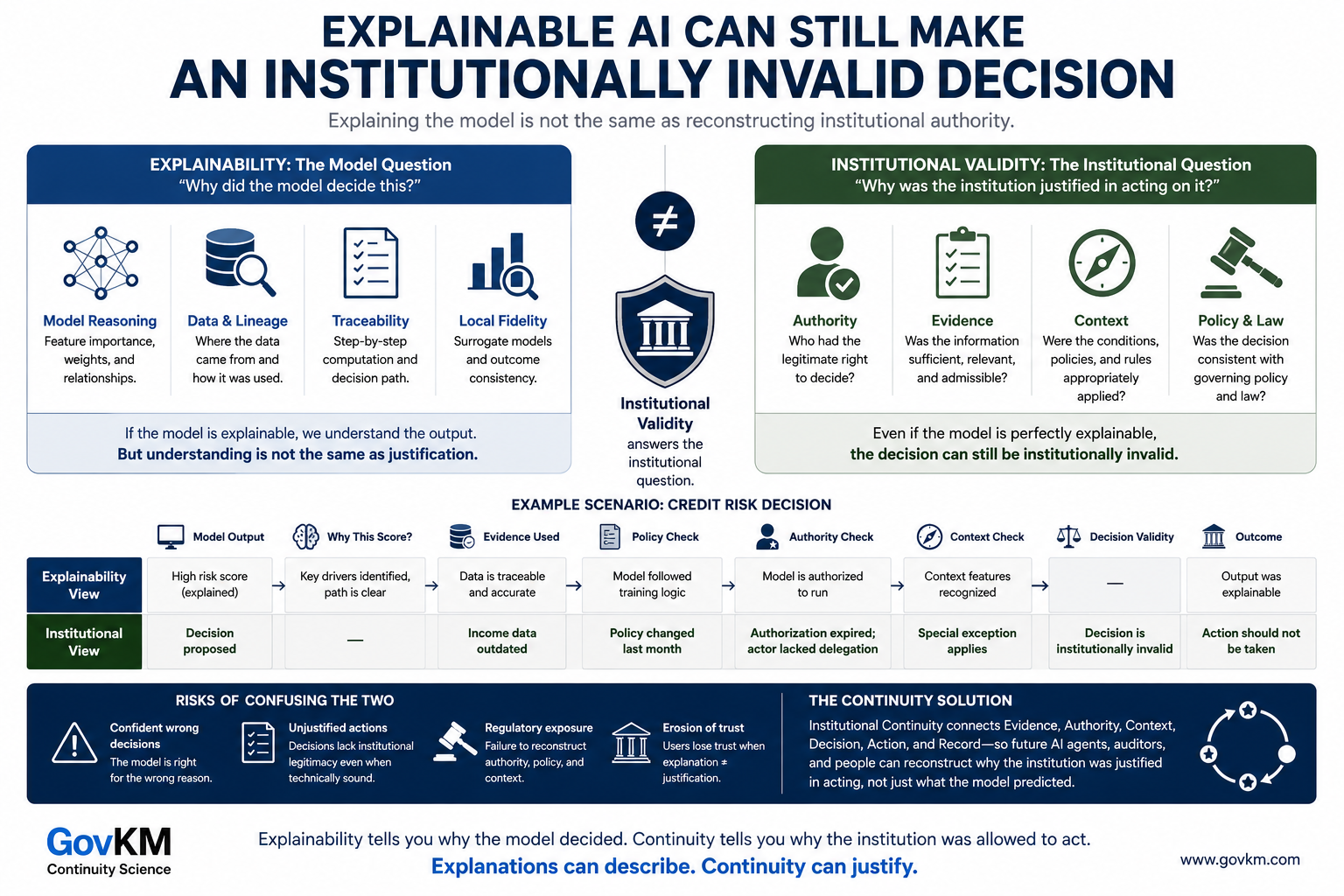

Explainability has become one of the central requirements of enterprise AI governance. Organizations want models that can show which inputs influenced an output, why a prediction was made, how confident the system was, and what reasoning path an agent followed.
Those capabilities matter.
But an explainable AI decision can still be institutionally invalid.
The reason is simple: explaining why a model produced an output is not the same as proving why an institution was justified in acting on that output.
Model Explanation and Institutional Validity Are Different Questions
Dataiku defines AI explainability as making system behavior understandable to humans by describing which inputs influenced an output and why the system chose one action over another. Techniques such as SHAP, LIME, feature importance, visual reasoning paths, documentation, and audit trails can make otherwise opaque systems more inspectable.
This helps organizations test models, identify bias, support regulatory review, and understand individual predictions.
Yet consider an entirely explainable credit recommendation. The institution can identify the relevant features, the model version, the retrieved data, the scoring logic, and the factors that drove the result.
That still does not establish whether the institution was allowed to act on the recommendation.
Was the evidence appropriate for this applicant and this purpose? Did the applicable policy permit the use? Did the decision-maker possess delegated authority? Was the policy still current? Did a jurisdictional exception apply? Did the recommendation become a formal institutional decision, or was it advisory? What action actually followed?
Those are continuity questions.
Explainability Primarily Illuminates the Model
Most explainability methods concentrate on the relationship between model inputs, model behavior, and model output.
That is necessary because black-box systems can produce consequential results that users and regulators cannot meaningfully challenge.
But institutional decisions exist in a larger environment than the model.
The GovKM Continuity Topology represents that environment as Source → Evidence → Authority → Context → Decision → Action → Record → Institutional Memory → Future Reuse.
A model explanation may illuminate portions of Evidence → Context → Decision. It does not automatically reconstruct Authority, the institutional adoption of the recommendation, the resulting Action, or the Record that proves what happened.
A Coherent Explanation Can Describe an Invalid Decision
This distinction matters because reasoning can be coherent while the institutional basis is wrong.
An AI system may correctly explain that a transaction was flagged because of velocity, location, device characteristics, and account history. But if the data was not permitted for that purpose, the explanation describes an invalid use.
A hiring model may correctly explain the features behind a recommendation while operating under a policy that should no longer govern the position.
A clinical model may transparently identify the factors behind a risk score while relying on evidence that does not apply to the patient population.
An agent may show a complete reasoning trace for a configuration change while lacking the authority to modify the production environment.
Explainability makes these processes easier to inspect. It does not itself supply institutional legitimacy.
Governance Must Reconstruct the Decision Around the Model
For consequential AI, the institution needs a decision record that extends beyond the explanation object.
The record should preserve which source material was relied upon, which evidence was accepted, which authority governed the matter, what context constrained interpretation, what model or agent contributed analysis, what recommendation was produced, who or what converted that recommendation into a decision, what action followed, and what durable record preserves the outcome.
This is the difference between explaining the model and reconstructing the institution.
As AI systems participate in larger workflows, the distinction becomes even more important. A single institutional outcome may involve retrieval systems, models, agents, rules engines, human approvals, tool calls, external APIs, and downstream automation. No single model explanation necessarily describes the full decision path.
Agentic AI Makes the Gap Larger
Agentic systems challenge traditional governance because the identifiable moment of decision can become distributed. Dataiku has argued that governance frameworks built around human decision-making face new problems when agents act across multiple systems and when errors propagate before a person can intervene.
Explainability remains necessary in that environment, but the object being governed is no longer only a prediction.
The institution must govern a sequence of context acquisition, reasoning, delegation, tool selection, decision, action, and resulting state change.
That sequence requires continuity.
Institutional Validity Requires Authority and Context
Continuity Science treats Authority and Context as independent elements because they perform functions that model explanation cannot replace.
Authority answers whether the source, actor, rule, or decision-maker possessed recognized standing for the present purpose. Context answers which temporal, legal, organizational, semantic, and situational conditions governed interpretation.
An explanation without authority can tell us why the model acted while leaving unanswered whether it had the right to matter.
An explanation without context can tell us why a rule applied while leaving unanswered whether the rule applied here.
Explainability Should Feed Reconstructability
The correct conclusion is not that explainability is inadequate or unnecessary. It is that explainability should become one component of a larger reconstructability architecture.
Model explanations, feature attributions, reasoning traces, confidence measures, lineage, evaluation results, and human review should be preserved as evidence inside the institutional decision path.
Then future personnel or AI systems can recover not only why the model produced the result, but also why the institution accepted or rejected that result, what authority applied, what action occurred, and whether the outcome remains usable as precedent.
Explainability tells us why the model produced an output. Institutional Continuity tells us why the organization was justified in turning that output into action.
Trustworthy enterprise AI requires both.
Continue Exploring
The Answer Was Correct. The Evidence Could Not Prove It.
The Model Hadn't Answered Yet. Its Memory Was Already Wrong.