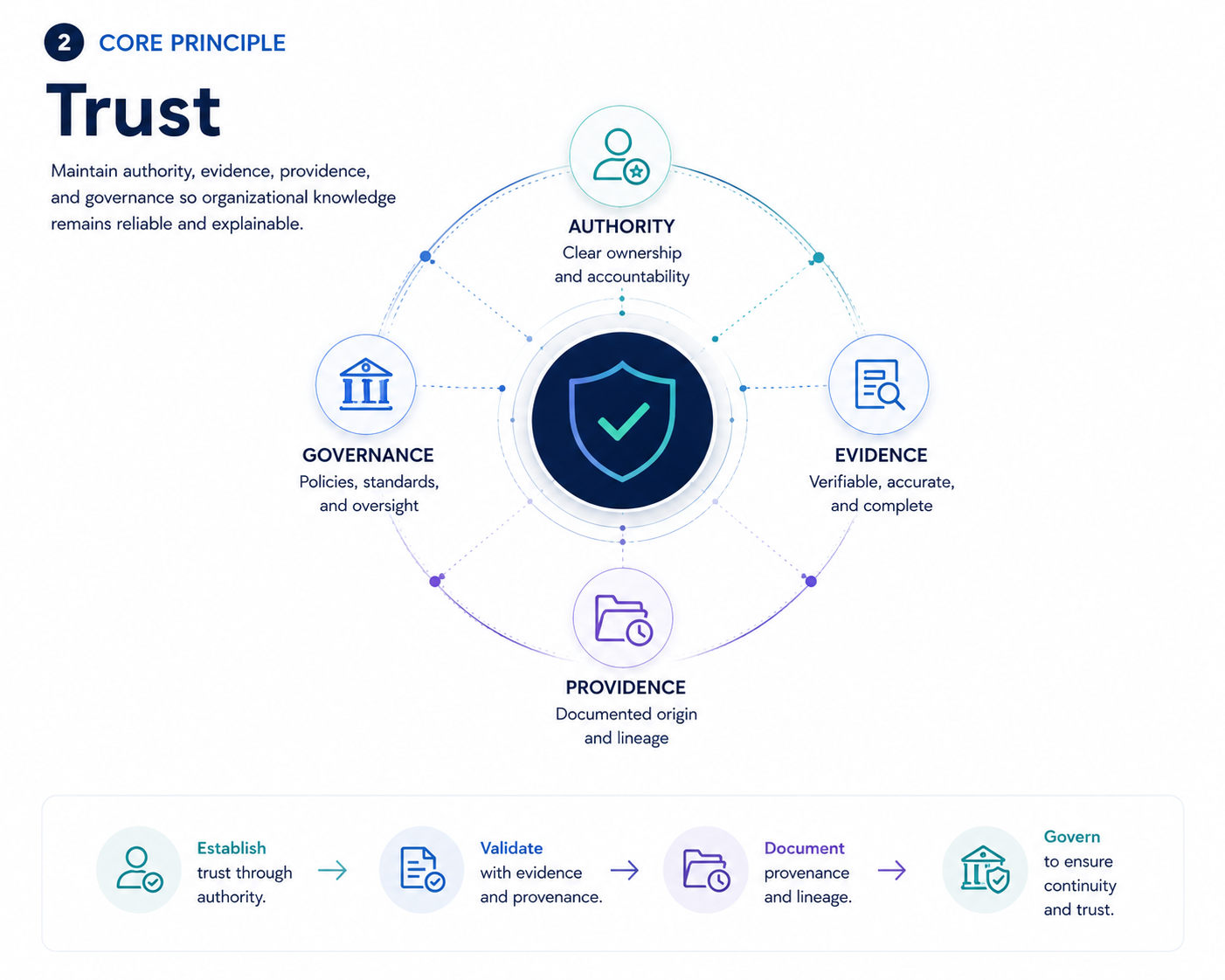
From File Plan to Continuity Plan: The Office Artifact Must Evolve With the Work
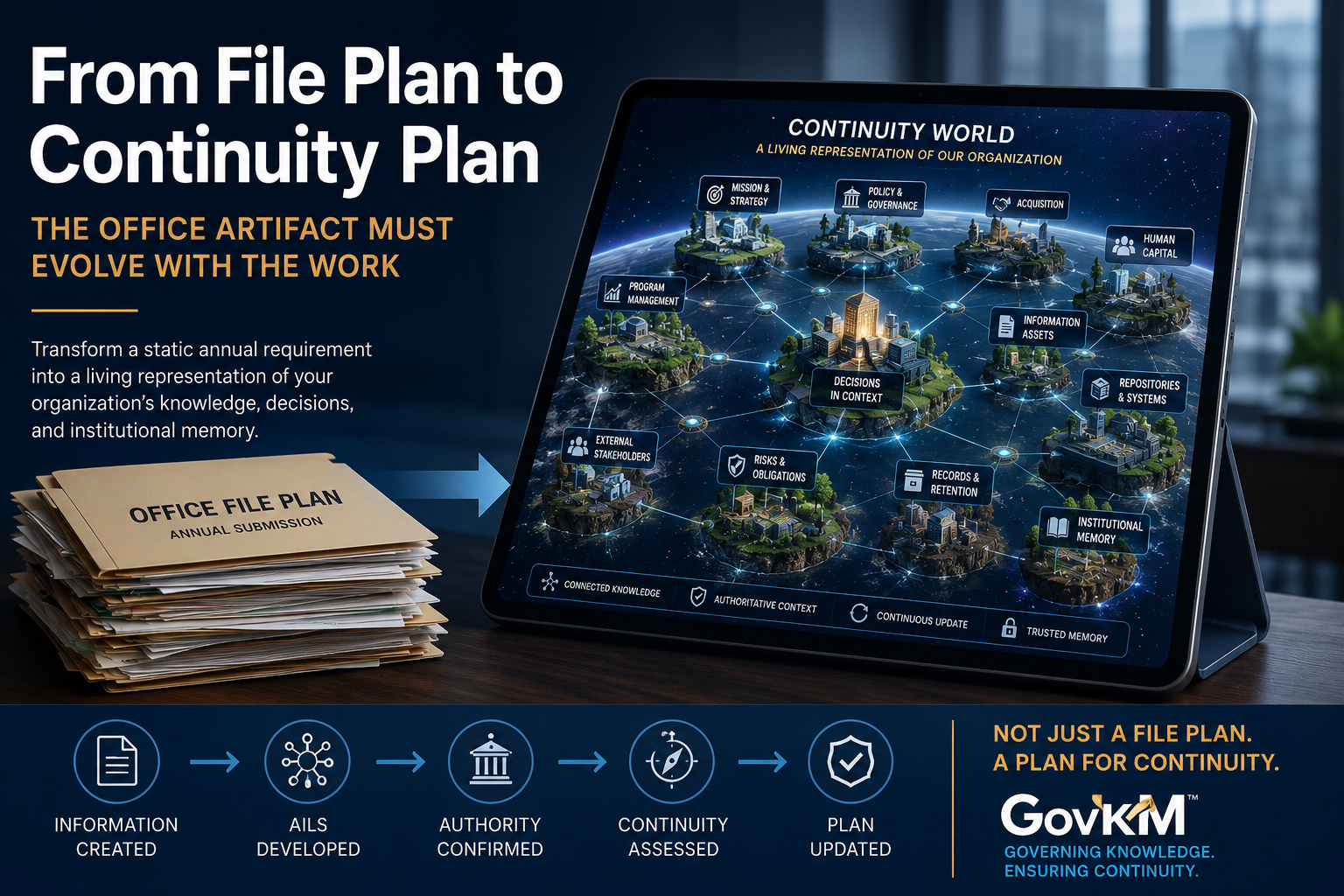

The File Plan Already Contains the Seed of a Continuity System
Federal records management already has an office-level artifact that connects work to record series and disposition authority: the file plan. NARA describes file plans as tools that typically apply to a single office or program and that give staff a succinct set of instructions for the records they actually create and maintain.
That matters because a file plan is more than a filing aid. It is a compact representation of relationships among an office, its functions, its records, and the legal authorities governing those records.
But continuity introduces a harder requirement. The office does not remain static between reviews. New systems appear. Functions move. New information series emerge. AI-assisted work creates new forms of recorded information. Responsibilities shift. Repositories change. A file plan that accurately represented the office at one point can become incomplete while still appearing formally valid.
The continuity problem is therefore not simply whether a file plan exists. It is whether the institutional relationships represented by that plan remain current as the work changes.
NARA Already Treats the File Plan as a Maintainable Artifact
NARA guidance provides an important foundation. Its current implementation guidance says a file plan should contain up-to-date and accurate disposition authorities and should be created or updated by reviewing office functions, consulting a current records inventory, and matching identified records to approved schedules. NARA's flexible-scheduling guidance goes further: as new series are created, file plans should be updated to identify the applicable schedule item.
Older NARA training materials also advise annual review and amendment as needed. That supports an important distinction: annual review can be a control point, but it should not be mistaken for the only moment at which the artifact becomes accurate.
Continuity requires the operational representation to change when the underlying environment changes.
Do Not Modify the Authority to Fit the Application
This distinction is especially important for the General Records Schedules. NARA issues the GRS as disposition authority for records common across federal agencies. Agencies apply those authorities or obtain approved exceptions where appropriate.
A continuity system therefore should not silently rewrite or reinterpret the authoritative GRS. If an office needs richer operational metadata—such as content type, information domain, system, custodian, dependency, or local business context—that information should be maintained as a governed local layer or crosswalk connected to the applicable disposition authority.
The authority remains authoritative. The operational model becomes more expressive.
This preserves a critical continuity relationship: local knowledge about what the office actually does remains connected to, but distinguishable from, the legal authority that governs disposition.
From File Plan to Office Continuity Plan
A broader office continuity plan would not replace the file plan. It would place the file plan inside a larger representation of institutional work.
Such a plan could identify the office's functions, information domains, records series, authoritative systems, repositories, responsible roles, lifecycle authorities, significant dependencies, and known gaps. Its records-governance view could then produce the familiar file-plan artifact required for operational records management.
The change is conceptual but consequential: the annual or approved document becomes an output of maintained continuity relationships rather than the sole container of those relationships.
The Continuity Topology Makes the Difference Visible
Source → Evidence: Current inventories, systems, repositories, workflows, and records provide evidence of what the office actually creates and maintains.
Evidence → Authority: Those observations must be mapped to authoritative records schedules, policies, roles, and approved exceptions rather than inferred from storage location or naming convention.
Authority → Context: A disposition authority only becomes operationally meaningful when connected to the office function, content, system, and circumstances to which it applies.
Context → Decision: Records managers and responsible officials determine how new or changed information should be classified, governed, scheduled, or escalated as unscheduled.
Decision → Action: The office updates its plan, mappings, controls, training, or systems.
Action → Record: The updated plan and its approvals become durable evidence of the governance state that was established.
Record → Institutional Memory: Successive governed states show how the office's information environment changed and why.
Institutional Memory → Future Reuse: Later personnel, auditors, system owners, and AI systems can reuse prior knowledge without treating an obsolete office configuration as current.
The Failure Mode Is a Stale Representation of a Living Office
A file plan can be perfectly formatted and still fail continuity if the office has changed around it.
The most important warning signs are predictable: a new series exists but is absent from the plan; a system has replaced another without preserving mappings; a repository becomes operationally authoritative without formal recognition; a new information type is forced into an old category because no current representation exists; or an annual review discovers changes that should have been governed months earlier.
These are not merely documentation defects. They are breaks between institutional reality and institutional authority.
A Continuity Plan Makes the Artifact Honest
The office file plan remains valuable precisely because it tethers governance to a concrete artifact. Continuity should preserve that strength while changing what sits behind the artifact.
The goal is not to abolish the file plan. It is to make the plan the trustworthy projection of a maintained continuity model—one that can evolve with the office while preserving the legal authorities, approvals, and historical states necessary to reconstruct what was governed at any point in time.
Continue Exploring
The Answer Was Correct. The Evidence Could Not Prove It.
The Model Hadn't Answered Yet. Its Memory Was Already Wrong.