Governance Before AI: Why Structure Determines Intelligence
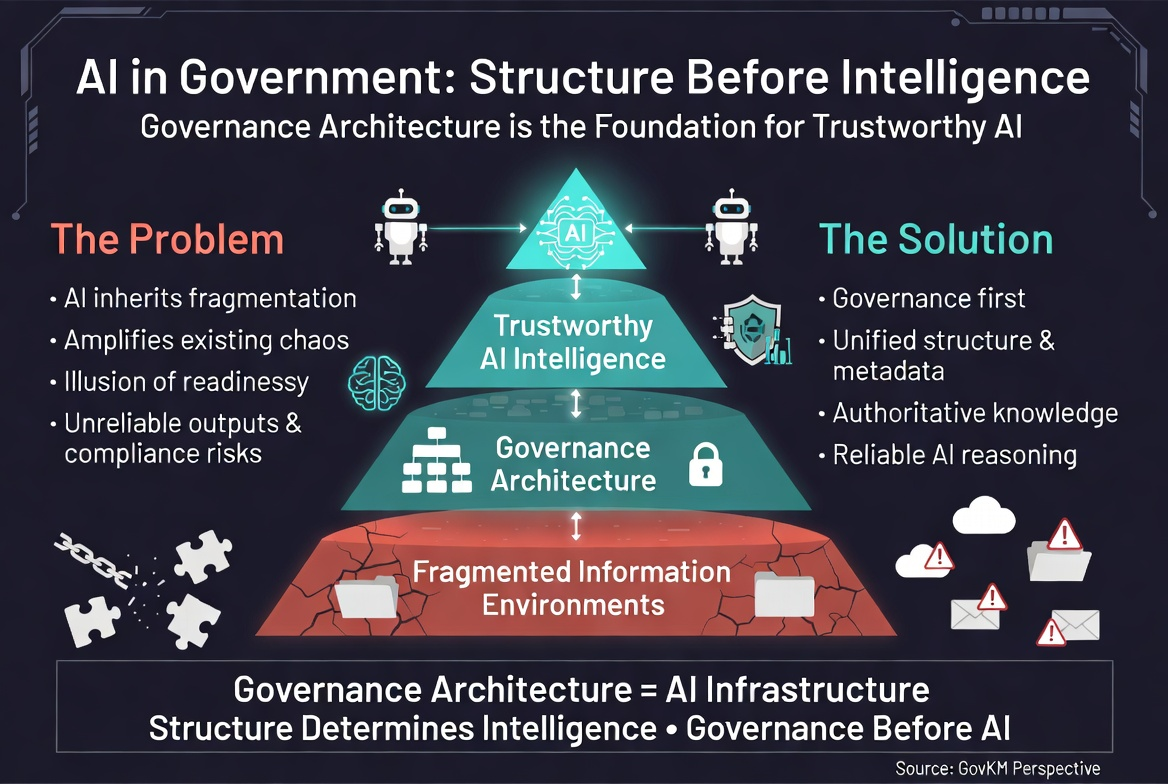

Government Is Attempting to Deploy AI Into Structurally Broken Environments
Across government, agencies are rapidly deploying artificial intelligence tools into information environments that humans themselves struggle to navigate. AI copilots, enterprise search platforms, automated summarization systems, and knowledge assistants are being layered onto repositories that remain fragmented, inconsistently classified, poorly governed, and structurally disconnected.
The assumption driving many modernization efforts is that artificial intelligence can compensate for governance failures. In reality, AI systems inherit the structure of the environments they operate within. If the underlying information architecture is inconsistent, the resulting intelligence will also be inconsistent.
Artificial intelligence does not eliminate governance problems. It amplifies them.
AI Cannot Create Authoritative Knowledge From Non-Authoritative Systems
Most government information environments were never designed as unified knowledge systems. Agencies operate across disconnected repositories, overlapping collaboration platforms, inconsistent metadata models, duplicated records, and decentralized governance practices.
Humans compensate for these problems through institutional knowledge, personal workarounds, folder structures, tribal processes, and contextual interpretation. AI systems cannot reliably do the same.
When artificial intelligence operates against fragmented environments, several systemic problems emerge:
- Conflicting records generate conflicting outputs
- Inconsistent metadata produces unreliable retrieval
- Disconnected repositories prevent complete reasoning
- Poor classification weakens contextual understanding
- Duplicate content undermines authority and trust
- Unstructured lifecycle management introduces compliance risk
AI systems can only reason over the information structures they are given. If the environment lacks authoritative structure, the resulting intelligence becomes probabilistic, incomplete, and operationally unreliable.
The Illusion of AI Readiness
Many organizations now describe themselves as “AI-ready” simply because they have deployed modern tooling. Purchasing an AI platform, enabling enterprise search, or integrating a large language model does not create organizational intelligence.
In many cases, these deployments expose how structurally fragmented the underlying environment actually is.
An AI assistant operating across inconsistent repositories may retrieve outdated guidance, conflicting policies, duplicate records, or incomplete lifecycle information. The system may appear intelligent while quietly reinforcing structural confusion underneath the surface.
This creates a dangerous illusion:
The appearance of intelligence without authoritative knowledge governance.
The problem is not primarily the model.
The problem is the architecture feeding the model.
Why Structure Determines Intelligence
Human intelligence and machine intelligence both depend on structure.
Information only becomes operationally useful when relationships, classification, metadata, authority, lifecycle state, and contextual meaning are consistently governed across the environment.
Effective intelligence requires:
- Unified classification structures
- Consistent metadata standards
- Authoritative repositories
- Lifecycle governance
- Controlled relationships between information objects
- Reliable access controls and policy enforcement
- Transparent auditability and traceability
Without these structural foundations, AI systems cannot reliably distinguish authoritative information from redundant, outdated, conflicting, or contextually incomplete content.
Artificial intelligence is not a replacement for governance architecture.
It is a consumer of governance architecture.
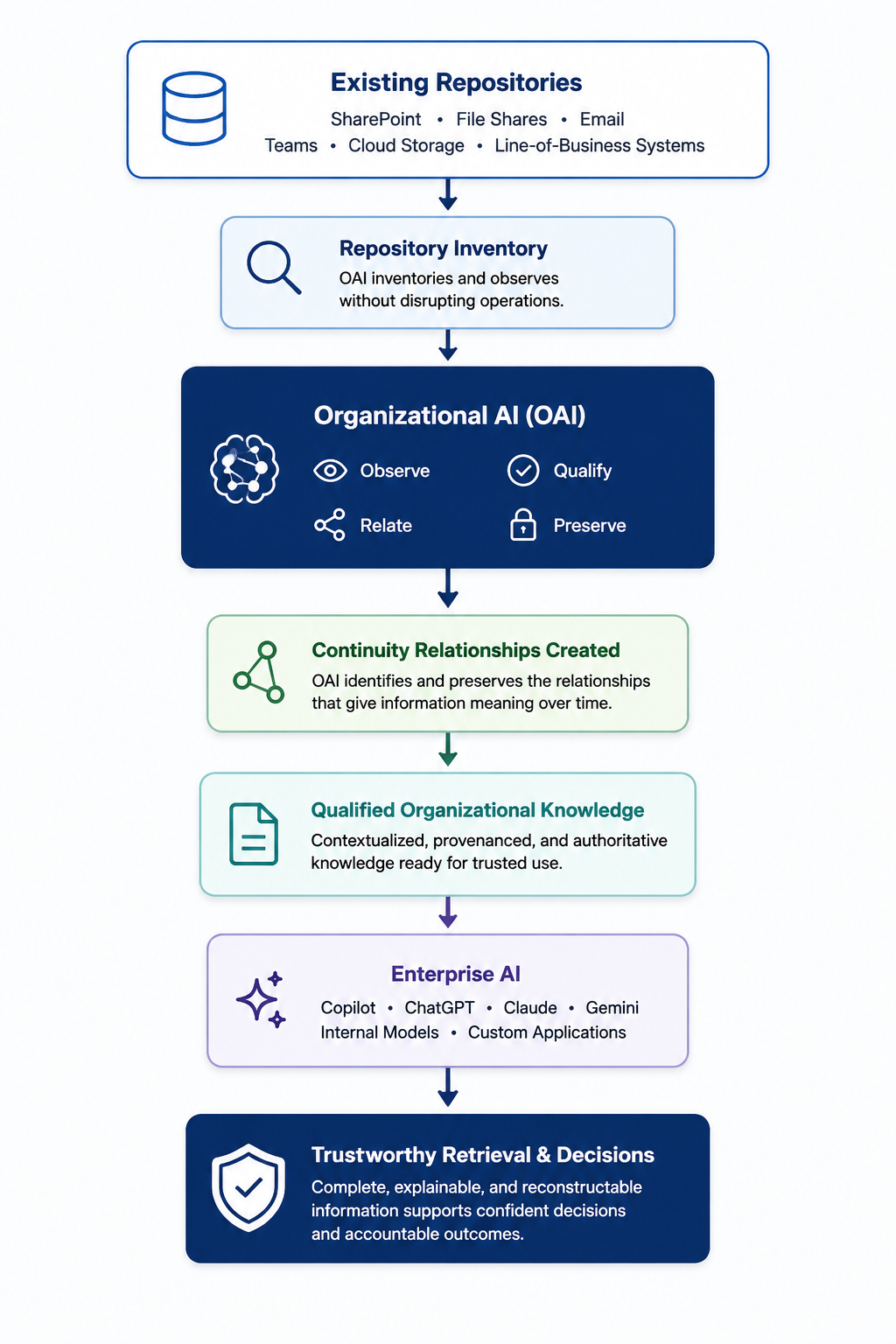
Governance Architecture Is AI Infrastructure
Government agencies often treat governance as a compliance overlay applied after systems are deployed. In reality, governance architecture is foundational infrastructure that determines whether automation, retrieval, interoperability, and machine reasoning are possible at scale.
The governance architecture layer establishes:
- Structural consistency across repositories
- Unified classification and metadata standards
- Lifecycle enforcement
- Retention automation
- Authority relationships between information objects
- Interoperability between systems
- Reliable policy enforcement
Once authoritative governance structures exist, AI systems can operate against environments that are consistent, interpretable, and operationally trustworthy.
Without governance architecture, AI simply accelerates disorder.
The Future of Government AI Depends on Governance Maturity
The future of government artificial intelligence will not be determined solely by which models agencies deploy, which vendors they select, or which platforms they purchase.
It will be determined by whether agencies establish authoritative knowledge architectures capable of supporting trustworthy automation, retrieval, machine reasoning, and institutional intelligence.
Governance must come before AI.
Structure must come before intelligence.
That is the transition GovKM is designed to support.
Continue Exploring
A Malformed Image Became a Pull Request.
The Agent Deleted the Evidence of Its Own Failure.