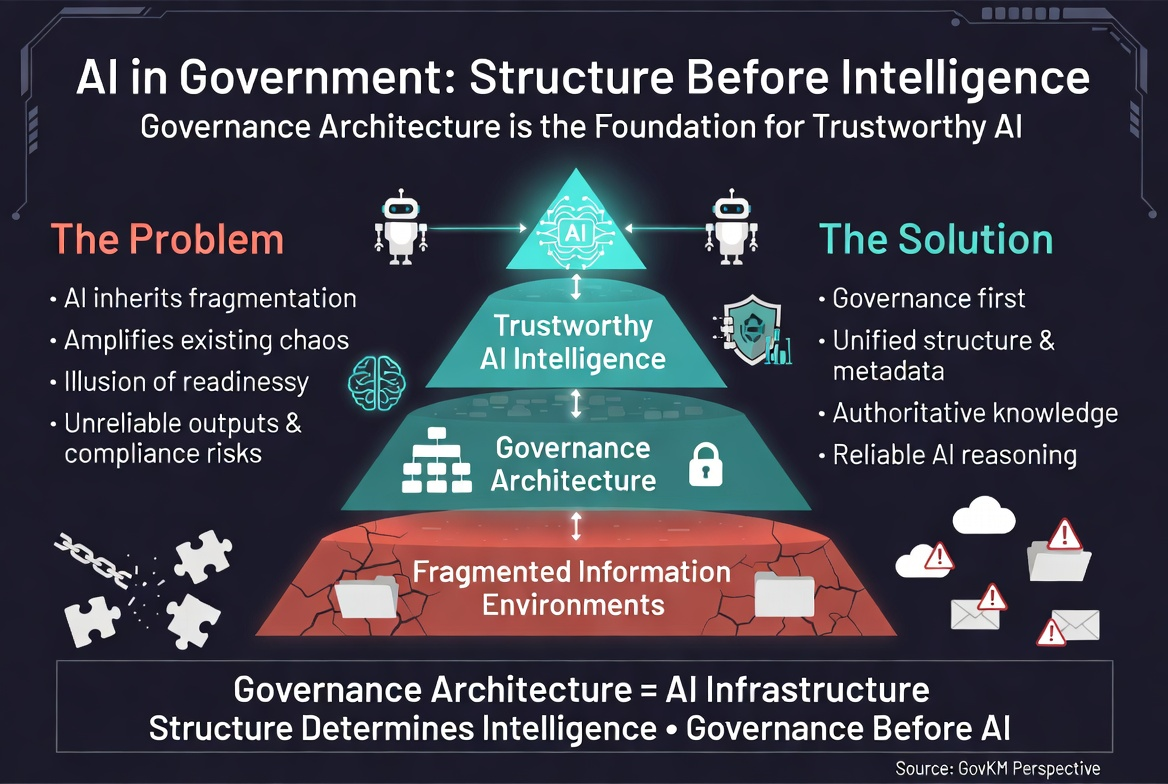
Governance Is Not a Folder: Why Structure Determines Intelligence
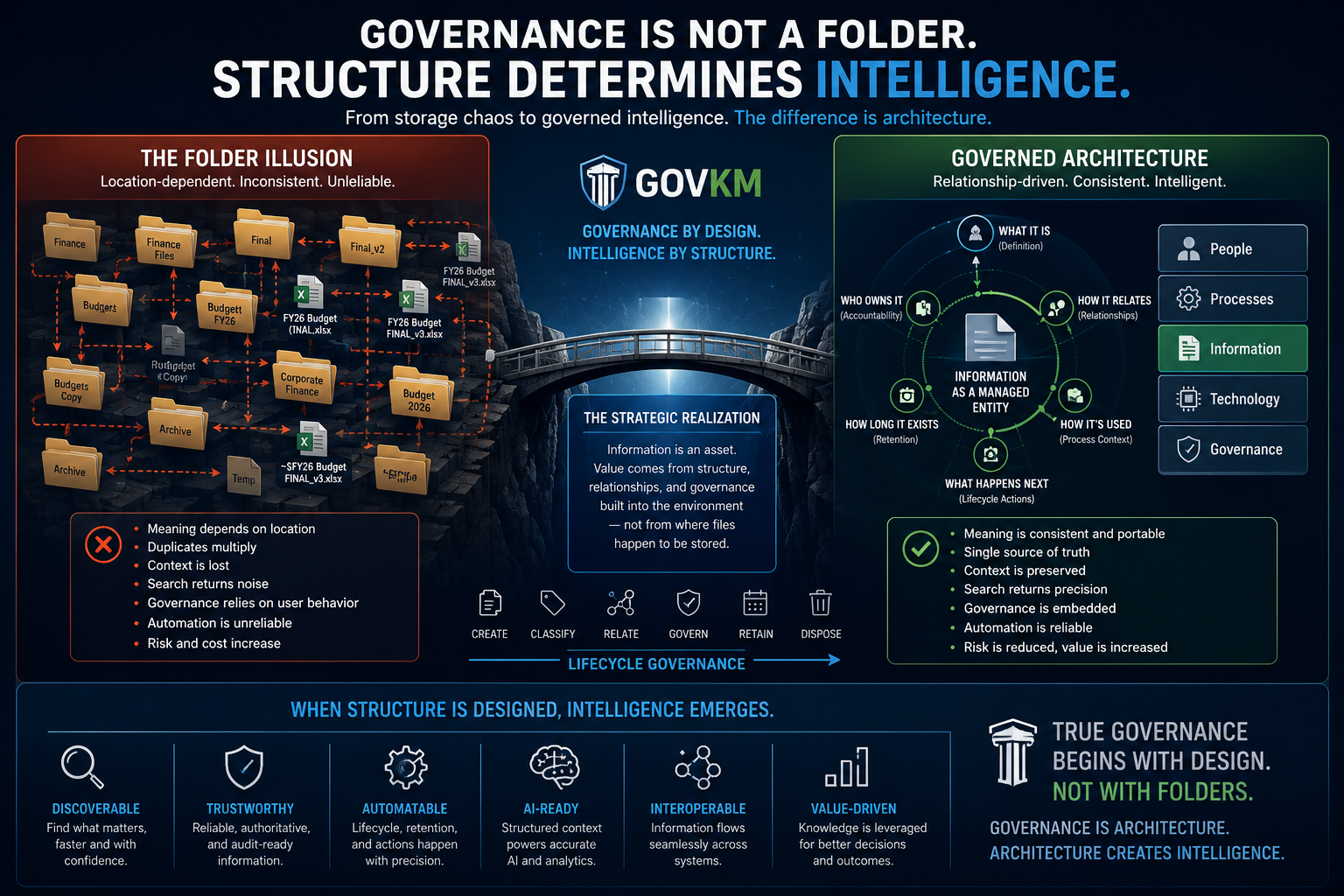

For decades, organizations have treated folders as governance.
Create enough directories.
Nest enough subfolders.
Apply naming conventions.
Train employees where to save things.
Hope search can recover the rest.
This approach became so normalized that many organizations no longer distinguish between storage structure and governance architecture.
But folders were never governance.
They were merely containers.
And containers alone do not create intelligence.
The strategic realization behind GovKM begins with a difficult but necessary recognition:
If governance depends entirely on where users choose to place files, governance does not truly exist.
The Folder Illusion
Folders were originally designed for human convenience, not organizational intelligence.
They provided a simple way to separate documents into visible groups:
- Finance
- HR
- Projects
- Operations
- Policies
At small scale, this appeared manageable.
But as organizations expanded, several problems emerged simultaneously:
- Multiple copies of the same document appeared across locations
- Departments created competing structures
- Naming conventions diverged
- Employees interpreted classifications differently
- Knowledge became siloed
- Search became overloaded compensating for structural inconsistency
- Metadata became optional or ignored entirely
Eventually, organizations accumulated vast quantities of information without establishing any real governance architecture beneath it.
What remained was not governed information.
It was organized chaos.
Folders Create Location Dependency
One of the largest hidden risks in folder-driven environments is that meaning becomes dependent on location.
A document placed inside:
Finance > Budget > FY26
inherits a completely different contextual meaning than the exact same document stored elsewhere.
The file itself often contains little structured intelligence.
The surrounding folder path becomes surrogate metadata.
This creates several dangerous conditions:
- Governance exists only if users follow rules perfectly
- Classification depends on human consistency
- Context becomes fragile
- Automation becomes unreliable
- AI systems inherit ambiguity
- Records management becomes reactive instead of operational
In this model, the organization does not govern information.
Users do.
And users inevitably create divergence over time.
Search Does Not Solve Structural Disorder
Many organizations believe enterprise search eliminates the need for governance architecture.
It does not.
Search engines can retrieve information.
They cannot establish organizational meaning.
When governance architecture is weak:
- Search results become noisy
- Duplicate records multiply
- Obsolete documents remain discoverable
- Authoritative versions become unclear
- Relationships between information objects disappear
- Context collapses
Search compensates for disorder.
It does not eliminate it.
The more fragmented the architecture becomes, the more organizations depend on increasingly sophisticated retrieval technologies merely to survive their own information chaos.
GovKM approaches the problem differently.
Instead of improving retrieval across disorder, GovKM focuses on eliminating the disorder itself.
Intelligence Requires Structured Relationships
True governance architecture is not about storage locations.
It is about structured relationships between information.
This is the foundational shift most organizations have not yet made.
Information gains operational value when systems understand:
- what the information represents,
- how it relates to other information,
- where it belongs operationally,
- how long it must exist,
- who controls it,
- what processes govern it,
- and what actions should occur throughout its lifecycle.
Folders alone cannot provide this intelligence.
At best, they provide visual grouping.
GovKM’s strategic realization recognizes that intelligence emerges from governed structure, not storage hierarchy.
AI Will Expose Weak Governance Architectures
The rise of AI is accelerating this realization dramatically.
Organizations are now attempting to deploy:
- Copilots
- Enterprise AI assistants
- Automated classification
- Semantic search
- Predictive analytics
- Knowledge discovery platforms
But AI systems depend on structured context.
When enterprise information environments are fragmented:
- AI inherits inconsistent meaning
- Duplicate content pollutes outputs
- Unstructured relationships weaken analysis
- Governance gaps become operational risks
- Trust in AI results declines
AI cannot create governance architecture retroactively.
It amplifies the quality of the environment it inherits.
Organizations with weak governance structures will discover that AI scales confusion just as efficiently as it scales intelligence.
Governance Must Become Operational
Traditional governance often exists outside operational work:
- separate retention teams,
- isolated compliance offices,
- disconnected records departments,
- after-the-fact classification projects.
GovKM rejects this separation.
Governance must exist operationally within the environment itself.
That means:
- structure is intentional,
- relationships are engineered,
- classification is embedded,
- lifecycle management is automated,
- governance logic exists before content creation begins,
- and systems guide users naturally toward governed behavior.
In this model, governance stops being a downstream administrative burden.
It becomes part of organizational infrastructure.
The Strategic Realization
Folders are not governance.
Storage is not intelligence.
Search is not structure.
Metadata alone is not architecture.
True governance begins when organizations intentionally engineer the relationships, rules, structures, and operational pathways that allow information to become discoverable, trustworthy, reusable, and automatable at scale.
This is the realization behind GovKM.
Not governance as filing.
Governance as architecture.
Because intelligence does not emerge from where information is stored.
It emerges from how information is structured.
Continue Exploring
The Agent Was Asked to Fix the App. It Changed the Model.
The Government Email Was Real. The Authority Wasn’t.