Governance Without Configuration Authority Is Not Governance
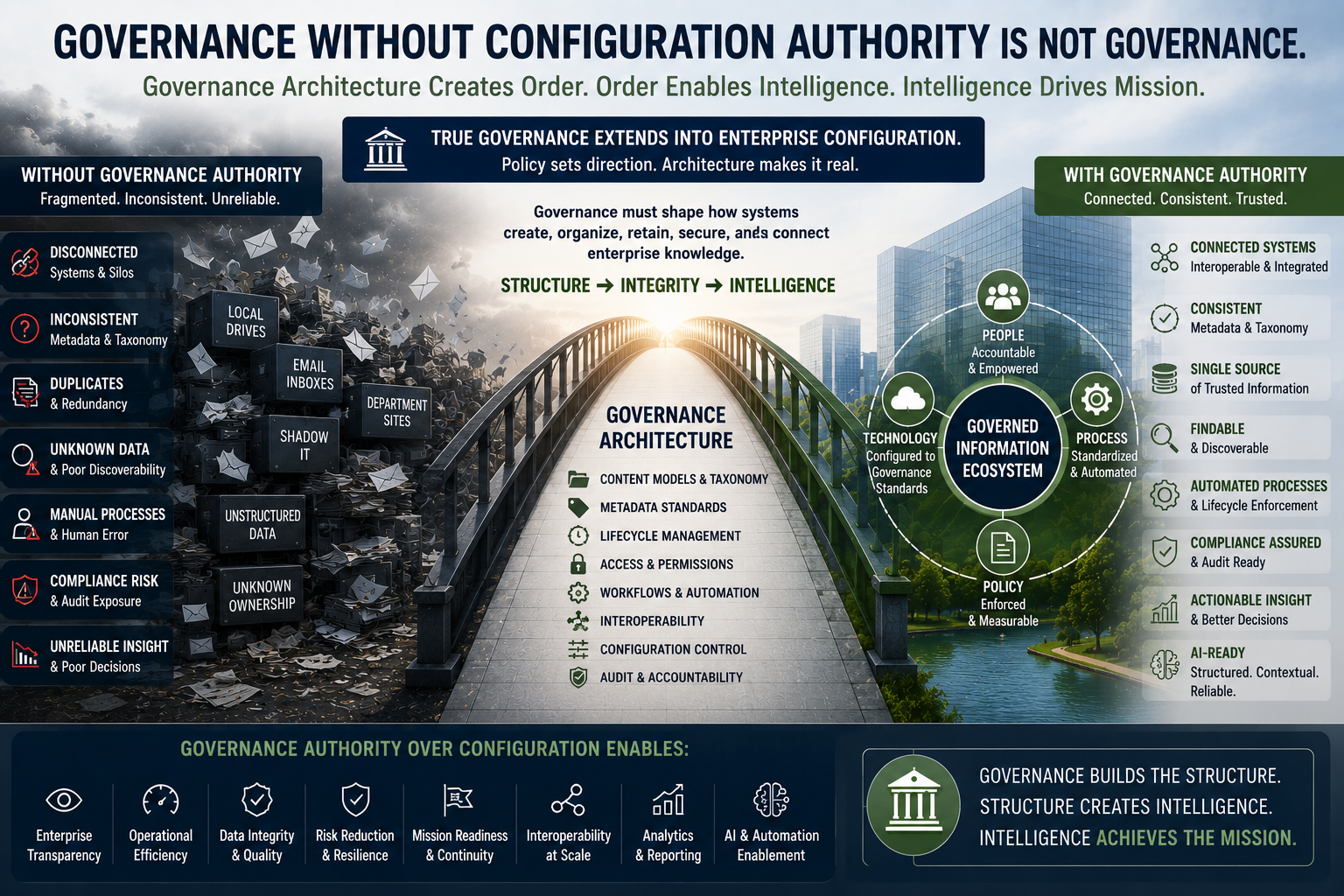

Across government and industry, organizations are rapidly developing “data governance” policies intended to improve accountability, interoperability, security, analytics, and information management.
Yet despite growing investment in governance initiatives, many organizations continue struggling with:
- fragmented repositories,
- inconsistent metadata,
- duplicated content,
- failed enterprise search,
- weak records accountability,
- interoperability breakdowns,
- and unreliable analytics.
The problem is not the absence of governance policies.
The problem is that governance rarely possesses authority over how enterprise systems actually structure information.
Without configuration authority, governance remains theoretical.
The Governance Illusion
Many organizations approach governance primarily as a policy exercise.
Committees draft standards.
Frameworks define expectations.
Policies describe requirements.
Strategic plans establish goals.
But once operational systems are implemented, governance often loses influence over the actual architecture generating enterprise knowledge.
Technology teams configure systems.
Programs create local workflows.
Offices establish independent structures.
Applications inherit inconsistent metadata models.
Repositories evolve separately.
Permissions are implemented inconsistently.
Content types diverge across environments.
Over time, organizations accumulate disconnected operational ecosystems governed more by local implementation decisions than by enterprise governance architecture.
This creates the governance illusion:
- governance exists on paper,
- while operational systems continue generating structural fragmentation.
Governance Is an Architectural Function
True governance is not simply policy oversight.
Governance is structural authority over how enterprise knowledge is created, organized, related, secured, discovered, retained, and operationalized.
This distinction is critical.
Metadata standards are configuration decisions.
Lifecycle automation is a configuration decision.
Access inheritance is a configuration decision.
Search discoverability is a configuration decision.
Content relationships are configuration decisions.
AI-readiness is a configuration decision.
Records accountability is a configuration decision.
Governance therefore cannot remain separated from system architecture.
If governance lacks influence over enterprise configuration, organizations cannot produce consistent operational knowledge ecosystems.
Records Management Accidentally Revealed the Larger Problem
For years, records management legislation and policy frameworks recognized that information lifecycle accountability matters.
Federal records statutes established requirements for:
- retention,
- disposition,
- accountability,
- preservation,
- and information integrity.
Historically, however, these responsibilities were pushed downward toward end users.
Employees became responsible for:
- categorizing content,
- retaining records correctly,
- managing disposition,
- preserving accountability,
- and organizing information manually.
That model was created in a paper-based era.
Modern enterprise systems now possess the ability to automate much of this governance structurally.
The challenge is no longer whether automation is possible.
The challenge is whether governance possesses sufficient authority to shape how systems themselves operate.
This realization extends far beyond records management.
It affects the entire operational knowledge ecosystem.
Governance Must Extend Into Enterprise Configuration
Modern organizations operate across increasingly complex environments:
- cloud platforms,
- collaboration systems,
- content repositories,
- SaaS ecosystems,
- workflow engines,
- AI systems,
- analytics environments,
- and distributed operational platforms.
Within these ecosystems, governance cannot succeed through policy statements alone.
Governance must shape:
- metadata architecture,
- content models,
- taxonomy,
- ontology,
- lifecycle automation,
- interoperability standards,
- permissions inheritance,
- workflow structure,
- search architecture,
- and machine-readable relationships.
These are not abstract governance concepts.
They are system configuration realities.
Organizations that separate governance from enterprise architecture inevitably produce:
- inconsistent repositories,
- fragmented operational data,
- broken discoverability,
- governance drift,
- and unreliable intelligence environments.
Why This Matters Now
For decades, fragmented systems were tolerated because organizations primarily viewed technology as storage infrastructure.
That model no longer works.
Modern enterprises now depend on:
- operational analytics,
- enterprise search,
- automation,
- machine-assisted discovery,
- interoperability,
- and artificial intelligence.
These capabilities require structurally governed information ecosystems.
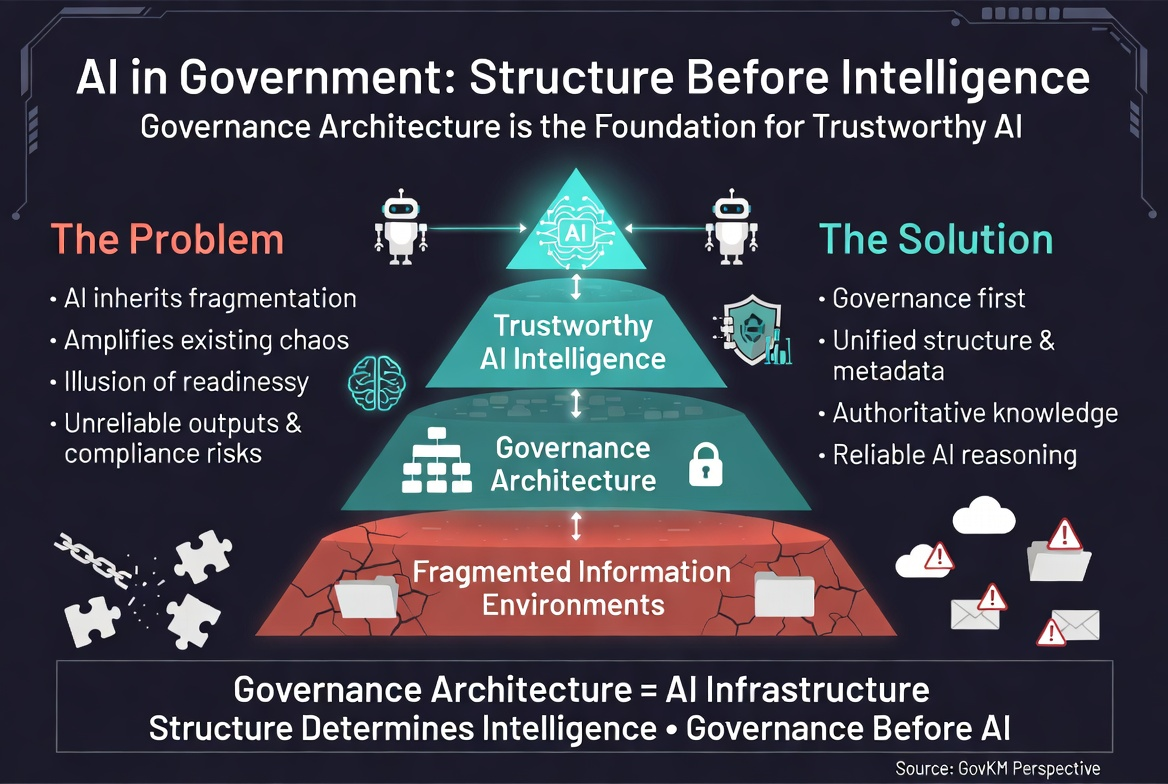
AI systems cannot reason reliably against:
- duplicated content,
- inconsistent metadata,
- fragmented repositories,
- unmanaged lifecycle structures,
- or conflicting information architectures.
Structure determines intelligence.
This means governance is no longer simply about compliance.
Governance is becoming the operational foundation of enterprise cognition itself.
Governance Architecture Is Emerging as Strategic Infrastructure
Organizations are beginning to realize that governance must evolve from:
- advisory oversight,
- policy documentation,
- and compliance administration
into:
- governance architecture.
Governance architecture establishes authoritative enterprise structure across systems by defining:
- operational content models,
- metadata inheritance,
- lifecycle rules,
- interoperability standards,
- contextual permissions,
- search relationships,
- and machine-readable enterprise knowledge frameworks.
This changes governance fundamentally.
Governance is no longer downstream from technology.
Technology becomes downstream from governance architecture.
Infrastructure supports systems.
Governance structures intelligence.
The Future Enterprise
The next generation of enterprise modernization will not succeed merely because organizations deploy newer platforms.
Modernization succeeds only when governance possesses sufficient authority to shape how information ecosystems themselves are constructed.
This is the missing layer in most governance initiatives today.
Organizations continue attempting to govern operational chaos after systems are already deployed rather than architecting governed ecosystems from the beginning.
The future enterprise requires a different model.
A model where:
- governance shapes configuration,
- configuration shapes structure,
- structure enables intelligence,
- and intelligence enables mission success.
Because governance without configuration authority is not governance.
It is aspiration.
Continue Exploring
The Agent Was Asked to Fix the App. It Changed the Model.
The Government Email Was Real. The Authority Wasn’t.