Government’s Largest Product Is Information — But Its Least Governed Asset Is Knowledge

The modern government enterprise produces many things:
- policy,
- regulation,
- diplomacy,
- defense,
- public services,
- oversight,
- enforcement,
- infrastructure,
- and administration.
But beneath every government activity lies a single operational constant:
Government runs on information.
Every mission, every decision, every process, every action, and every outcome depends on the continuous generation, movement, analysis, and preservation of organizational knowledge.
In reality, government is one of the largest knowledge-producing ecosystems on Earth.
Yet despite this reality, information itself remains one of the least structurally governed assets in the enterprise.
The Hidden Operational Engine of Government
Most public attention focuses on visible mission outcomes:
- military operations,
- investigations,
- legislation,
- diplomacy,
- public policy,
- national security,
- public programs.
But mission execution represents only one layer of government operations.
Beneath mission systems exists a much larger operational ecosystem responsible for sustaining the enterprise itself.
Every day, government organizations generate enormous volumes of operational content:
- contracts,
- acquisition artifacts,
- financial records,
- staffing documents,
- organizational reports,
- training materials,
- briefings,
- schedules,
- analyses,
- communications,
- evaluations,
- workflow records,
- planning documents,
- administrative actions,
- and collaborative knowledge artifacts.
This operational content forms the business infrastructure of government.
Without it:
- missions cannot be funded,
- personnel cannot be managed,
- systems cannot be maintained,
- operations cannot be coordinated,
- accountability cannot exist,
- and continuity cannot survive organizational change.
Ironically, this operational knowledge ecosystem often receives far less governance attention than highly visible mission content.
Mission Information vs Operational Enterprise Knowledge
Mission-related information is typically governed with significant rigor.
Policies, directives, intelligence products, doctrine, enforcement actions, and mission-critical operational outputs often pass through structured approval pipelines with:
- controlled authorship,
- metadata requirements,
- publication standards,
- security controls,
- and formal accountability.
These systems are visible.
They are inspected.
They are operationally critical.
But the overwhelming majority of government information exists outside these tightly governed environments.
Most enterprise knowledge is generated through daily operational activity.
And this is where fragmentation begins.
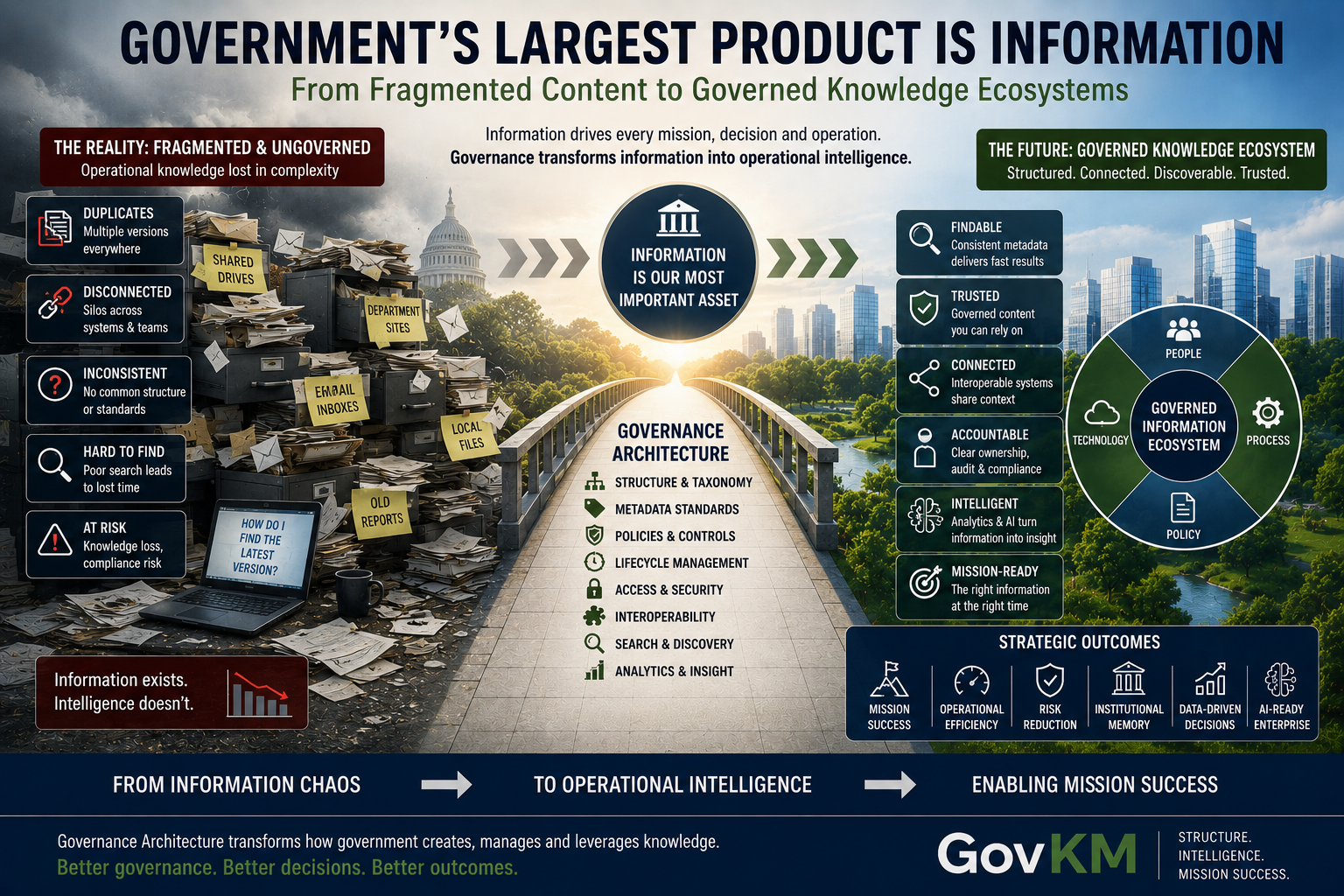
Across government, operational content is frequently:
- duplicated,
- inconsistently structured,
- stored across disconnected platforms,
- governed locally rather than enterprise-wide,
- dependent on human organizational habits,
- and difficult to search, analyze, or preserve.
This creates a dangerous contradiction:
The largest information ecosystem in government often operates with the least structural governance.
The Enterprise Was Built Around Storage, Not Intelligence
Historically, organizations focused on storing information rather than governing knowledge.
Shared drives, email systems, collaboration sites, and departmental repositories evolved organically over time. Employees created local folder structures that made sense within their immediate operational context.
At small scale, this appeared manageable.
At enterprise scale, it became operational fragmentation.
Folder structures became surrogate metadata systems.
Email became a records repository.
Collaboration platforms became disconnected silos.
Duplicate content spread across environments.
Ownership became unclear.
Institutional knowledge became increasingly difficult to preserve.
The issue was never the lack of technology.
Government organizations already possess sophisticated platforms capable of:
- lifecycle automation,
- records accountability,
- metadata enforcement,
- search optimization,
- analytics,
- interoperability,
- governance inheritance,
- and AI enablement.
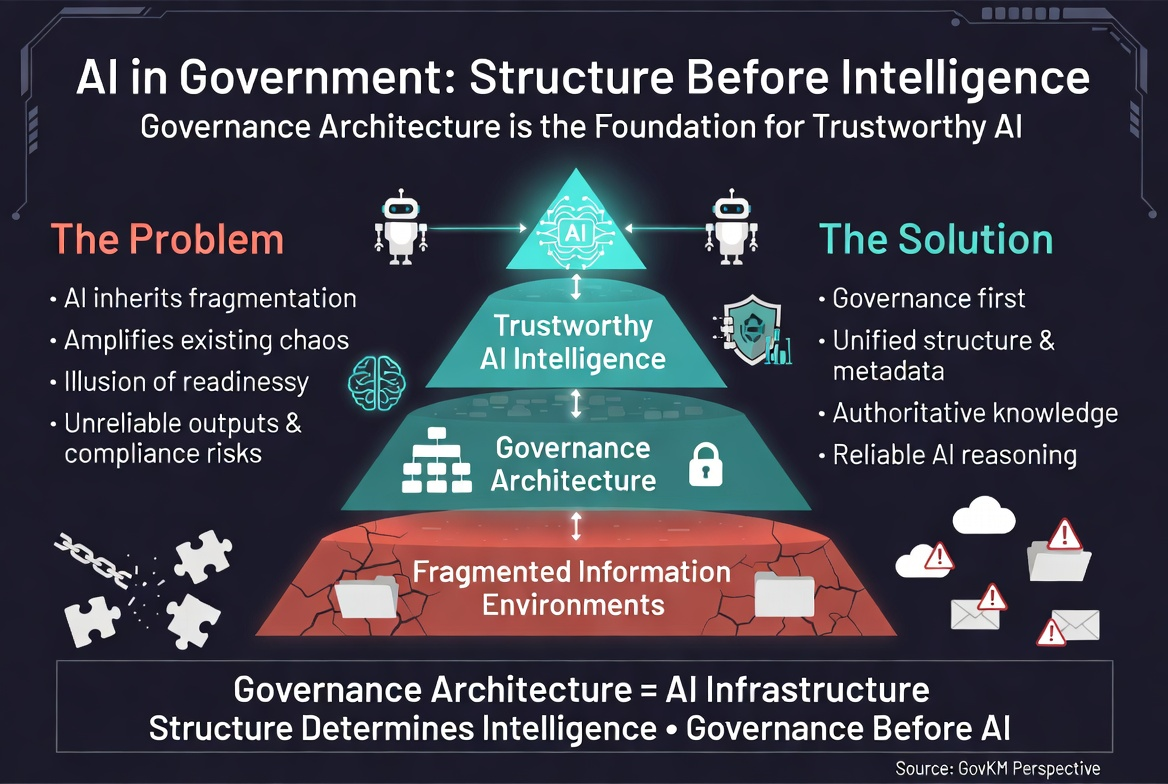
The missing layer has always been governance architecture.
Governance Architecture Is Organizational Infrastructure
Most organizations still think of infrastructure primarily in technical terms:
- networks,
- servers,
- cloud systems,
- cybersecurity,
- endpoints,
- storage platforms.
But the future enterprise depends equally on informational infrastructure.
Governance architecture defines:
- how enterprise knowledge is structured,
- how systems interoperate,
- how metadata remains authoritative,
- how information relationships are maintained,
- how lifecycle management functions,
- how discoverability operates,
- and how organizational intelligence becomes usable at scale.
Without governance architecture, organizations accumulate information without creating intelligence.
This distinction is becoming increasingly important as governments modernize toward:
- enterprise analytics,
- automation,
- AI-driven operations,
- machine-assisted discovery,
- and distributed collaboration ecosystems.
Artificial intelligence does not eliminate the need for governance.
It amplifies it.
AI systems cannot reason effectively against fragmented, duplicated, unstructured repositories lacking authoritative governance models.
Structure determines intelligence.
Operational Knowledge Is Becoming Strategic Infrastructure
Government modernization discussions often focus heavily on:
- cloud adoption,
- cybersecurity,
- platform migrations,
- application modernization,
- and infrastructure consolidation.
These efforts matter.
But increasingly, the true strategic challenge is no longer technological capability.
It is informational coherence.
The organizations that succeed in the next era of modernization will not simply collect more information.
They will govern it structurally.
They will recognize that operational enterprise knowledge is not secondary administrative residue.
It is mission infrastructure.
It is institutional memory.
It is organizational cognition.
It is the operational substrate enabling:
- mission execution,
- accountability,
- continuity,
- interoperability,
- search,
- analytics,
- automation,
- and AI readiness.
The Future Government Enterprise
The future government enterprise will not be defined by how many systems it owns.
It will be defined by how intelligently those systems organize knowledge.
This requires a shift away from:
- storage-centric thinking,
- isolated repositories,
- unmanaged collaboration,
- and locally defined organizational structures.
And toward:
- governed enterprise ecosystems,
- interoperable information architectures,
- authoritative metadata models,
- lifecycle automation,
- and machine-readable operational environments.
Government’s largest product has always been information.
The next realization is understanding that information itself must become governed operational infrastructure.
Because modern government no longer depends merely on managing documents.
It depends on enabling intelligence.
Continue Exploring
The Agent Was Asked to Fix the App. It Changed the Model.
The Government Email Was Real. The Authority Wasn’t.