Information and Technology Are No Longer the Same Discipline

Modern organizations continue operating under a foundational assumption inherited from the early days of enterprise computing:
That information management and technology management are the same operational discipline.
They are not.
For decades, organizations grouped:
- infrastructure operations,
- hardware lifecycle management,
- networking,
- platform administration,
- and cybersecurity
together with:
- collaboration governance,
- business process analysis,
- workflow design,
- enterprise content management,
- software enablement,
- knowledge architecture,
- training,
- operational discoverability,
- and organizational information governance.
Over time, all of these responsibilities became absorbed under the broad label of “IT.”
But the modern enterprise is increasingly revealing that these are fundamentally different operational domains.
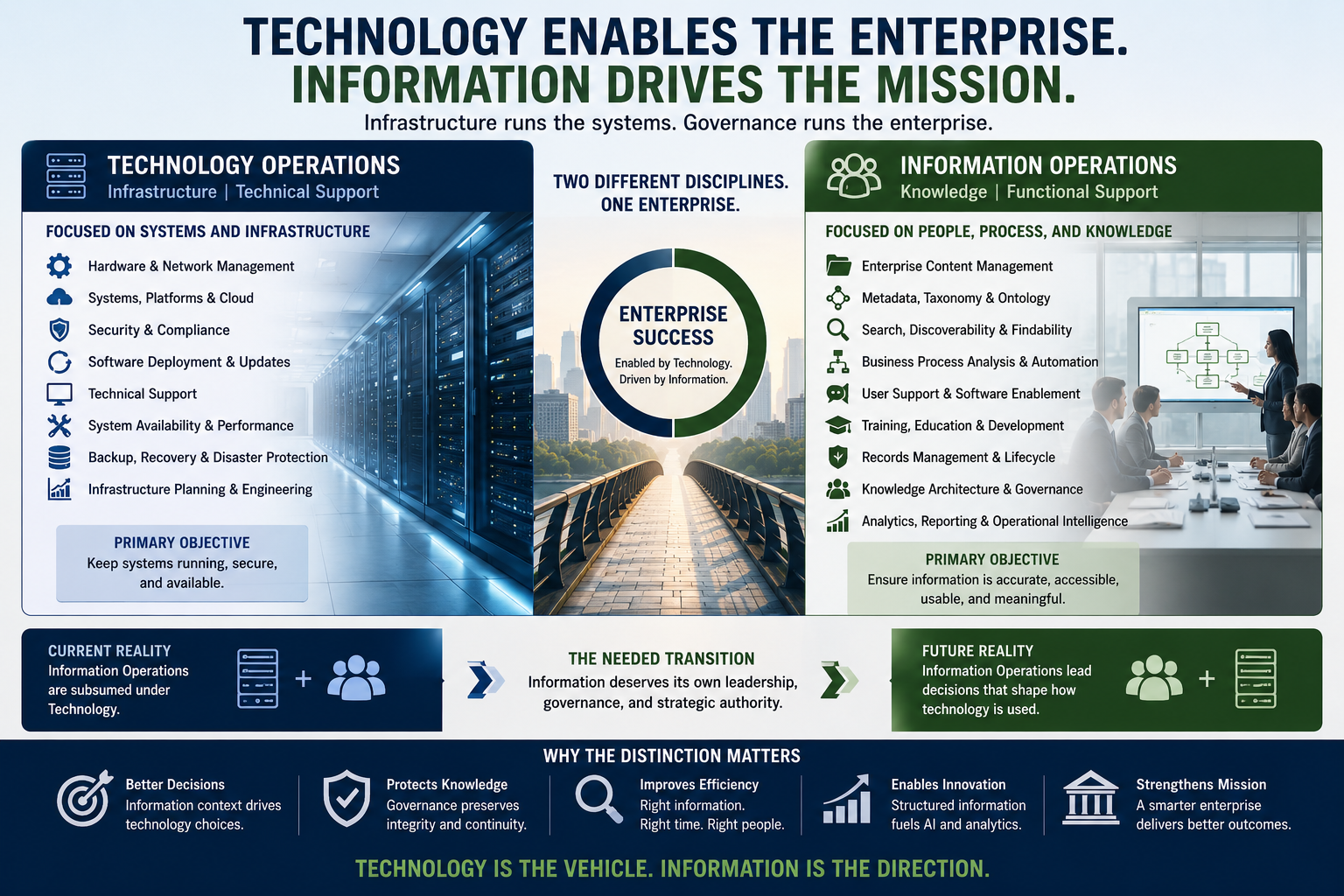
Technology Supports Infrastructure
Technology operations focus primarily on:
- hardware,
- networks,
- cloud infrastructure,
- endpoint management,
- software deployment,
- cybersecurity,
- system uptime,
- and platform lifecycle management.
These are essential enterprise capabilities.
But they are infrastructure-centric.
Their primary objective is ensuring that systems remain operational, available, secure, and technically supportable.
Infrastructure teams optimize for:
- reliability,
- scalability,
- maintenance,
- compliance,
- and technical continuity.
This is highly specialized work requiring deep technical expertise.
But infrastructure alone does not create organizational intelligence.
Information Operations Support Organizational Function
A second operational discipline emerged alongside enterprise technology:
the management of organizational knowledge itself.
This includes:
- enterprise content management,
- collaboration governance,
- workflow architecture,
- metadata design,
- taxonomy,
- ontology,
- software enablement,
- training,
- operational discoverability,
- process automation,
- analytics support,
- lifecycle governance,
- and organizational knowledge stewardship.
These responsibilities are fundamentally different from infrastructure administration.
They are operationally centered on:
- how organizations use information,
- how knowledge moves,
- how workflows function,
- and how enterprise intelligence is created.
This is not infrastructure work.
It is governance and operational-intelligence work.
The Enterprise Accidentally Merged Two Different Professions
In the early era of desktop computing, users naturally turned to the same personnel who installed systems to also explain how to use them.
Over time, this unintentionally merged two distinct operational domains:
- technical support,
- and information enablement.
As enterprise software ecosystems expanded, organizations increasingly required personnel who understood:
- business applications,
- organizational workflows,
- collaboration systems,
- training,
- operational processes,
- and software utilization.
These functions grew rapidly but remained organizationally subordinate to infrastructure-focused IT structures.
The result was an enterprise model where:
- infrastructure priorities dominated,
- while information governance remained secondary.
This imbalance still exists across many organizations today.
Technology Decisions Frequently Ignore Information Impact
One consequence of this imbalance is that enterprise technology decisions are often made without sufficient governance visibility into their impact on organizational knowledge ecosystems.
Platform migrations occur.
Software updates are scheduled.
Repositories are consolidated.
Cloud transitions are mandated.
Applications are replaced.
But little consideration is frequently given to:
- metadata continuity,
- workflow disruption,
- discoverability degradation,
- taxonomy alignment,
- operational knowledge relationships,
- or lifecycle governance.
The organization optimizes infrastructure while unintentionally fragmenting information.
This creates operational instability across the enterprise.
Information Is Becoming More Important Than Infrastructure
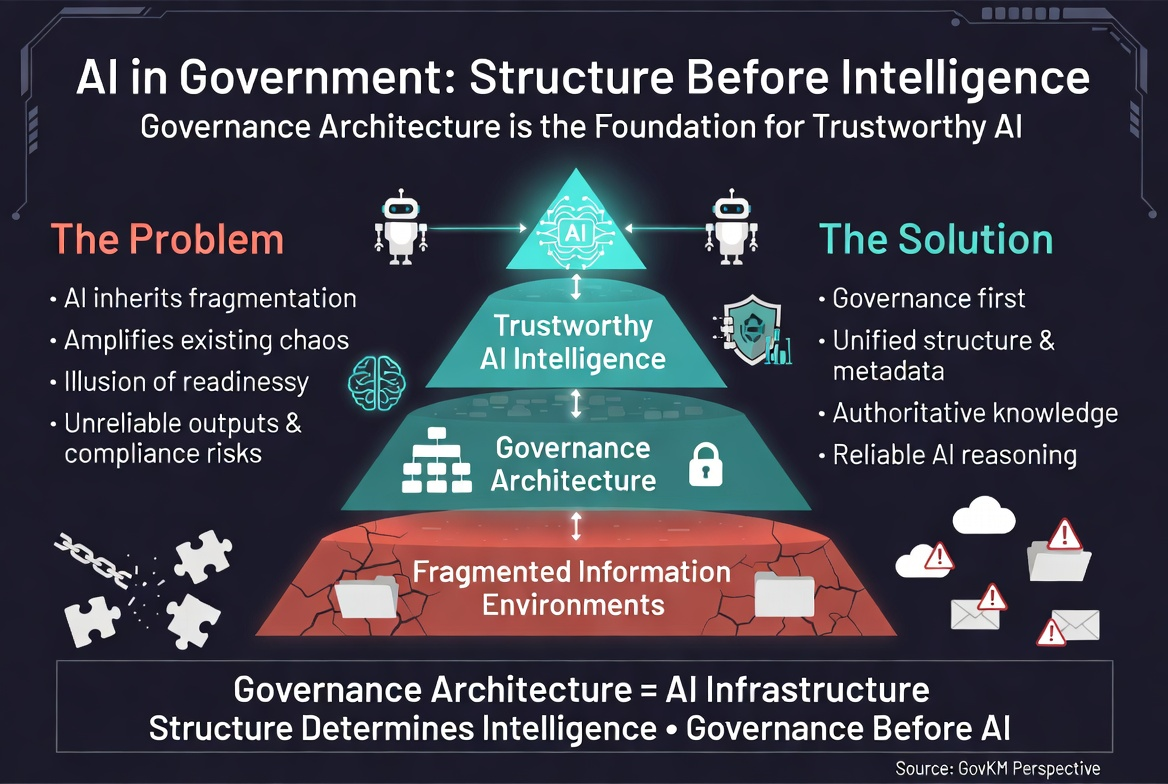
The modern enterprise is now entering a transition where information itself is becoming the primary operational asset.
Organizations increasingly depend on:
- enterprise search,
- analytics,
- interoperability,
- automation,
- machine-readable content,
- operational discoverability,
- and artificial intelligence.
These capabilities depend less on hardware than on structured information environments.
This changes the hierarchy entirely.
Technology increasingly becomes downstream from governance architecture.
Infrastructure exists to support operational intelligence.
Not the other way around.
Corporate Operational Knowledge Exposes the Problem Most Clearly
This divide becomes especially visible within the corporate operational environment shared across government agencies:
- Acquisition,
- Administration,
- Budgeting,
- Communications,
- Finance,
- Facilities,
- Human Resources,
- Installations,
- Knowledge Management,
- Public Affairs,
- Security,
- and related organizational functions.
Unlike mission systems, these operational environments often lack:
- dedicated governance architecture,
- structured metadata models,
- operational taxonomy,
- lifecycle automation,
- and authoritative knowledge ownership.
As a result, corporate operational content becomes:
- fragmented,
- duplicated,
- difficult to search,
- operationally disconnected,
- and structurally unmanaged.
The issue is not technological inadequacy.
The issue is that organizational information has historically been governed as a technical byproduct rather than as strategic operational infrastructure.
Governance Architecture Is Emerging as Its Own Operational Domain
Organizations are increasingly recognizing that:
- infrastructure management,
- and information governance
require different expertise, priorities, operational models, and leadership structures.
This realization is already visible in organizations separating:
- Information Management,
- Knowledge Management,
- Digital Transformation,
- Enterprise Governance,
- and Technology Operations
into distinct operational functions.
The separation is inevitable because modern enterprises no longer compete based solely on infrastructure capability.
They compete based on operational intelligence.
The Future Enterprise
The future organization will increasingly treat:
- information governance,
- operational knowledge architecture,
- metadata stewardship,
- enterprise taxonomy,
- workflow intelligence,
- and machine-readable organizational structure
as strategic operational infrastructure independent from traditional technology administration.
Technology will remain essential.
But infrastructure will increasingly serve governance architecture rather than govern it.
Because modern enterprises no longer succeed simply by maintaining systems.
They succeed by structurally governing organizational intelligence across those systems.
And that requires recognizing that information and technology are no longer the same discipline.
Continue Exploring
The Agent Was Asked to Fix the App. It Changed the Model.
The Government Email Was Real. The Authority Wasn’t.