Information Governance: Why the Era of Unstructured Government Knowledge Is Ending

Government agencies are approaching a breaking point in how organizational knowledge is created, stored, governed, and operationalized.
For decades, government information environments evolved without architectural governance. Shared drives expanded endlessly. Email became a records repository. Teams created disconnected folder structures based on local habits rather than enterprise design. Content management platforms were implemented, but governance was often treated as optional configuration rather than foundational infrastructure.
The result is not merely disorganization. It is systemic operational fragmentation.
Most government knowledge workers today operate within environments where the lifecycle of information is largely unmanaged beyond the individual level. Documents are created in one system, copied into another, attached to email threads, downloaded locally, revised repeatedly, and ultimately abandoned across disconnected repositories. Records management responsibilities are frequently pushed onto content creators themselves, despite the existence of technologies capable of automating governance processes at scale.
This is not a technology problem.
It is an architectural governance problem.
Government organizations already possess mature platforms capable of automating retention, disposition, access control, auditability, and structured information lifecycle management. What most agencies lack is a unified governance architecture capable of organizing enterprise knowledge as an operational system rather than a collection of disconnected storage locations.
The modern government enterprise no longer operates within a centralized information reality. Information now exists simultaneously across collaboration platforms, cloud repositories, messaging systems, shared drives, SaaS platforms, mobile environments, and external partner ecosystems. Without governance architecture, these systems become isolated knowledge silos that weaken operational continuity, searchability, accountability, and institutional memory.
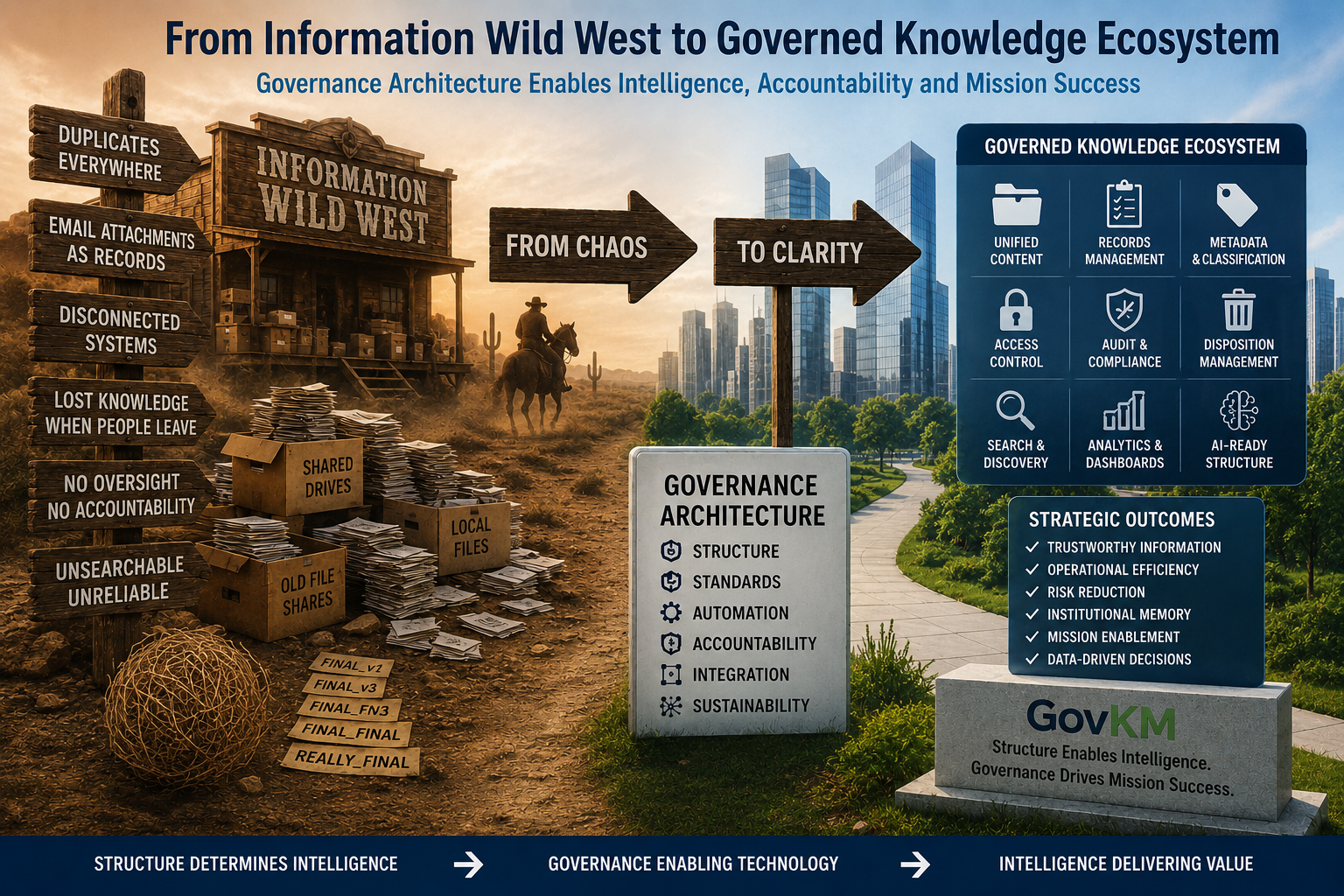
This unstructured freedom created what can only be described as the “Wild West” era of government information management.
In many organizations:
- Multiple copies of the same document exist across multiple platforms.
- Email attachments function as uncontrolled records duplication mechanisms.
- Folder structures become surrogate metadata systems.
- Search results become unreliable due to inconsistent structure and ownership.
- Records accountability becomes nearly impossible to audit.
- FOIA and legal discovery responses become increasingly expensive and inaccurate.
- Organizational knowledge disappears when employees retire, transfer, or leave government service.
These conditions are not sustainable.
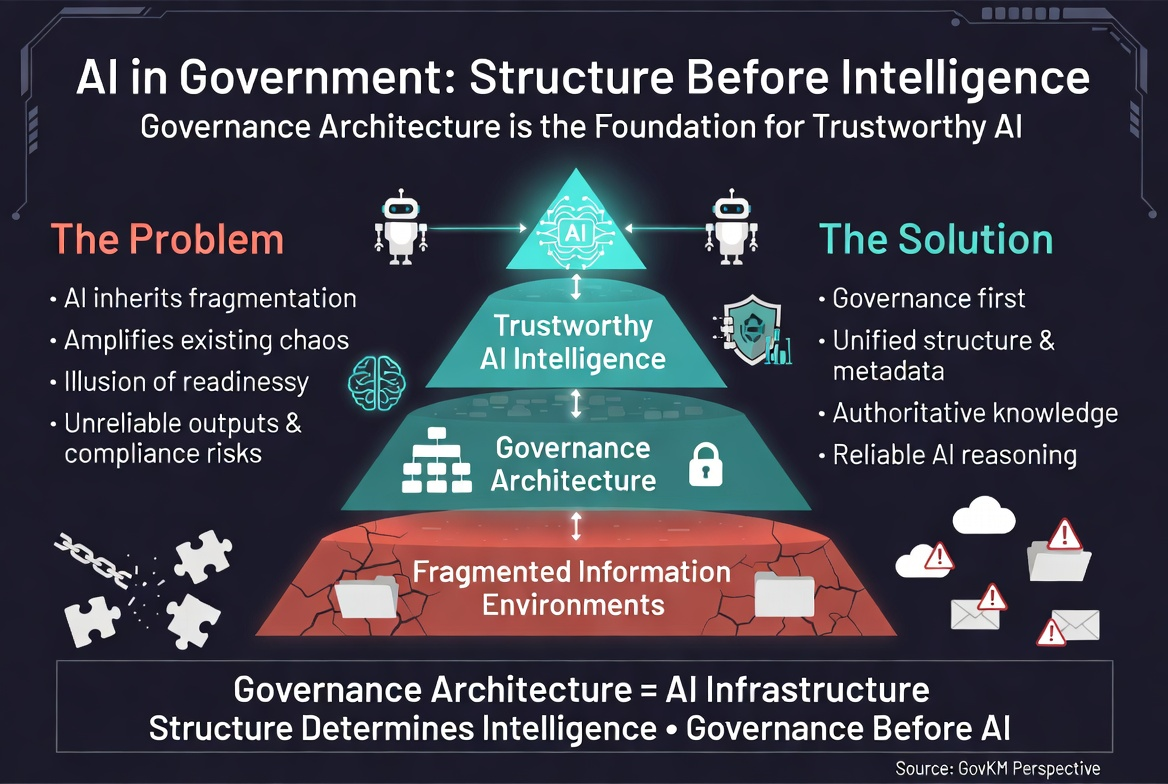
The next phase of government modernization will not be driven primarily by new tools or artificial intelligence platforms. It will be driven by governance architecture.
AI systems cannot operate effectively against fragmented, duplicated, unstructured repositories lacking authoritative governance models. Search cannot become intelligent when organizational information lacks consistent structure. Analytics cannot produce trustworthy insight when data lineage and content ownership are undefined.
Structure determines intelligence.
The future of government knowledge management depends on transitioning from user-managed storage behavior to enterprise-governed information architecture.
This requires a fundamental shift in how agencies conceptualize information itself.
Government information exists within two distinct operational domains:
Government Mission Information
Mission information supports the direct operational purpose of the agency. This includes mission execution, investigations, diplomacy, operations, regulatory actions, intelligence activities, enforcement, or other agency-specific responsibilities.
Mission content is unique to each agency and requires governance aligned to operational context, mission sensitivity, and organizational function.
Government Corporate Information
Corporate information represents the operational business infrastructure that allows agencies to function internally. This includes:
- Human Resources
- Budgeting
- Acquisition
- Finance
- IT
- Facilities
- Security
- Administration
- Communications
Unlike mission information, corporate content is structurally similar across government and already governed through established federal records management authorities, including National Archives guidance and General Records Schedules.
This distinction is critical.
One of the largest governance failures in government modernization has been the unnecessary customization of corporate information management. Agencies repeatedly attempt to reinvent governance models for content categories that are already standardized across government.
The future state requires agencies to stop thinking in terms of storage locations and begin thinking in terms of governed knowledge ecosystems.
Governance is not about restricting productivity.
It is about enabling operational continuity, auditability, discoverability, machine-readability, and enterprise intelligence.
The era of unmanaged enterprise knowledge is ending because the operational cost of fragmentation has become too large to ignore.
Organizations that continue treating governance as an afterthought will face increasing failure in:
- AI implementation
- Enterprise search
- Data analytics
- Records accountability
- Legal discovery
- Institutional knowledge preservation
- Cross-organizational collaboration
The agencies that succeed will be those that recognize governance not as compliance bureaucracy, but as foundational operational infrastructure.
Because in the modern enterprise, governance is no longer about managing files.
It is about enabling organizational intelligence itself.
Continue Exploring
The Agent Was Asked to Fix the App. It Changed the Model.
The Government Email Was Real. The Authority Wasn’t.