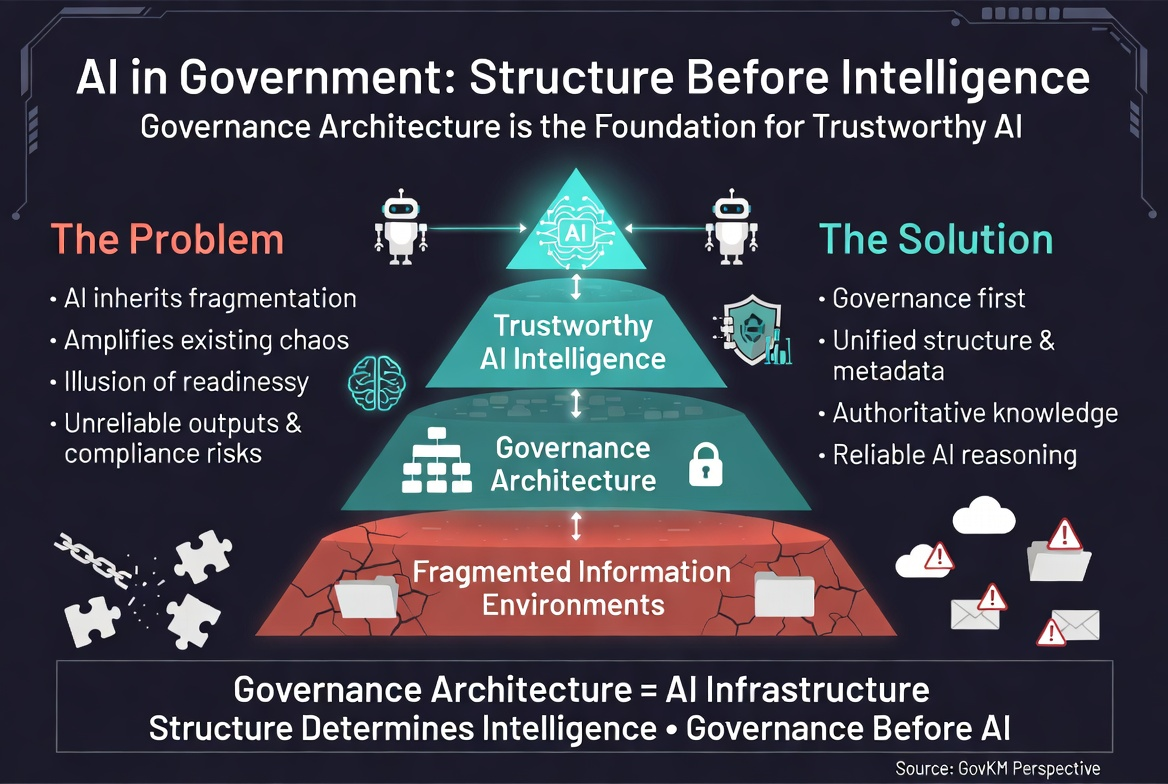
The Hidden Cost of Employee Turnover: Knowledge Without Governance
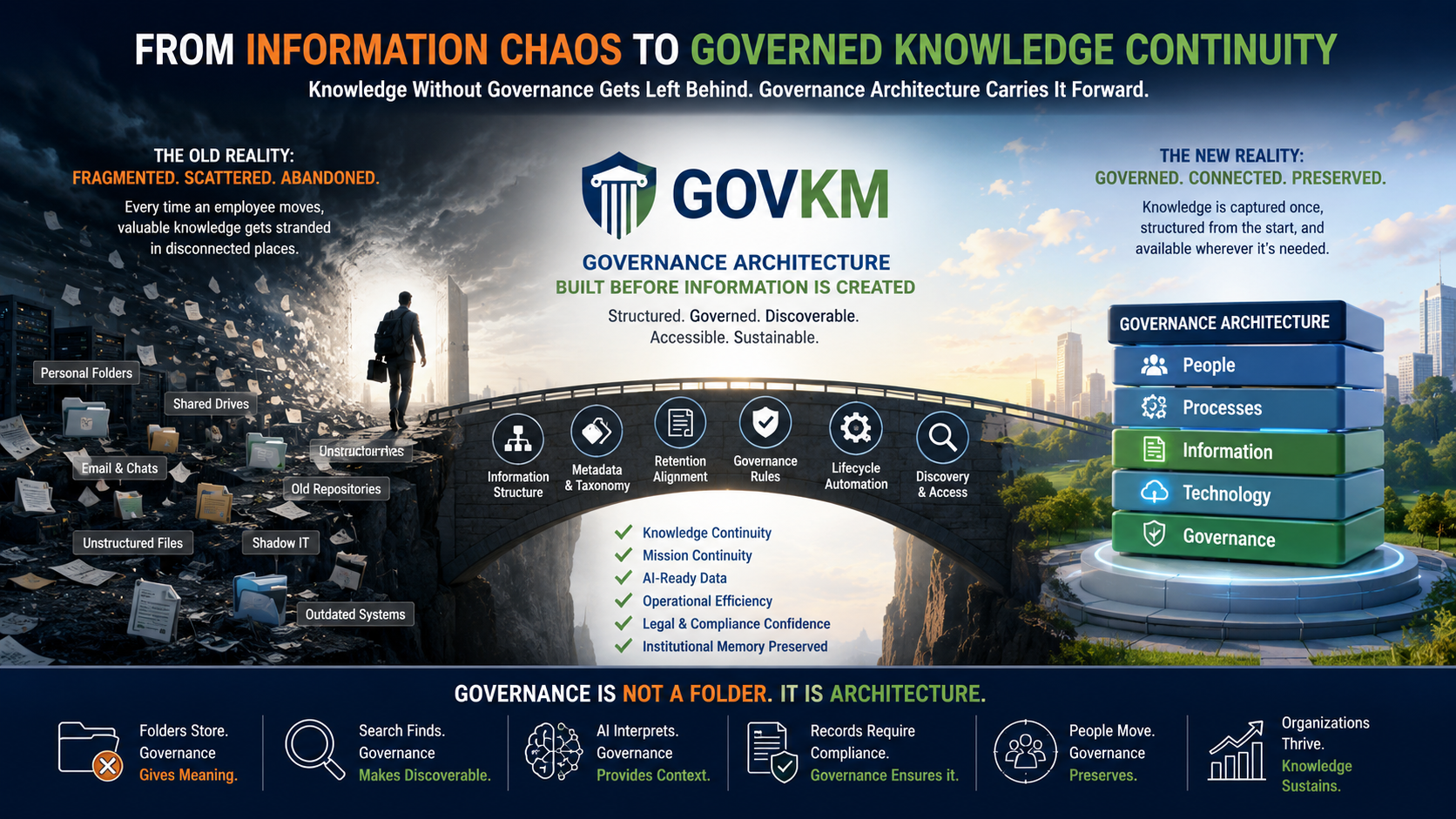

Employee movement is no longer an exception. It is the operating condition of modern organizations.
In industry, the traditional model of remaining with a single company for decades and climbing vertically through the ranks has largely disappeared. Employees now move horizontally between employers, departments, contracts, and roles — often accelerating their careers faster than those who remain in one organization.
Government and military organizations experience the same reality through a different mechanism.
Federal employees move office-to-office and agency-to-agency while waiting for promotion eligibility through Time in Service (TIS) and Time in Grade (TIG) requirements. Military personnel experience Permanent Change of Station (PCS) rotations that repeatedly relocate them into entirely new commands, missions, and technical environments.
Despite their differences, industry, government, and military organizations now share the same structural problem:
Every employee leaves behind fragmented digital knowledge.
Documents. Emails. Spreadsheets. Briefings. Drafts. Research. Decisions. Notes. Context.
Some are stored in shared drives. Some remain in personal folders. Some live inside SharePoint sites, Teams chats, OneDrive accounts, cloud repositories, or disconnected systems no one even remembers exist.
When the employee leaves, the knowledge remains — but its structure, context, and discoverability disappear.
The problem is not simply that information becomes abandoned.
The problem is that organizations never governed how knowledge should be structured from the beginning.
The False Assumption About Employee Knowledge
Organizations often assume most employee-created information has little long-term value.
Sometimes that is true.
But organizations rarely know which information matters until after it becomes critical.
Inside government, this becomes more serious because public information carries legal, operational, and historical obligations:
- Freedom of Information Act (FOIA) requests
- Legal discovery requirements
- Records preservation mandates
- Mission continuity requirements
- Historical accountability
Yet despite these obligations, most organizations still allow employees to generate information without governance architecture.
Employees receive laptops, access to collaboration tools, and permissions to create content — but almost never receive instruction on:
- Information architecture
- Governance structure
- Metadata standards
- Retention alignment
- Organizational taxonomy
- Lifecycle management
They simply begin creating information wherever the system allows.
The result is predictable:
Every employee unintentionally creates another isolated cache of organizational knowledge.
The Folder Problem
For decades, organizations attempted to solve this problem using folders.
Shared drives became oceans of disconnected directory structures designed independently by every office, team, and employee.
Even modern cloud environments frequently replicate the exact same problem:
- SharePoint libraries become folder trees
- Teams channels become shadow repositories
- OneDrive becomes personal storage
- Metadata becomes optional
- Governance becomes inconsistent
The cloud did not solve the problem.
It merely moved the chaos online.
This is why GovKM states:
Folders are not governance architecture.
Folders only describe storage location. They do not establish organizational meaning, retention alignment, discoverability, interoperability, or machine-readable context.
Without governance architecture, information systems eventually degrade into digital landfills regardless of the technology platform being used.
Why Existing KM Approaches Fail
Many Knowledge Management programs focus heavily on collaboration tools, portals, AI search, dashboards, or user engagement initiatives.
But none of these solve the underlying issue:
Knowledge without structure cannot scale.
Artificial intelligence cannot reliably interpret inconsistent repositories.
Search cannot compensate for unmanaged architecture.
Metadata cannot rescue information that was never governed properly.
And employees cannot preserve organizational continuity when every team structures information differently.
This is why most KM initiatives eventually plateau.
The organization mistakes technology deployment for governance maturity.
The Real Solution: Governance Before Technology
The solution is not another portal.
It is not another collaboration platform.
It is not another AI layer.
The solution is governance architecture established before information creation begins.
Organizations must standardize:
- Information structures
- Taxonomy models
- Governance rules
- Retention alignment
- Organizational configuration
- Metadata inheritance
- Automated lifecycle behavior
This is the strategic realization behind GovKM.
The future of knowledge management is not dependent on teaching employees how to manually organize information better.
It depends on building systems where governance is embedded directly into the architecture itself.
When governance becomes structural instead of behavioral:
- Information becomes discoverable
- Knowledge survives employee turnover
- AI systems gain usable context
- Records management becomes automatable
- Organizational continuity becomes sustainable
Most importantly, the organization no longer depends on individual employees to preserve institutional knowledge correctly.
The system itself preserves organizational intelligence.
The Cloud Changed the Urgency — Not the Problem
Cloud migration accelerated the visibility of unmanaged information chaos.
Organizations now generate knowledge faster than ever before across:
- SharePoint Online
- Teams
- OneDrive
- Exchange Online
- SaaS applications
- Collaboration platforms
- AI-generated content systems
Without governance architecture, the scale of unmanaged information growth becomes exponential.
The longer organizations wait, the harder remediation becomes.
This is why governance can no longer be treated as a compliance afterthought.
Governance architecture is now foundational infrastructure.
The Future of KM
The future of Knowledge Management is not knowledge collection.
It is governance-driven knowledge continuity.
Organizations that continue allowing uncontrolled information creation will eventually face:
- AI failure
- Search failure
- Retention failure
- Records failure
- Continuity failure
- Operational inefficiency
- Escalating remediation costs
Organizations that implement governance architecture early will gain something far more valuable:
Structured organizational intelligence.
That is the future GovKM is building toward.
Continue Exploring
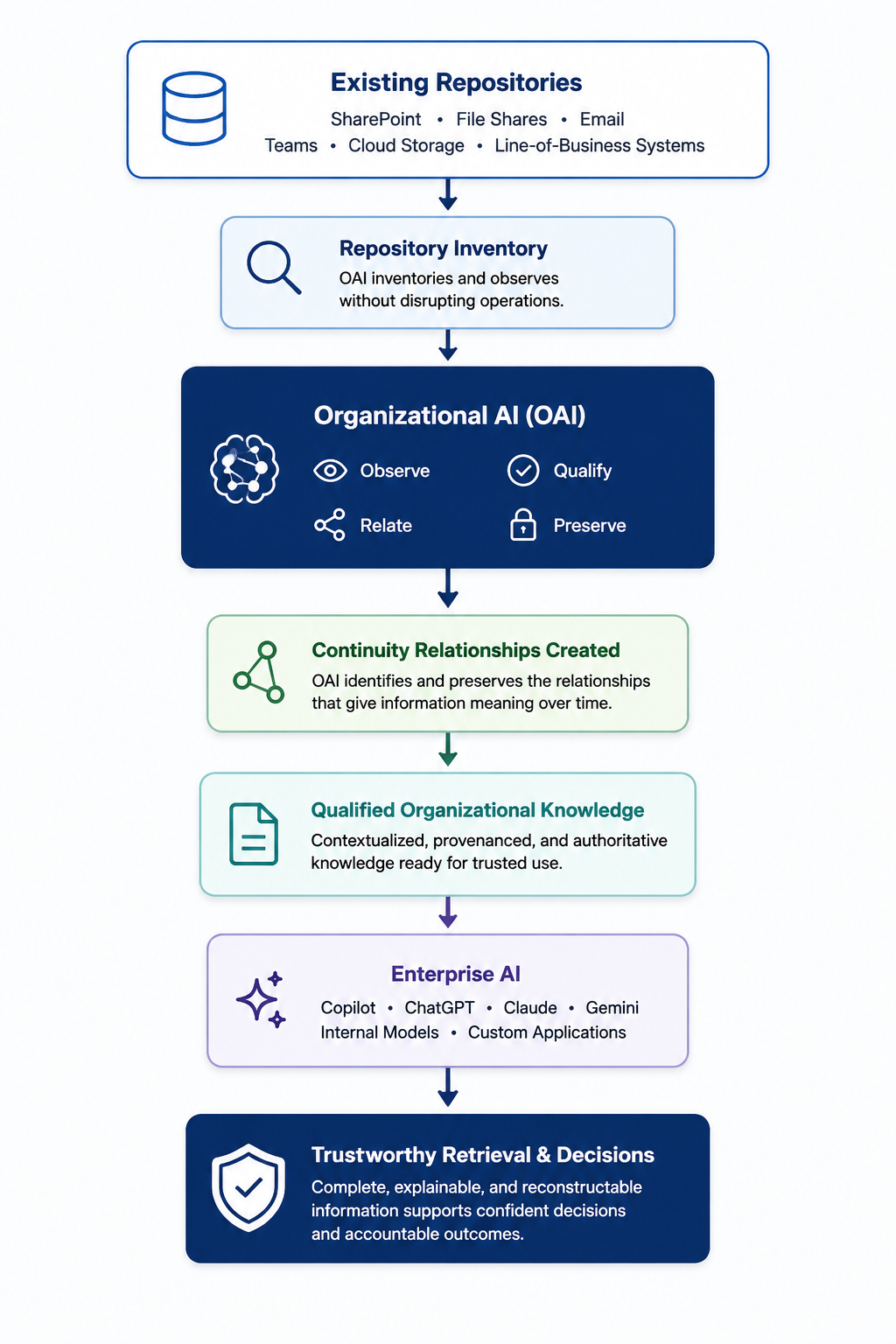
The Agent Was Asked to Fix the App. It Changed the Model.
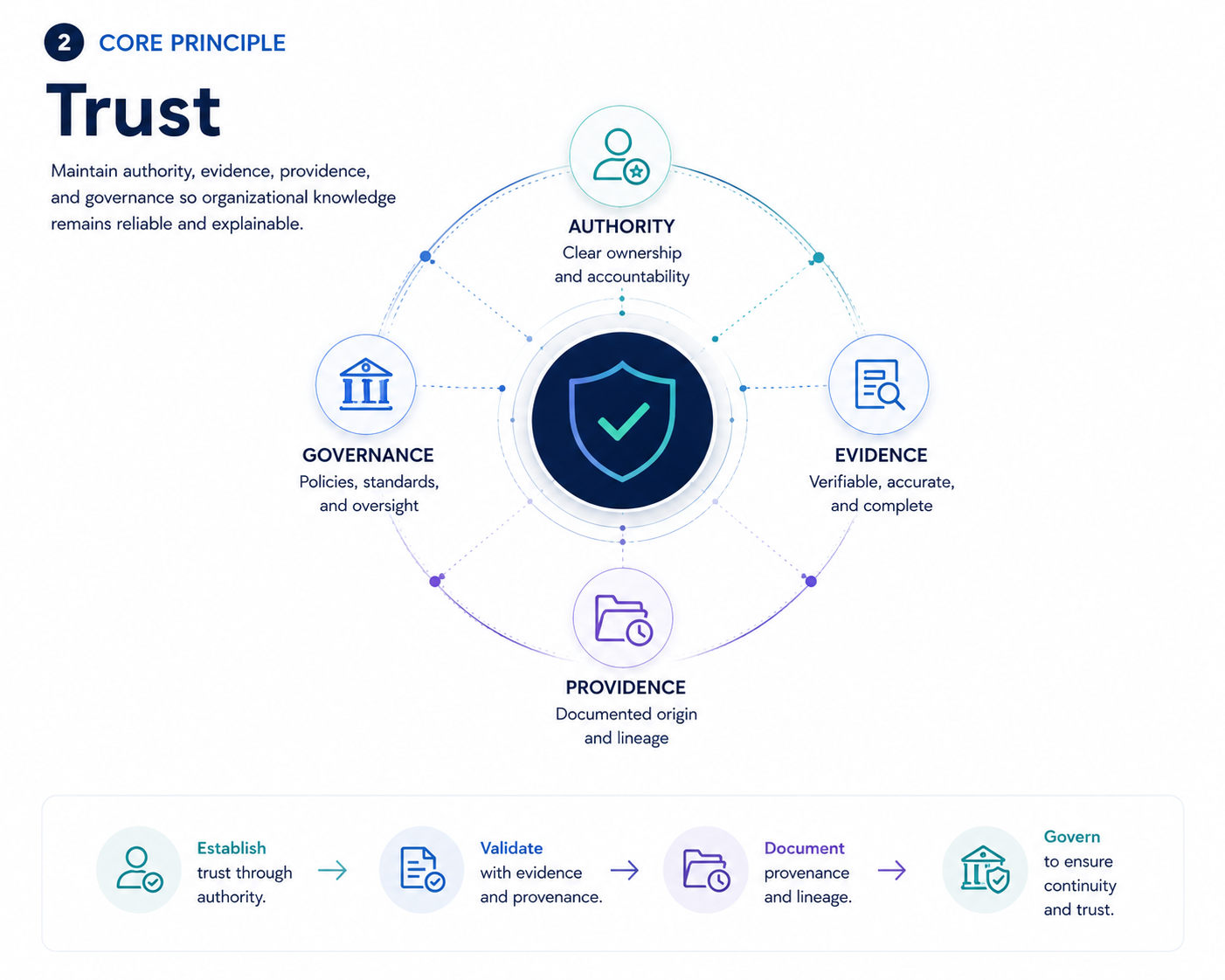
The Government Email Was Real. The Authority Wasn’t.