The Document Was Scanned. Can the Agency Prove It Became a Trustworthy Federal Record?
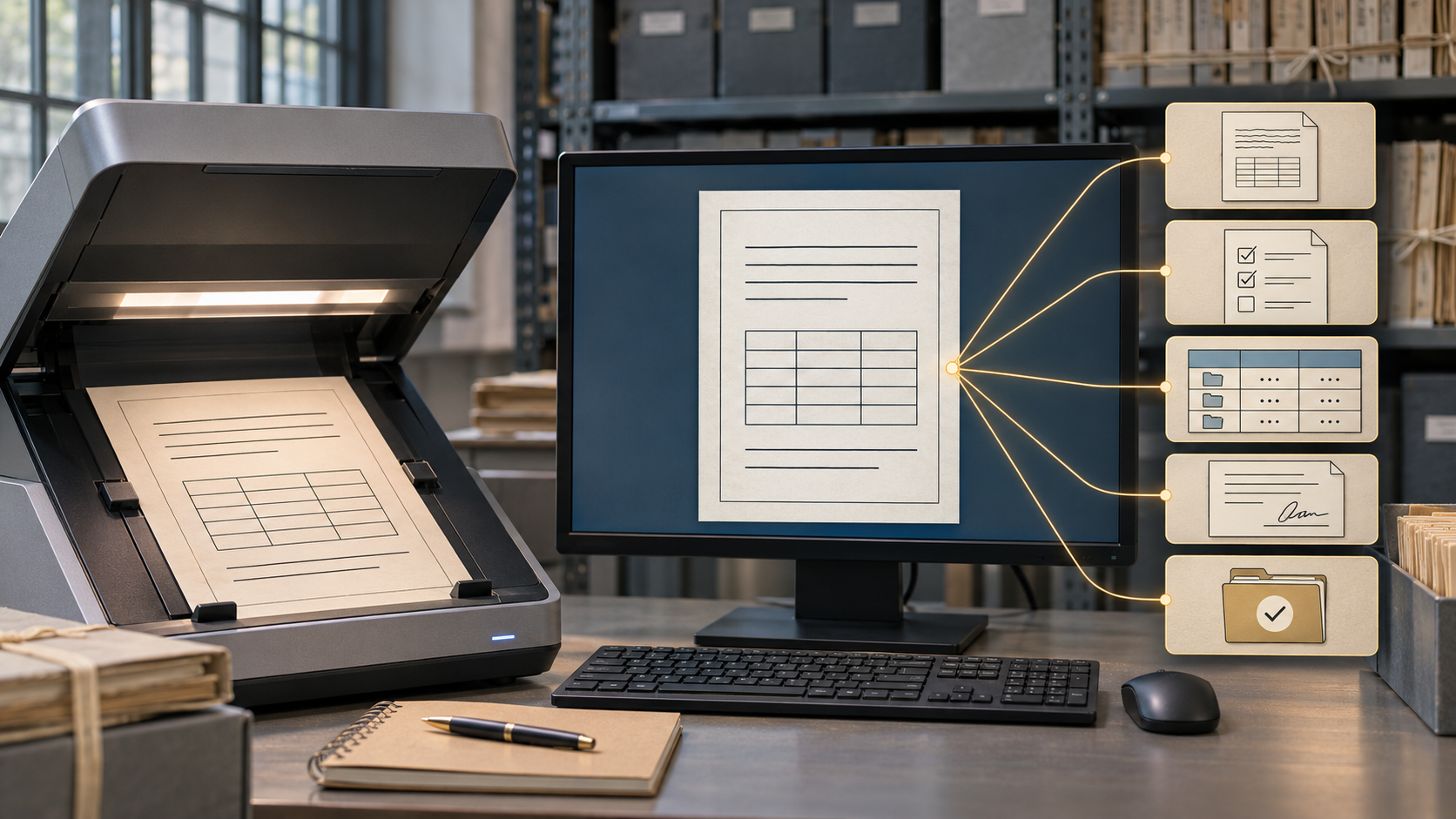

If the original document disappears, can you prove that its digital replacement contains everything that mattered?
A digital copy may look identical to the original while losing information needed to establish its meaning, completeness, provenance, or authority. Someone relying on the copy later needs to know what it came from, what was checked, and whether it was accepted for the purpose at hand. An AI system needs access to that same evidence.
What NARA’s November 2026 guidance establishes
The National Archives and Records Administration’s November 2026 guidance on non-compliant digitized permanent records addresses digitized records that fall short of the applicable standards, including records scanned before those standards were issued. NARA explains that both the source and digitized versions need disposition authority. An agency needs to establish which authority covers each version before it acts on either.
General Records Schedule (GRS) 4.5 provides conditional disposition authority for eligible source records. Item 010 covers source records when digitization meets the applicable standards and the schedule’s conditions are met. Item 011 can apply to eligible older non-compliant permanent records after NARA accepts legal custody of the digitized records. GRS 4.5 does not govern the digitized recordkeeping copy, which remains subject to its applicable approved records schedule. Exclusions include source records with intrinsic value in the original medium and certain permanent or unscheduled source records created before January 1, 1950.
For non-compliant permanent records, NARA’s guidance considers when digitization occurred relative to the end of the calendar year in which the relevant standards were issued and whether the source still exists. For covered records digitized after that cutoff, agencies generally need to rescan if the source remains. If the source is gone in the scenario described by NARA, the agency must report the unauthorized disposition. The guidance describes separate pathways for older digitization, including transfer under an existing schedule and, where eligible, source disposition after NARA accepts legal custody.
The perceived Organizational Information Continuity challenge
Consider a government office converting thousands of paper records. A contractor scans the documents, agency staff validate the output, an IT team moves the files into a repository, and an authorized official decides whether eligible source material can be destroyed. Years later, the people may have left, the scanning software may have changed, and the repository may have moved.
Can the agency still trace a file to its source, retrieve the validation evidence, identify the schedule in force when a decision was made, and establish who authorized disposition? GovKM’s independent analysis focuses on how those connections can break and what that would mean for the people and AI systems that rely on the records.
1. Validation evidence becomes detached from the file
36 CFR § 1236.34 requires agencies to validate temporary records digitized to replace the source and document the validation process. For covered permanent records, 36 CFR § 1236.56 requires validation by staff who did not perform the digitization quality-control inspections. A later reviewer who can open the file but cannot retrieve the evidence may be unable to establish whether the scan was accepted as a recordkeeping copy.
Consequence for AI trustworthiness. An assistant could cite accurately transcribed text from a readable scan and miss an omitted attachment or page. Its citation tells the reader where the answer came from. Establishing completeness and recordkeeping status requires the validation evidence.
2. The schedule changes while the repository classification stays the same
Staff need to distinguish the authority for source disposition from the schedule governing the digital recordkeeping copy. If a repository migration carries forward a label without its schedule item, effective dates, or applicability, staff may have to reconstruct which rule governed a particular decision before they can act.
Consequence for AI trustworthiness. An assistant could present a superseded rule as current or use the digital copy’s retention classification to infer that the source can be destroyed. A reviewer needs to see which rule the assistant relied on, when it applied, and which version of the record it governed.
3. The source is gone and the disposition decision cannot be reconstructed
GRS 4.5 allows longer source retention for business needs and identifies legal constraints agencies must consider. For temporary records, 36 CFR § 1236.36 expressly requires agencies to consider restrictions such as litigation holds before destruction. A date in a disposition log may show when the action occurred while leaving staff unable to retrieve the applicable authority, validation result, or hold determination.
Consequence for AI trustworthiness. An assistant could treat the destruction date as evidence that the action was authorized. It should identify the missing basis and state what it can verify. These examples describe prospective risks identified by GovKM.
GovKM’s proposed standards-aligned solution
The Federal Records Act, 44 U.S.C. § 3102, requires agency heads to maintain a continuing records-management program. GovKM proposes six controls for making that responsibility operational in a digitization project.
1. Establish governing authority before scanning
Have the program office and agency records officer inventory the record series, identify temporary and permanent records, and document the approved schedule item, media, and exclusions. Resolve uncertain classifications before routing source material for disposition. NARA’s GRS 4.5 FAQ explains why an agency must schedule unscheduled records before assessing eligibility for source disposition. For covered permanent records, 36 CFR § 1236.44 requires project documentation that associates the digitized records with their source records’ agency schedule items.
2. Preserve the source-to-digital relationship
Assign stable identifiers and link the source inventory, digital files, schedule items, and project documentation in the approved recordkeeping environment. Preserve file order, attachments, and access restrictions through migration. Apply the permanent-record metadata requirements in 36 CFR § 1236.54 where applicable, tailoring additional controls to the record types, approved systems, and agency policies.
3. Validate the digitization and retain the evidence
Apply the applicable validation rules for temporary records or permanent records. In GovKM’s proposed workflow, record the criteria, validator, date, result, and exception resolution and link that evidence to the digitized records. Retain temporary-record validation-process documentation and permanent-record project documentation according to their respective requirements. Verify that the file set, metadata, and validation record can be retrieved together before closing the project.
4. Govern source disposition separately from digital retention
Have the authorized official record the disposition authority, its conditions, and the outcome of any hold or exception review before approving source disposition. Maintain the schedule that governs the digital copy as a separate relationship. For non-compliant permanent records, route the case according to the NARA guidance and consult agency records-management staff, counsel, or NARA as appropriate. Use GRS 4.5 only where its eligibility criteria and conditions are met.
5. Automate checks and keep decisions with authorized personnel
In a supported Microsoft 365 environment, SharePoint can maintain metadata, Power Automate can check prerequisites and route exceptions, and Microsoft Purview can enforce configured retention controls. A workflow can stop when validation evidence is missing, route a hold or classification dispute to the right official, and record the resulting decision. Agency officials establish the applicable authority and resolve exceptions. GovKM’s related analysis explains how those decisions support federal records-management automation with SharePoint, Power Automate, and Microsoft Purview.
6. Preserve the evidence through changes in people, systems, and policy
Maintain the links among the source, validation evidence, applicable authority, disposition decision, and digital record when staff leave, offices reorganize, or systems migrate. OrgAI’s intended role in GovKM’s proposed continuity architecture is to help maintain and retrieve those governed relationships over time. That role is in development. The agency retains authority for its records, decisions, and compliance determinations.
Verify the result
Sample digitized records and reconstruct their source, schedule, processing history, validation outcome, recordkeeping status, and any source-disposition decision. Repeat the test after a handoff or migration. Include a record subject to a hold and an item with missing validation evidence to confirm that the workflow routes both for review.
Then ask the AI system to retrieve an authoritative record where the repository contains both a validated copy and an unvalidated scan. Check that it can identify the basis for using the validated record, respect access restrictions, and state when the available evidence is insufficient. These tests are proposed acceptance checks for the agency to perform in its environment.
Why the same problem exists outside government
A healthcare organization replacing paper clinical records can link each digital copy to the source inventory, validation outcome, and approval, then derive its applicable requirements from health-record laws and institutional policy. A manufacturer can apply the same method to inspection records used to release a product, using applicable regulations, customer obligations, and its quality procedures. What carries across sectors is the ability to verify what the digital record represents, who accepted it, and how it remains governed.
The question after digitization
A contractor can deliver every file on time and still leave the agency with work to do. Years later, can the organization prove what a digital record represents, why people can rely on it, and what obligations still govern it?
GovKM helps organizations assess those gaps and design standards-aligned Organizational Information Continuity controls that preserve records, authority, and supporting evidence across changes in personnel, technology, and policy. Contact GovKM to discuss an information-continuity assessment or governed digitization implementation.
Continue Exploring

GAO 27-107628: Who Keeps Pension Plan Design Guidance Current?
The Work Is Done. Who Can Close the Request?
