Open Weights, Closed Provenance: Why Owning the Model Does Not Mean Preserving the Institution

Open-weight artificial intelligence models promise to transform how organizations use their accumulated knowledge. Unlike proprietary models accessed through external services, open-weight models can be downloaded, deployed within organizational infrastructure, adapted for specialized missions, and operated under locally defined security controls.
For knowledge managers, the possibilities are significant. Organizations may be able to analyze sensitive information without transmitting it to an external model provider. Models can be adapted to organizational terminology, taxonomies, business processes, and mission requirements. Specialized models can support classification, retrieval, summarization, discovery, and decision analysis at enterprise scale.
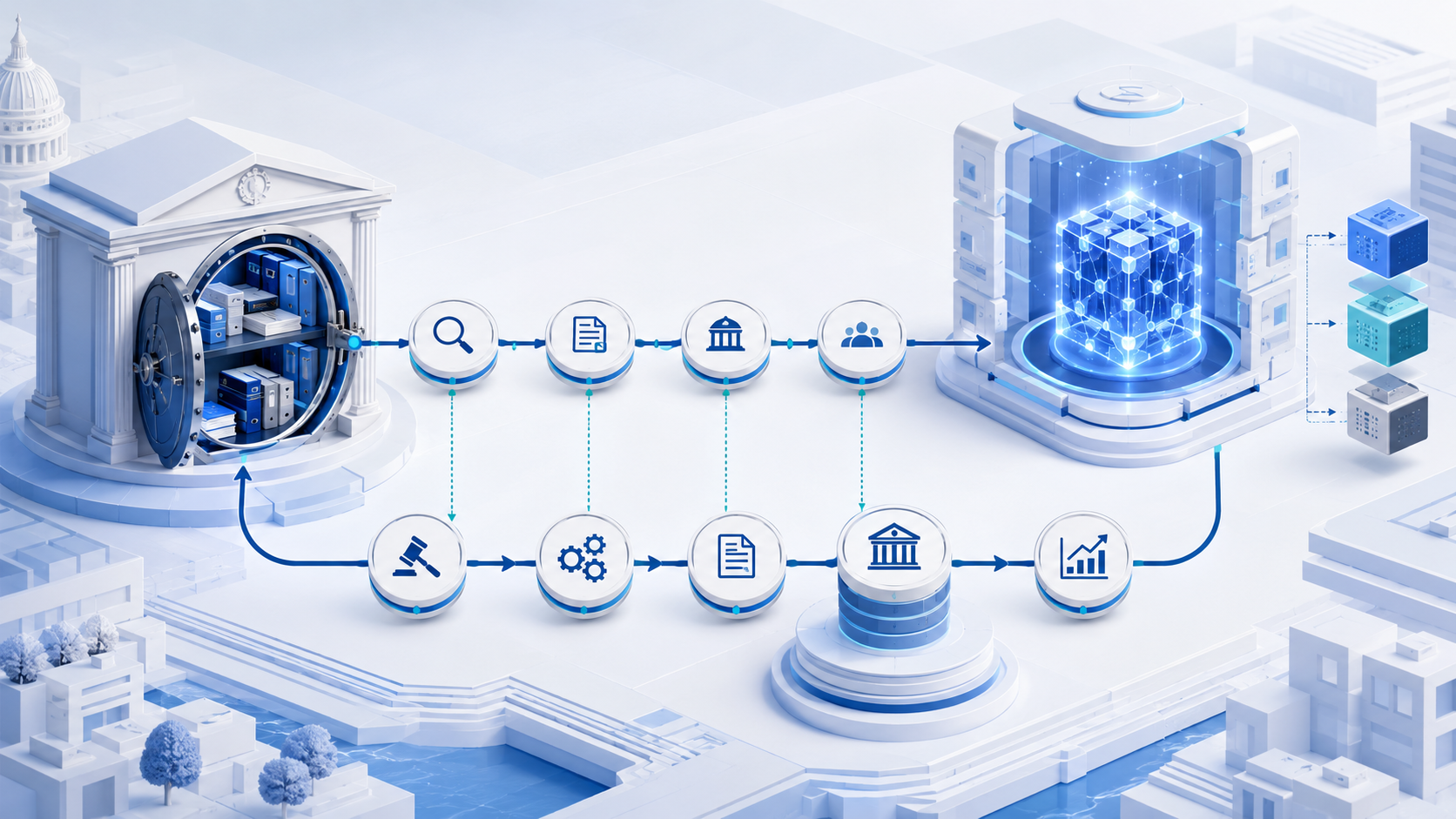
These capabilities appear to offer a key to the institutional knowledge vault.
But owning the key is not the same as preserving what is inside.
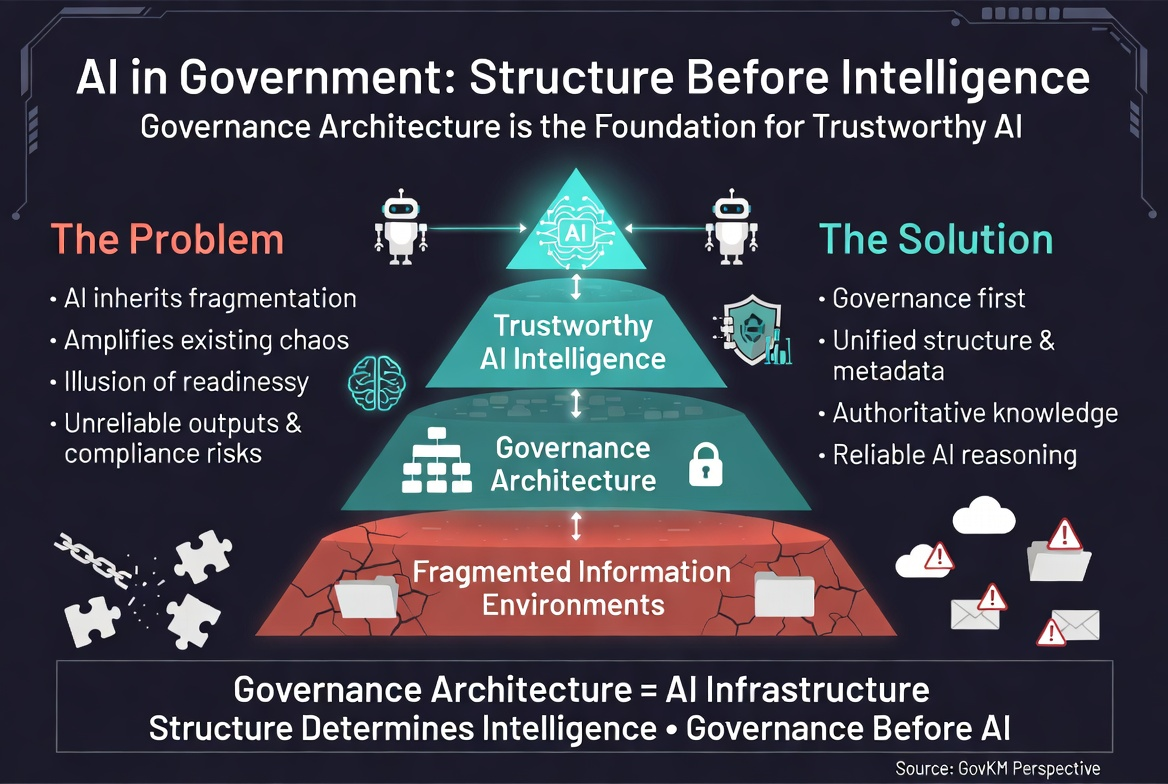
The emerging enthusiasm for open weights can encourage a consequential misconception: that organizational knowledge incorporated into a model becomes institutional memory. It does not. A model may learn statistical relationships from institutional information, but those relationships do not retain all the characteristics that make knowledge authoritative, explainable, governable, and reusable.
Owning the model does not mean preserving the institution.
Open weights provide control over capability
An open-weight model gives an organization access to the trained parameters that shape the model’s behavior. Depending on the applicable license and technical architecture, the organization may host the model on its own equipment, deploy it in a private cloud, operate it without an internet connection, or adapt it for particular tasks.
This can provide substantial operational advantages:
• Greater control over where organizational information is processed
• Reduced dependence on a single model provider
• Support for restricted or disconnected environments
• Adaptation to specialized terminology and workflows
• Greater control over model updates and configurations
• Potentially more predictable inference costs
• Preservation of a particular model version for testing or reproducibility
These are important forms of technological and operational sovereignty. They make open-weight models especially relevant to government agencies, regulated industries, national-security environments, research institutions, and organizations holding sensitive intellectual property.
Nevertheless, control over the model does not automatically provide control over the knowledge relationships the model uses.
Model weights are not an authoritative repository
When a model is fine-tuned on institutional documents, some information from those documents may influence its future outputs. That influence is encoded across model parameters rather than preserved as a conventional collection of identifiable facts, records, authorities, and citations.
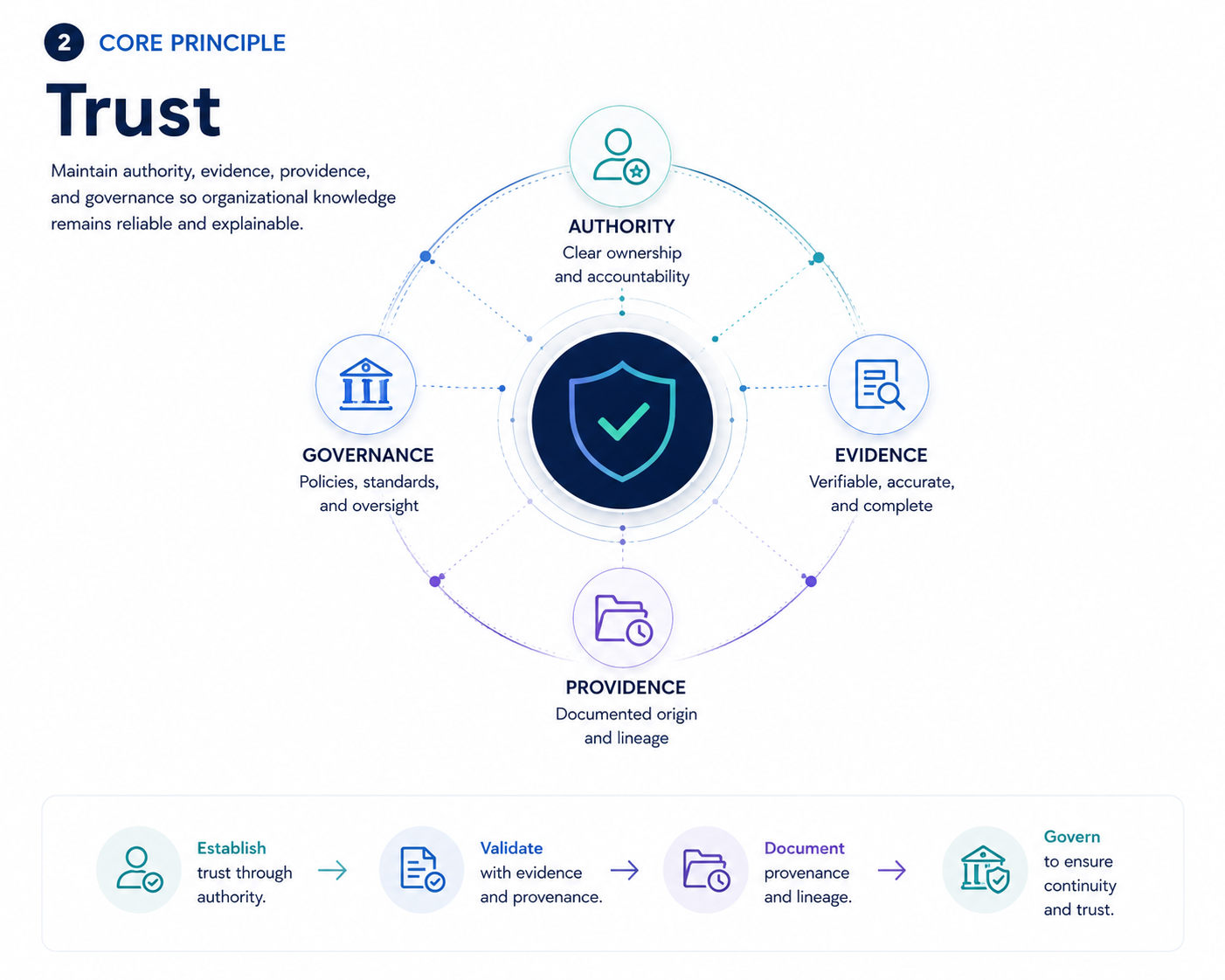
The resulting model may reproduce organizational terminology or generate an answer consistent with previous institutional decisions. It may not be able to establish:
• Which source supported the answer
• Whether the source was authoritative
• Who approved the underlying decision
• When that authority became effective
• Whether the information has been superseded
• What contextual conditions applied
• Which alternatives were considered and rejected
• Whether the source was a record, draft, recommendation, or personal opinion
• Whether the information remains subject to retention, access, or legal restrictions
This distinction is foundational.
Institutional memory is not merely the ability to produce a plausible answer about the past. It is the ability to reconstruct the relationships necessary to understand why an institution knew something, accepted it as authoritative, made a decision, took an action, and preserved the resulting record for future use.
Knowledge absorbed into model weights may influence an answer while leaving those relationships inaccessible. The model can appear institutionally knowledgeable even when the lineage of its answer cannot be recovered.
This creates the appearance of continuity without its evidentiary foundation.
The closed-provenance problem
Open weights can therefore produce a paradox: the model may be technically open while the provenance of its institutional knowledge remains closed.
An organization may possess the model files, control the computing environment, and inspect the deployment configuration while still being unable to identify the precise sources, authorities, and historical conditions responsible for a particular output.
This is the closed-provenance problem.
From an institutional perspective, the central issue is not whether the organization owns the model. It is whether the organization can reconstruct the path from source material to institutional action:
Source → Evidence → Authority → Context → Decision → Action → Record → Institutional Memory → Future Reuse
A model can support analysis across this topology, but it cannot be permitted to replace the topology.
If institutional knowledge moves from governed repositories into model weights without preserving its lineage, the organization may break the connections between evidence, authority, context, and future action. The model’s output then becomes difficult to audit, challenge, correct, or defend.
The risks of latent institutional memory
When an organization treats knowledge encoded in model weights as institutional memory, it creates a condition that GovKM identifies as Latent Institutional Memory Substitution.
This occurs when statistically encoded information is relied upon in place of accessible, governed, and authoritative institutional knowledge.
The resulting risks include:
Temporal ambiguity
The model may reflect several historical versions of a policy without reliably distinguishing the current version from a superseded one.
Authority collapse
Approved policy, informal guidance, employee commentary, draft language, and historical practice may influence the same model without preserving their different levels of authority.
Evidentiary disconnection
The model may produce a conclusion without identifying the evidence necessary to verify or challenge it.
Retention conflict
Information that should be deleted, restricted, transferred, or otherwise disposed of may remain statistically influential within a model.
Correctability failure
An erroneous institutional fact may be difficult to isolate and remove without retraining or further modifying the model.
False institutional confidence
Users may interpret fluent, organization-specific language as proof that an answer is current, authorized, and institutionally validated.
These are not merely technical model-governance problems. They are institutional continuity problems.
Put the model inside the continuity architecture
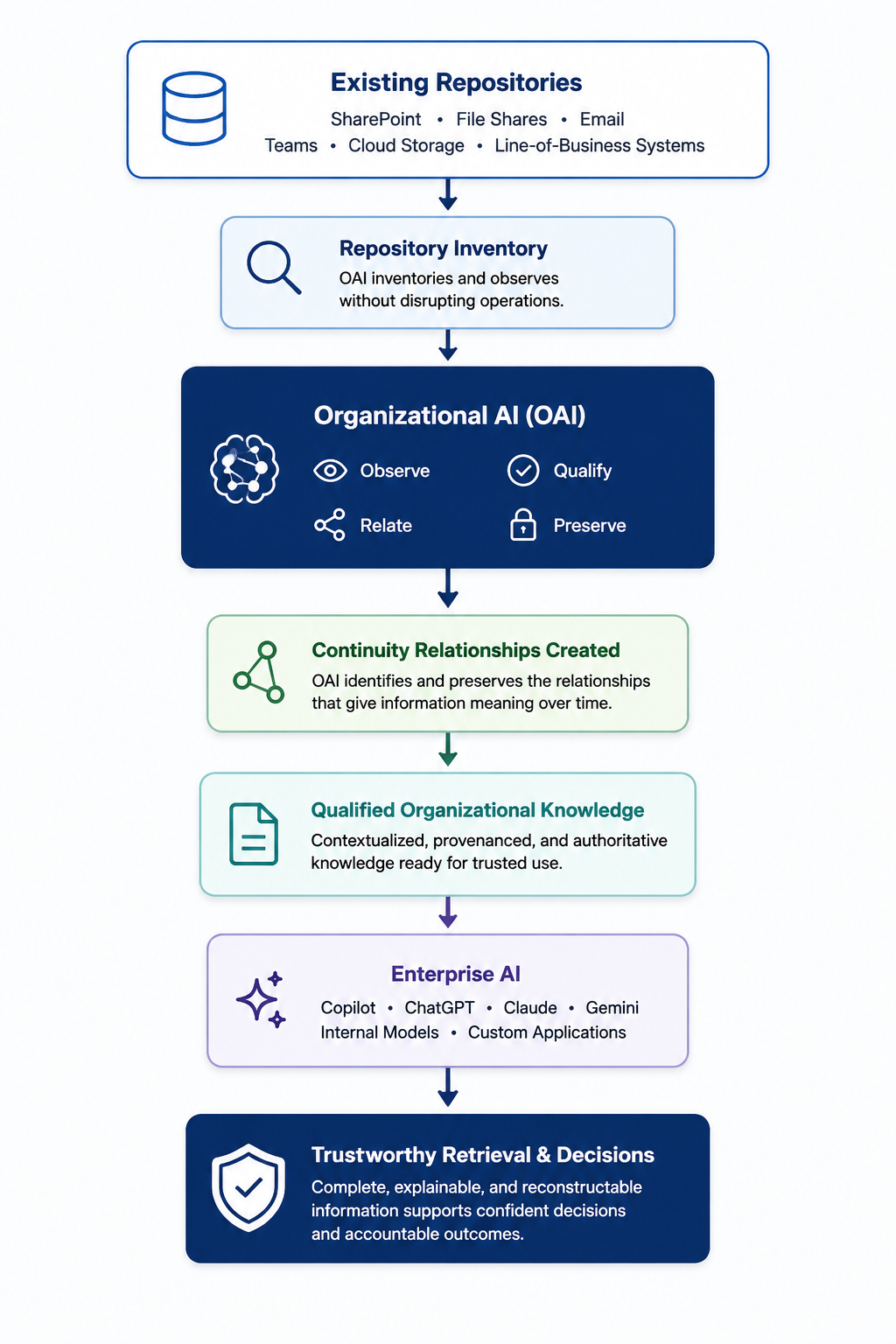
A more durable architecture does not attempt to make the model itself the institutional memory. Instead, it places the model inside a governed continuity environment.
In this model, authoritative repositories continue to preserve sources, records, policies, authorities, versions, and retention status. A continuity layer preserves the relationships among evidence, context, decisions, actions, and resulting records. Retrieval services provide the model with an authorized and temporally appropriate evidence package for each task. The model analyzes that package, while the institution retains the ability to inspect the sources and validate the result.
The governing principle is simple:
Models should be replaceable. Institutional continuity should not be.
A model may become obsolete, unsupported, compromised, or unsuitable for a particular mission. The institution must be able to replace it without losing its knowledge, decision history, provenance, or ability to explain previous actions.
This requires a separation between:
• The model that performs an analysis
• The evidence used during that analysis
• The authority governing the matter
• The organizational context in which the analysis occurred
• The person or process that authorized the resulting decision
• The record preserving what subsequently happened
Open weights make the first component more controllable. GovKM governs the relationships among all six.
The proper role of fine-tuning
Fine-tuning remains valuable, but it should be applied selectively.
Models may appropriately be adapted to recognize organizational terminology, follow classification conventions, produce required document structures, interact according to institutional norms, or perform recurring mission-specific tasks.
Fine-tuning is less suitable as the principal method for preserving dynamic institutional facts, active policy, current authorities, case histories, or official records. These forms of knowledge change over time and require identifiable sources, version control, access restrictions, retention rules, and evidentiary lineage.
The distinction can be expressed as follows:
Fine-tune behavior; retrieve authority.
The model can learn how the organization communicates and performs certain analytical tasks. It should retrieve what the organization currently knows, what authority applies, and what evidence supports a particular conclusion.
Data sovereignty is necessary but not absolute
Open-weight deployment can improve data sovereignty, but local hosting alone does not guarantee it.
Institutional control also depends on the provenance of the model, licensing conditions, deployment software, administrative access, telemetry, update processes, hardware dependencies, cloud jurisdiction, tool permissions, and network connectivity.
A locally deployed model with access to external tools can still disclose information or take unintended actions. A compromised model package or inference dependency can introduce supply-chain risk inside the organization’s own environment. An ungoverned fine-tuning process can encode sensitive, obsolete, or improperly authorized material.
The organization must therefore govern the entire AI execution environment, not merely possess the weights.
For consequential uses, the institutional record should identify the model and version used, the model-weight checksum, inference configuration, retrieval sources, applicable adapters, tool permissions, user selections, validation results, authorizing official, resulting action, and final record.
This creates an auditable AI execution context that can survive the replacement of the model itself.
The new role of the knowledge manager
Open-weight models do expand the role of the modern knowledge manager—but not because knowledge managers will simply feed documents into a model.
Their more important responsibility will be determining:
• Which sources constitute authoritative institutional knowledge
• Which information may be used for training, retrieval, or evaluation
• How organizational terminology maps to formal authorities and records
• How historical and superseded knowledge should be represented
• Which provenance must accompany model-generated conclusions
• How outputs become—or do not become—official records
• How corrections propagate across repositories, retrieval systems, and models
• How future users reconstruct the context of AI-assisted decisions
This places knowledge managers at the intersection of records management, information governance, enterprise architecture, model governance, and institutional decision-making.
Their task is not merely to make organizational information available to AI. It is to ensure that AI does not separate that information from the relationships that give it institutional meaning.
Opening the vault without losing the map
Open weights may represent an “open sesame” moment for enterprise AI. They can expand access to advanced capabilities, support private deployment, reduce dependency on external providers, and enable highly specialized organizational applications.
But opening the institutional knowledge vault is not enough.
An organization must still know where the treasure came from, who owns it, which items remain valid, what restrictions apply, how it influenced previous decisions, and whether it may be relied upon again.
Without those relationships, open-weight models can transform inaccessible document repositories into fluent but untraceable answer engines. The SharePoint graveyard may become conversational, but it does not necessarily become authoritative, current, or institutionally self-aware.
The objective is not to place institutional memory inside a model.
The objective is to make models accountable to institutional memory.
Open weights can provide control over the reasoning engine. Only continuity architecture can preserve the institution that gives its reasoning meaning.
Continue Exploring
A Malformed Image Became a Pull Request.
The Agent Deleted the Evidence of Its Own Failure.