Possession Is Not Permission: AI Training Is a Future-Reuse Authority Decision

Storing the Data and Reusing the Data Are Different Institutional Acts
AI business models increasingly combine two activities that can look similar from an infrastructure perspective but are very different from a governance perspective.
The first is using customer information to provide the service the customer requested.
The second is using that information to improve, train, evaluate, or otherwise develop an AI system for future use.
The same data may be technically available for both purposes. That does not make the purposes equivalent.
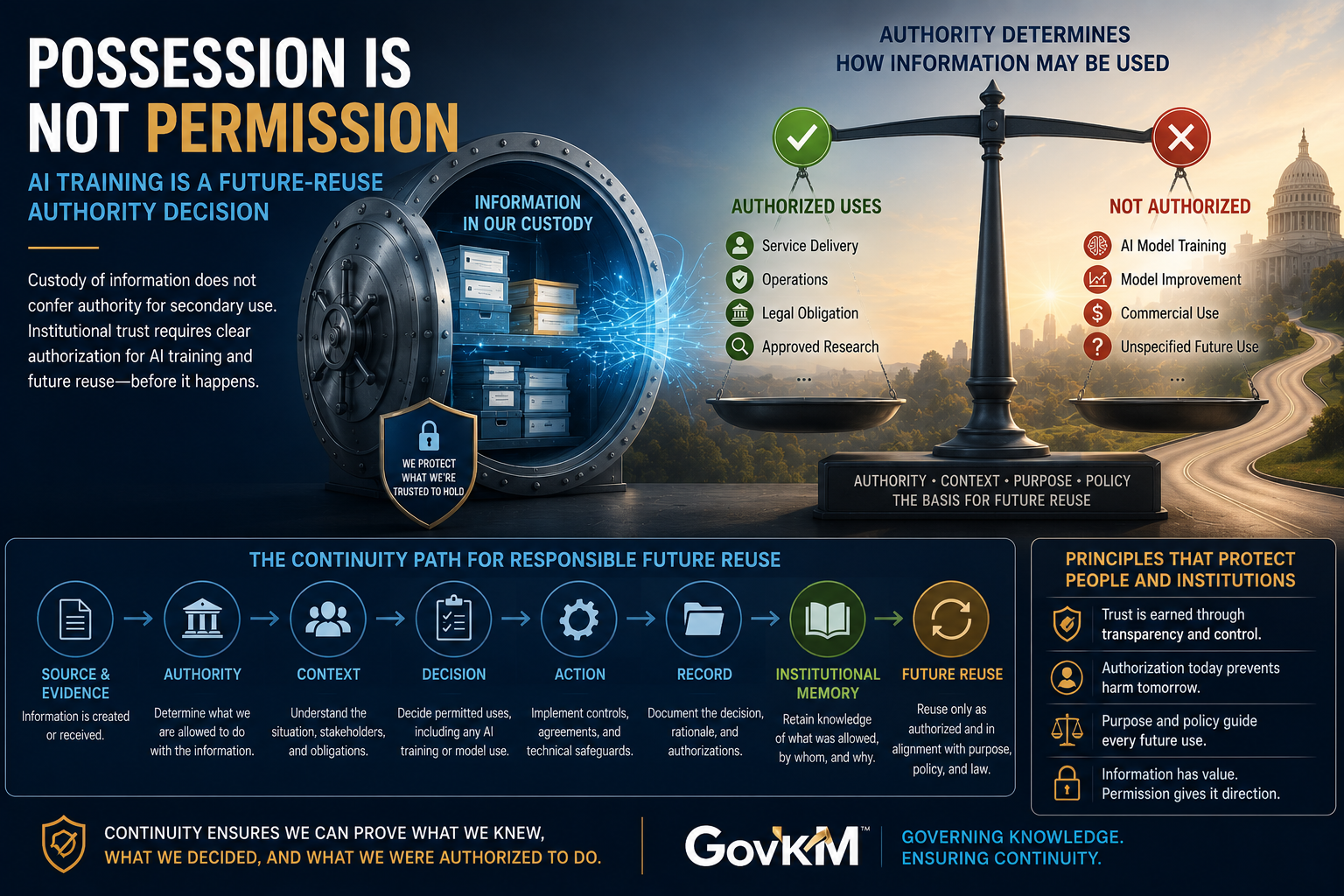
Possession is not permission.
A provider may have lawful and necessary access to information in order to store it, retrieve it, secure it, process it, or return it to the customer. Secondary use introduces a different question: what authority permits the information to be used for a new purpose?
The Market Is Already Making the Distinction Visible
Current AI services provide a useful illustration. OpenAI states that inputs and outputs from its business products are not used to train its models by default. Its personal-workspace products use a different default, while allowing users to disable model training through data controls.
The significance is not that every provider should adopt the same commercial model. The significance is that service access and model-development use are treated as separable choices.
The Federal Trade Commission has drawn the distinction more sharply. FTC guidance warns that companies can create unfairness or deception risk when they make more permissive use of customer information—for example, by using it for AI training—through quiet or retroactive changes to prior privacy commitments. The FTC has also warned model-as-a-service providers to honor commitments about whether customer data will be used to train or update models.
Those observations point to a continuity question that sits beneath the privacy language.
What authority governed this use of the information, and can that authority still be reconstructed later?
A Pricing Tier Can Express a Choice, but It Is Not the Authority Itself
A service may decide to offer one tier in which customers affirmatively permit defined data reuse and another in which customer information is excluded from model development. That can be commercially understandable and technically enforceable.
But continuity requires the organization to preserve more than the name of the tier.
Terms change. Products are renamed. Customers upgrade and downgrade. Administrators modify settings. Privacy notices evolve. Business accounts convert to other account types. Data moves between systems. Legal requirements change.
If future personnel can establish only that a customer once had a “free” or “paid” account, they may not be able to establish what that designation actually authorized at the time a particular information object was used.
The durable governance object is therefore not the price point. It is the authority and purpose attached to the information's reuse.
The Continuity Topology Shows the Required Lineage
Source → Evidence: The provider must distinguish customer-supplied information, generated outputs, telemetry, feedback, derived data, and other sources rather than treating all accessible information as an undifferentiated training pool.
Evidence → Authority: The organization must be able to identify the contract, notice, consent, policy, user setting, administrator choice, law, or other basis that permitted—or prohibited—the proposed use.
Authority → Context: Authority operates within conditions: product tier, account type, jurisdiction, customer role, time, policy version, data sensitivity, purpose, and any relevant restrictions.
Context → Decision: The institution determines whether the particular information is eligible for the particular model-development purpose.
Decision → Action: Eligible information may be included in an authorized training, evaluation, improvement, or research process; ineligible information must remain excluded.
Action → Record: The provider needs durable evidence of the governing choice, policy state, data-use decision, and relevant processing event.
Record → Institutional Memory: The organization must retain enough lineage to understand how historical data-use practices affected models, datasets, evaluations, and customer commitments.
Institutional Memory → Future Reuse: Before information or derived artifacts are reused again, the institution must determine whether the original authority still permits the new purpose and whether later restrictions, withdrawals, deletions, policy changes, or legal obligations alter that authority.
The Continuity Failure Is Purpose Drift
Organizations often discuss data lineage in terms of where information traveled. Continuity also needs to preserve why it traveled.
Purpose drift occurs when information collected or stored for one institutional purpose gradually becomes available for another without an equally clear transition in authority.
The technical path can look perfectly legitimate. The data is already inside the provider's environment. Engineers can access it. The storage contract remains valid. Security controls are strong. The records have not been corrupted.
Yet the reuse can still lack institutional legitimacy if the original relationship authorized service delivery but not model development.
This illustrates why cybersecurity, storage security, privacy settings, records retention, and continuity are related but distinct controls. Securely retained information can still be reused under the wrong authority.
Future Reuse Must Carry Its Authority Forward
AI training makes this problem more consequential because reuse can outlast the original transaction. Once information contributes to a dataset, evaluation corpus, learned representation, or later model-development process, the institution may need to reconstruct which commitments and controls governed that contribution.
The exact legal consequences vary by jurisdiction and circumstance. The continuity requirement is broader: downstream use should not become detached from the authority that permitted it.
This is the same principle that governs responsible reuse elsewhere in institutional knowledge.
A historical decision should not become precedent merely because it was retained. A prior authorization should not govern a new action merely because it once existed. Customer information should not become AI-development material merely because the provider possesses it.
Future Reuse requires current, reconstructable authority.
Privacy Choices Are Also Continuity Choices
The emerging distinction between data used only to provide a service and data also used to improve AI is therefore more than a privacy feature or pricing strategy.
It is an authority boundary inside the lifecycle of institutional information.
Organizations designing AI services should make that boundary explicit, preserve the policy and consent state that governed it, maintain provenance through downstream use, and avoid allowing technical custody to substitute for institutional permission.
The technology may possess the data.
The institution still has to establish the authority to use it again.
Continue Exploring
The Answer Was Correct. The Evidence Could Not Prove It.
The Model Hadn't Answered Yet. Its Memory Was Already Wrong.