Research Databases Need Continuity, Not Just Records
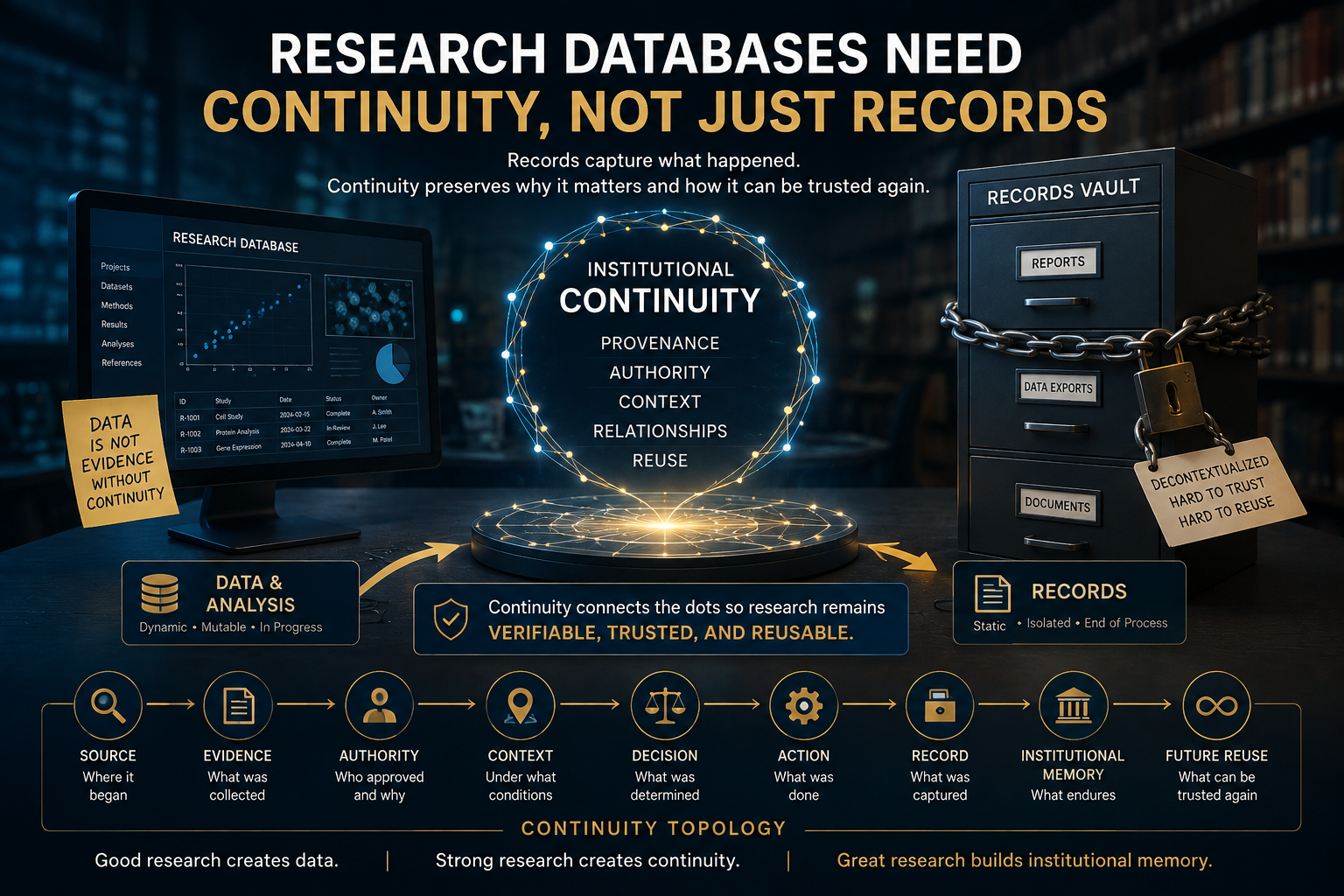

Research programs often treat the database as the evidence base.
If every incident has an identifier, every source has a citation, and every finding can be searched, the research appears durable. But a collection of well-structured records can still lose the institutional relationships that make the research defensible.
A source can remain in the database after the claim it supported has changed. A citation can survive after the underlying page is corrected or removed. An incident summary can remain while later verification changes its meaning. A pattern can accumulate examples without preserving which observations actually established it. A white paper can cite a finding without retaining the analytical path that connected the original evidence to the published conclusion.
The database still contains records. The research continuity has weakened.
The Evidence Base Is a Relationship System
A durable research program needs more than stored findings. It needs to preserve how findings became trustworthy enough to influence institutional judgment.
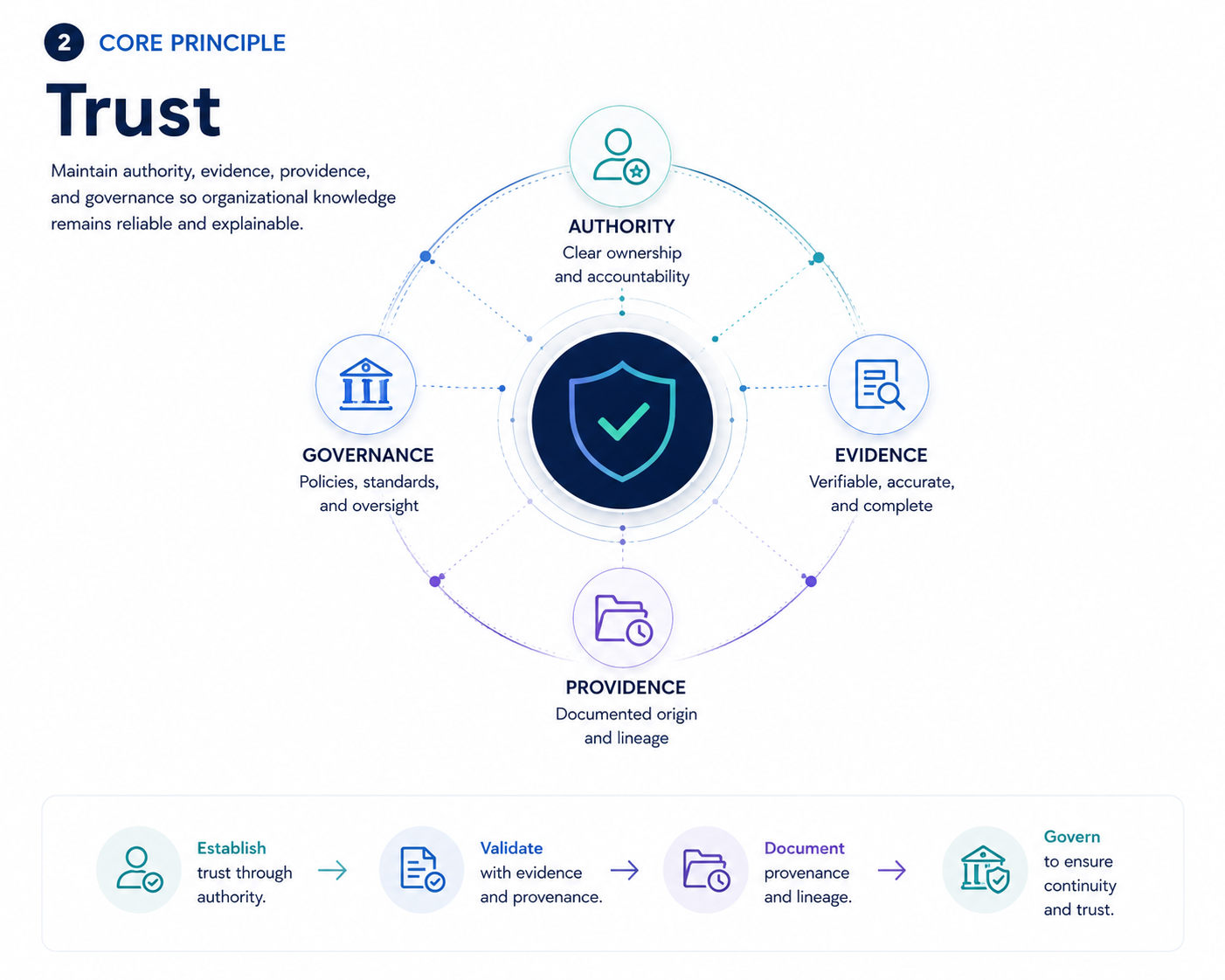
This is a provenance problem, but provenance alone is not the whole problem. The World Wide Web Consortium's PROV standards provide a useful external reference point. PROV-DM describes provenance through relationships among entities, activities, and agents, including derivation and responsibility. PROV-O provides a machine-readable ontology for representing and exchanging those relationships across systems and contexts.
That matters because research is not simply a set of documents. It is a sequence of institutional transformations: a source is discovered, material is evaluated as evidence, authority and limitations are established, context is applied, an interpretation is formed, a publication decision is made, a record is created, and the resulting knowledge may later be reused.
GovKM represents that path through the Continuity Topology:
Source → Evidence → Authority → Context → Decision → Action → Record → Institutional Memory → Future Reuse.
Applied to research, the topology makes a simple point visible: a citation is not the end of the evidence chain. It is one relationship inside it.
Source and Evidence Must Remain Distinct
A research database should preserve the difference between finding a source and accepting something from that source as evidence.
The distinction matters when a publication contains several claims, when only part of a report supports an observation, when a source is later corrected, or when an apparently authoritative source proves irrelevant to the question being studied.
A durable evidence record therefore needs to preserve what the source establishes, what it does not establish, which incident or pattern it supports, and how its limitations were evaluated.
This is also why a bibliography cannot substitute for evidence lineage. A bibliography tells a future reader what was consulted. It does not necessarily tell the reader which source supported which assertion, what version was reviewed, what evidence was accepted, or how contradictory material was resolved.
Verification Is a State That Can Change
Research often creates the appearance of finality too early. A source is verified once, a summary is written, and the record begins to circulate as established knowledge.
But verification has a lifecycle. Government reports are updated. Litigation changes the interpretation of earlier events. Organizations issue corrections. AI programs described as successful pilots may later be reduced or abandoned. URLs disappear. New audits expose facts that were unavailable when an incident was first recorded.
Continuity therefore requires the research system to preserve not only the current finding, but also enough revision lineage to explain how the finding changed.
The relevant question is not merely, “What does the database say now?”
It is, “What evidence was available when this conclusion was accepted, what changed afterward, and which conclusion now governs future reuse?”
That is reconstructability applied to research.
Patterns Need Lineage Back to Incidents
Pattern recognition is one of the most valuable outputs of a longitudinal research program. Repeated incidents can reveal a recurring weakness that no individual case makes obvious.
But the pattern itself can become another detached knowledge object.
A mature pattern register should remain connected to the observations that generated it, the references supporting those observations, the sectors in which it recurred, the dates on which it was observed, and the conditions under which the pattern was revised, strengthened, qualified, or rejected.
Otherwise the institution may remember the lesson while forgetting why it believes the lesson is true.
This is a subtle form of institutional memory failure. The conclusion survives. Its evidentiary ancestry does not.
Rollbacks Are Research Evidence, Not Just Project News
The same continuity requirement applies to failed, delayed, suspended, or abandoned AI deployments.
A rollback is often recorded as an outcome: the pilot ended, the deployment paused, the feature was withdrawn. For continuity research, that is only the beginning.
The durable research object should preserve what was attempted, which evidence supported the initiative, which authority approved it, what operating context applied, why the organization changed course, what evidence supported the later decision, what action followed, and whether the resulting lesson influenced future work.
Without that lineage, a rollback register becomes a list of failures. With it, the register becomes institutional memory about how organizations discover and respond to continuity weaknesses.
Positive Practices Need the Same Evidentiary Standard
Research programs can overlearn from failure. A system that records only visible breakdowns may miss organizations that prevented the same failure through stronger authority lineage, verification, provenance, lifecycle controls, reconstruction capability, or operational governance.
Positive practices should therefore be captured with the same discipline as incidents: what risk existed, what control preserved the relevant relationship, what evidence demonstrates that the control operated, and what remains uncertain about its effectiveness or transferability.
This matters because an institution cannot build doctrine from anecdotes alone. It needs a research memory capable of distinguishing observed failure, inferred pattern, tested control, and unresolved hypothesis.
Publication Should Be Reconstructable Back to Evidence
The strongest test of a research database comes when its contents are reused.
Imagine a future government white paper asserting that authority-lineage failures recur across AI deployments. A defensible evidence base should allow an authorized researcher to move backward from that sentence to the pattern record, from the pattern to the contributing incidents, from each incident to its supporting references, and from each reference to the exact evidence and verification state that justified inclusion.
That path should also work forward. If a primary source is corrected or an incident is reclassified, the research program should be able to identify which patterns, articles, briefs, and white-paper claims may require review.
This is where structured research becomes continuity architecture rather than recordkeeping alone.
AI Increases the Need for Research Continuity
AI can accelerate discovery, classification, summarization, comparison, and drafting across a large evidence base. Those capabilities make the research system more powerful, but they also increase the consequences of detached lineage.
NIST's Generative AI Profile identifies content provenance as a risk-management concern and describes provenance data tracking as a way to trace the origin and history of content. It also recommends documenting provenance limitations. That is an important baseline for AI-generated and AI-processed information.
For institutional research, the requirement extends further. A future AI system should not merely know where a research object originated. It should be able to distinguish source-derived fact from independent verification, institutional interpretation, inference, uncertainty, supersession, and publication authority.
The goal is not to make AI the authority over the evidence base. The goal is to preserve enough continuity that AI and human researchers can work from the same reconstructable institutional memory.
The Database Should Embody the Discipline It Studies
A research program devoted to Institutional Continuity cannot treat its own evidence as disconnected artifacts.
Its identifiers should remain stable. Its references should preserve provenance. Its observations should remain connected to patterns. Its revisions should be visible. Its publication decisions should be traceable. Its conclusions should be distinguishable from source facts. Its current state should not erase the historical path by which that state was reached.
That does not require every research system to use the same software or schema. It requires the relationships necessary for reconstruction to survive changes in tools, people, publications, and time.
A research database becomes an institutional evidence base when it preserves not only what the organization concluded, but the continuity of how the evidence became knowledge.
That is the difference between storing research and preserving research continuity.
Sources
Luc Moreau and Paolo Missier, eds., PROV-DM: The PROV Data Model, W3C Recommendation, April 30, 2013. W3C PROV-DM.
Timothy Lebo, Satya Sahoo, and Deborah McGuinness, eds., PROV-O: The PROV Ontology, W3C Recommendation, April 30, 2013. W3C PROV-O.
Chloe Autio et al., Artificial Intelligence Risk Management Framework: Generative Artificial Intelligence Profile, NIST AI 600-1, July 26, 2024. NIST AI 600-1 Generative AI Profile.
Continue Exploring
The Answer Was Correct. The Evidence Could Not Prove It.
The Model Hadn't Answered Yet. Its Memory Was Already Wrong.