Retail AI Needs More Than Business Context
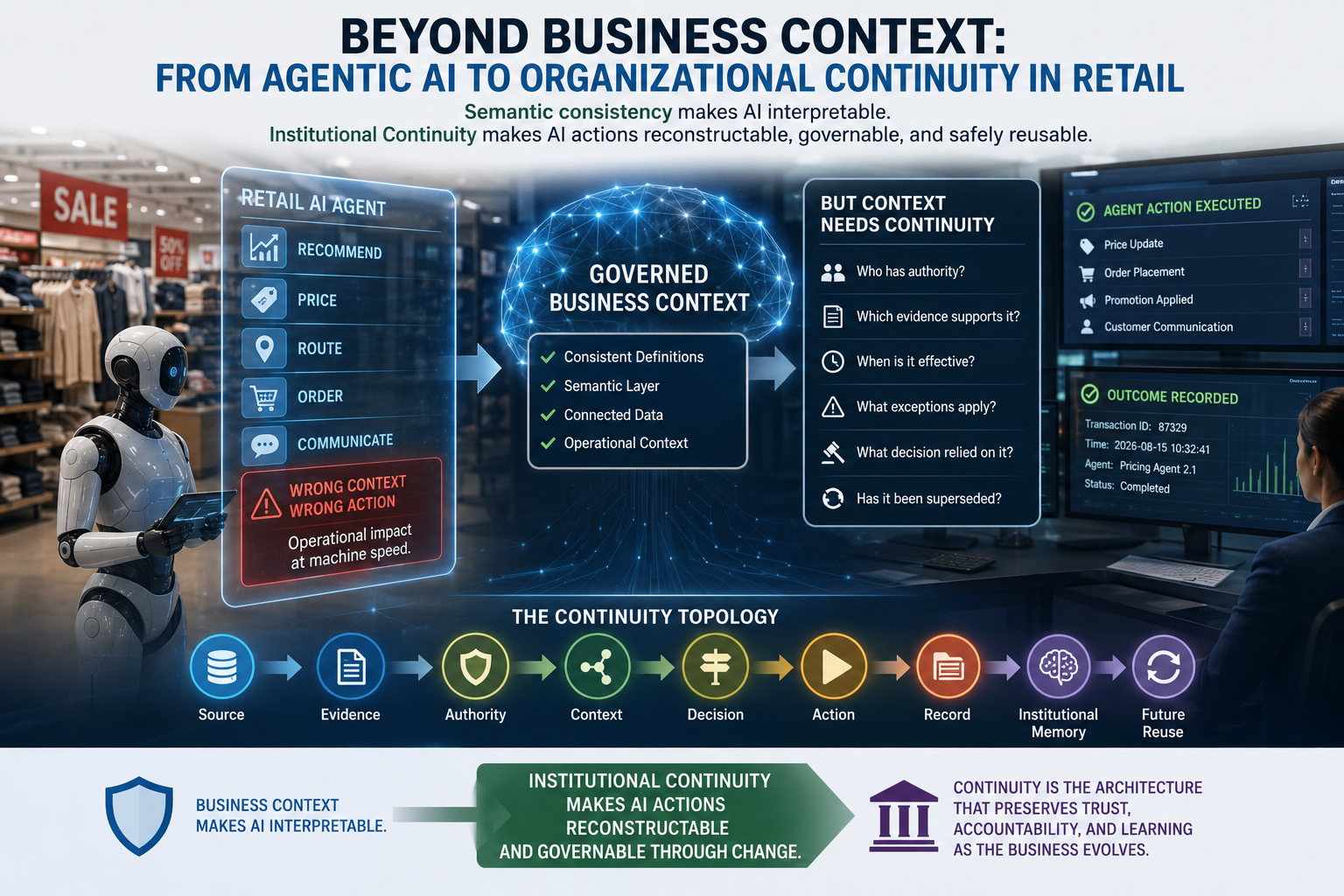

Retail is one of the environments where agentic AI can turn an information problem into an operational consequence almost immediately. An agent that misunderstands inventory, margin, promotion rules, fulfillment constraints, or customer policy does not merely produce a poor answer. It can recommend, price, route, order, or communicate incorrectly at machine speed.
AtScale's discussion of autonomous commerce identifies governed business context as the missing foundation. Its argument is that AI agents need consistent definitions and semantic context across operational systems before retailers should trust them to act.
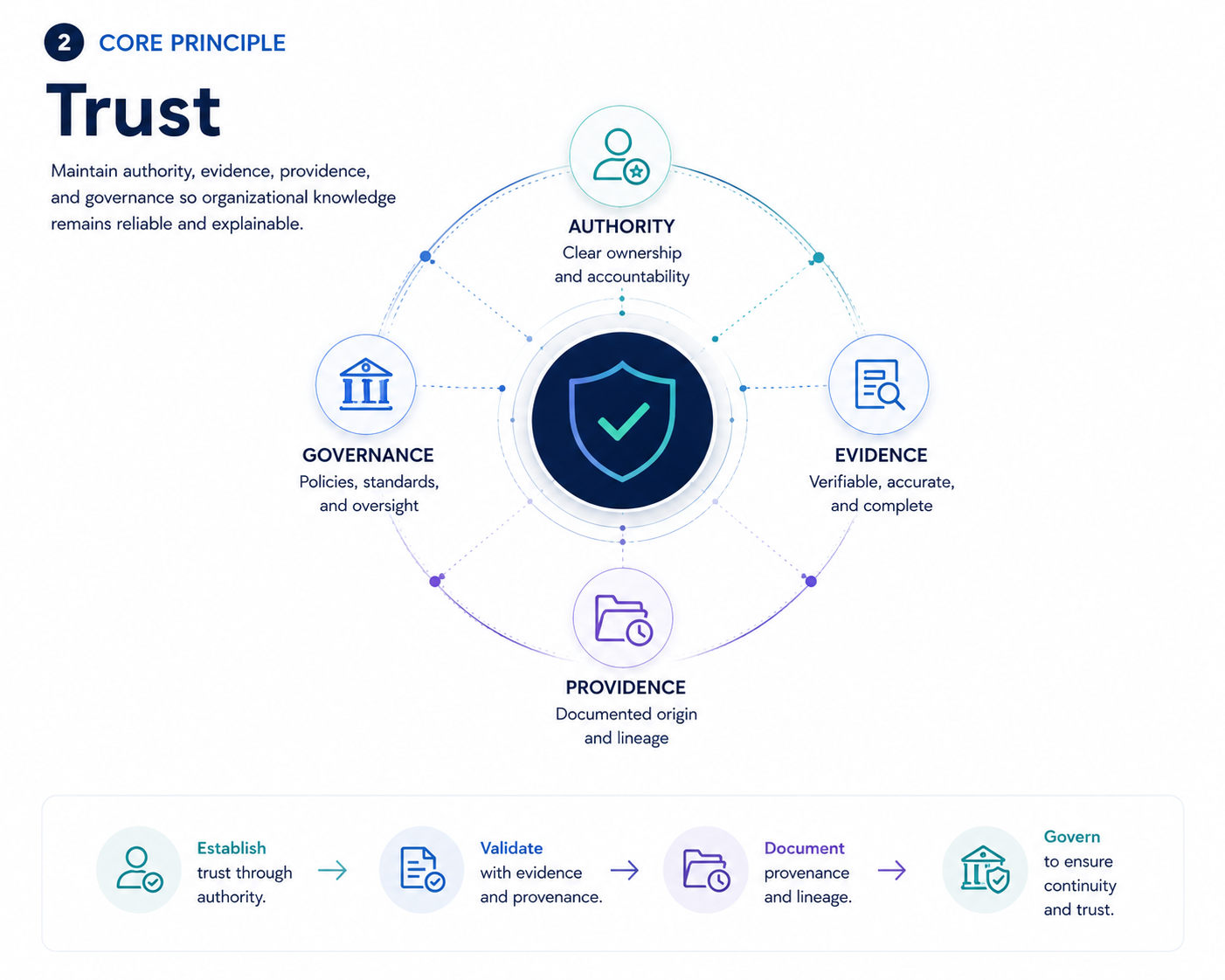
That diagnosis is important. But business context is not the endpoint of trustworthy retail AI. It is one continuity element inside a larger institutional chain.
Semantic Consistency Solves a Real Problem
Retail organizations frequently operate across point-of-sale platforms, inventory systems, warehouses, finance tools, merchandising applications, customer systems, and external marketplaces. The same business term can carry different operational meanings across those environments.
A semantic layer can reduce that ambiguity. It can establish governed definitions, connect data to business concepts, and give AI agents a more coherent interpretation of the enterprise. For autonomous systems, that is substantially better than allowing each agent to infer meaning independently from fragmented sources.
Yet semantic consistency answers primarily what a term means. Institutional action also requires answers to who controls the definition, which evidence supports it, when it became effective, what exception applies, what decision relied on it, and whether the definition remains valid after the business changes.
Context Without Authority Can Still Produce the Wrong Action
Consider a pricing rule. An AI agent may correctly understand the business meaning of margin, promotion, geography, inventory position, and customer segment. But if it cannot establish which policy is authoritative, whether an exception was approved, or whether a new rule superseded the old one, it can act from coherent but obsolete context.
The same problem appears in fulfillment. An agent can understand inventory terminology while relying on a source whose operational status is no longer authoritative. It can understand a return policy while missing a regional exception. It can reproduce a prior merchandising decision without knowing whether the conditions that justified it still exist.
This is why context and semantics need continuity with evidence and authority.
The Retail Decision Path Is a Continuity Path
GovKM represents this relationship through the Continuity Topology: Source → Evidence → Authority → Context → Decision → Action → Record → Institutional Memory → Future Reuse.
Retail AI often concentrates on the first four elements. Data platforms provide sources. Data quality and lineage strengthen evidence. Governance establishes portions of authority. Semantic layers create context.
Agentic commerce then crosses a threshold: the system decides and acts.
At that point, the institution must preserve what the agent relied on, which rules governed the decision, what action was executed, what record was created, and how the result should influence future behavior. Without those relationships, a retailer can have excellent business context and still be unable to reconstruct why an autonomous action occurred.
Retail Context Changes Continuously
The continuity challenge is particularly visible in retail because the operating environment changes rapidly. Prices change. Promotions expire. inventory shifts. suppliers change. fulfillment capacity moves. product information is corrected. customer policies evolve. regional requirements differ. business definitions themselves may be revised.
An AI agent therefore needs more than access to today's context. The institution needs a way to distinguish current context from superseded context and to preserve the lineage connecting changes to the decisions they affect.
Otherwise the same architecture designed to create consistency can institutionalize stale assumptions.
From Governed Context to Organizational Continuity
GovKM agrees with the proposition that autonomous AI should not operate against fragmented, semantically inconsistent business information. Governed context is a prerequisite for reliable agent behavior.
GovKM extends that proposition by asking what happens after the agent understands the context. Who or what possesses authority to act? Which evidence was accepted? What decision occurred? What transaction or communication followed? What durable record preserves the outcome? What should the organization learn, and under what future conditions may that learning be reused?
Business context makes an AI decision interpretable. Institutional Continuity makes the decision reconstructable and governable through change.
That distinction applies far beyond retail. Any industry moving from AI that retrieves information to AI that executes work will encounter the same requirement. Semantic consistency is necessary. The enduring institutional capability is preserving the relationships that allow context to remain authoritative, actionable, and safely reusable as the organization evolves.
Continue Exploring
The Answer Was Correct. The Evidence Could Not Prove It.
The Model Hadn't Answered Yet. Its Memory Was Already Wrong.