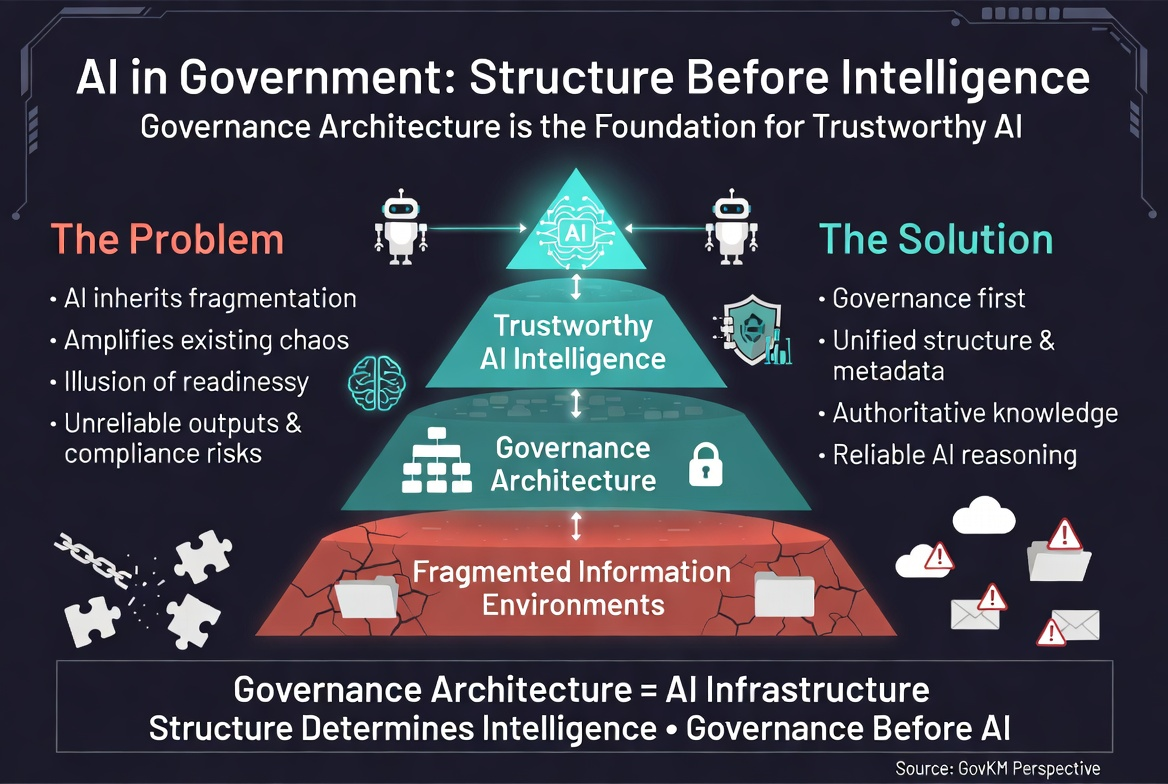
The End of File Management: Why Governance Architecture Must Replace Shared Drives
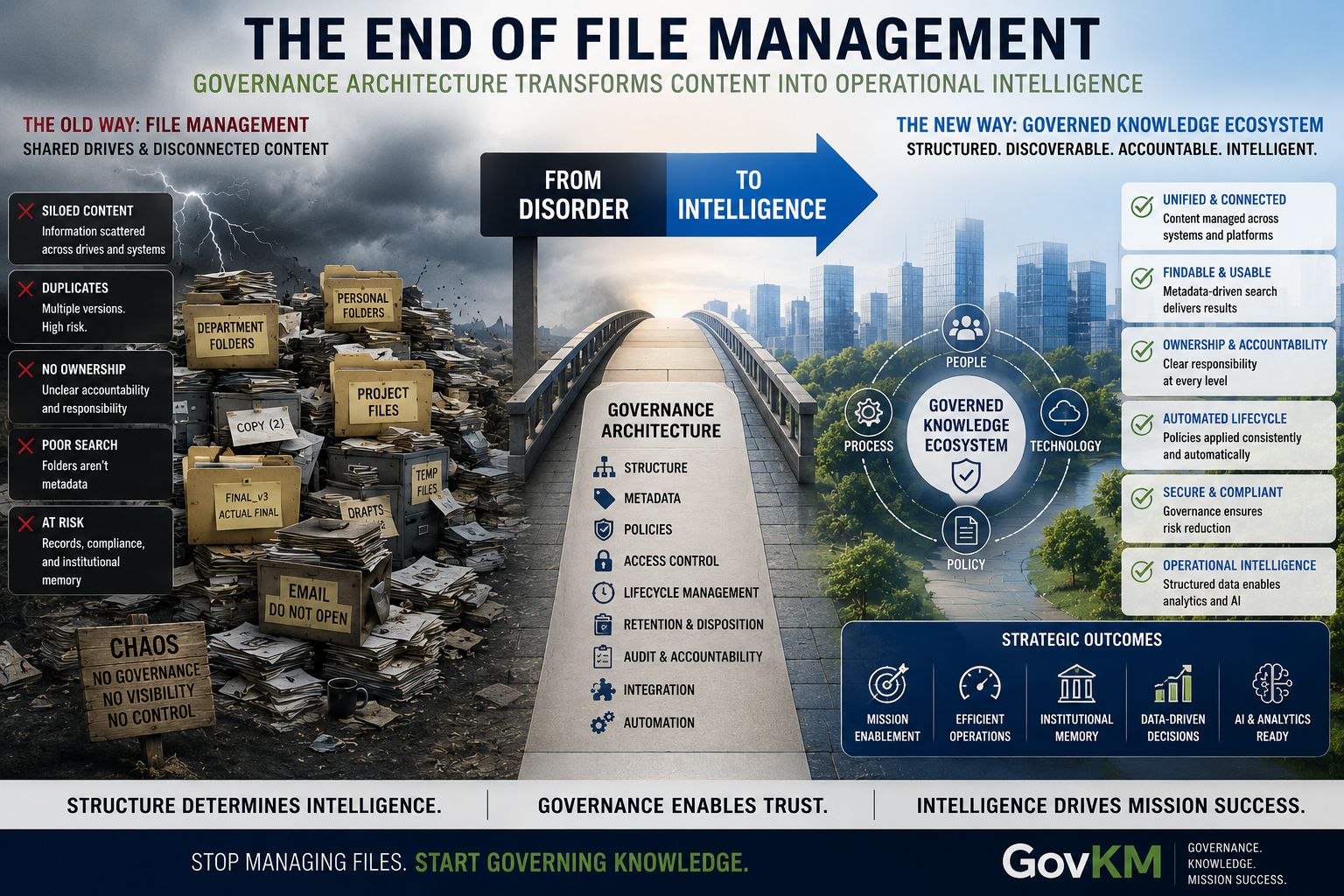

For decades, government organizations built their digital environments around a simple concept: storing files.
Shared drives expanded office by office, department by department, and eventually agency by agency. Folder structures became organizational maps. Employees created their own storage paradigms based on what made sense to them locally, often with little consideration for enterprise discoverability, interoperability, records accountability, or long-term operational value.
At the time, this approach appeared reasonable.
The enterprise world was still operating in the era of file management.
But that era is ending.
Modern government organizations no longer operate within centralized information environments. Enterprise knowledge now exists across collaboration platforms, cloud systems, messaging environments, mobile devices, SaaS ecosystems, mission applications, and distributed operational networks. The scale, complexity, and operational dependency on information have outgrown the capabilities of traditional file-based management models.
The problem is not merely that shared drives are outdated.
The problem is that file-based thinking cannot support modern organizational intelligence.
Mission Systems Already Demonstrated the Solution
Ironically, government agencies already solved this problem decades ago inside mission systems.
Across government, specialized mission and business systems were built to manage highly structured operational content. Financial systems govern budget execution. Acquisition systems manage procurement lifecycles. Personnel systems track workforce data. Security systems monitor access events. Mission platforms manage investigations, operations, intelligence, logistics, diplomacy, and countless agency-specific activities.
These systems succeed because governance architecture exists before content enters the environment.
The structure is predefined.
The metadata is governed.
The relationships are understood.
The permissions are contextual.
The lifecycle is controlled.
The content is machine-readable.
Most importantly, the information inside these systems becomes operationally usable.
Search works.
Reporting works.
Analytics work.
Auditability exists.
Accountability exists.
The enterprise already proved that governed information ecosystems function at scale.
The problem emerges everywhere outside those systems.
The Unmanaged Enterprise Content Reality
Most enterprise content does not originate inside structured mission applications.
Knowledge workers generate operational documents continuously:
- reports,
- presentations,
- action plans,
- briefings,
- meeting records,
- policies,
- spreadsheets,
- analyses,
- collaborative drafts,
- strategic planning materials,
- operational updates,
- and thousands of other forms of organizational knowledge.
Historically, this content was stored wherever users found most convenient:
- shared drives,
- email folders,
- desktop storage,
- collaboration spaces,
- personal repositories,
- temporary project folders,
- disconnected content management sites.
Over time, these environments evolved into sprawling repositories of unmanaged enterprise knowledge.
In many organizations:
- duplicate documents exist across multiple platforms,
- abandoned drafts accumulate indefinitely,
- folder structures become surrogate metadata systems,
- ownership becomes unclear,
- search becomes unreliable,
- records accountability becomes fragmented,
- institutional knowledge becomes difficult to preserve.
The operational problem is not storage capacity.
It is the absence of governance architecture.
Folder Structures Were Never Designed for Organizational Intelligence
Shared drives were built for storage convenience, not enterprise cognition.
Folders cannot:
- enforce structured governance,
- understand contextual relationships,
- maintain authoritative metadata,
- automate lifecycle management,
- provide meaningful analytics,
- support AI-driven discovery,
- establish enterprise accountability,
- or preserve institutional knowledge at scale.
As organizations grew more complex, users compensated by building increasingly elaborate folder hierarchies.
Folders inside folders inside folders became attempts to manually simulate governance architecture.
But human-generated organizational structures are inherently inconsistent.
One office structures content by year.
Another by project.
Another by customer.
Another by employee.
Another by mission area.
Another by whatever made sense during a crisis five years earlier.
The result is not enterprise knowledge management.
It is fragmented local survivability.
This distinction matters because modern organizations are no longer trying to simply store information.
They are trying to operationalize intelligence.
Governance Architecture Is the Missing Layer
The future of enterprise knowledge management is not defined by where content is stored.
It is defined by how content is governed.
Governance architecture transforms disconnected content into operationally usable enterprise knowledge by establishing:
- authoritative structure,
- governed metadata,
- contextual relationships,
- lifecycle automation,
- security inheritance,
- records accountability,
- discoverability,
- interoperability,
- and machine-readability.
This is the transition from file management to governed knowledge ecosystems.
In a governed environment:
- content is no longer dependent on folder paths for meaning,
- permissions become policy-driven,
- retention becomes automated,
- search becomes contextually intelligent,
- duplication becomes manageable,
- organizational knowledge becomes preservable,
- and enterprise systems become analyzable.
Most importantly, governance architecture creates the conditions necessary for artificial intelligence and advanced analytics to function reliably.
AI cannot reason effectively against fragmented, duplicated, unstructured repositories lacking authoritative governance.
Structure determines intelligence.
The Shared Drive Is Becoming Transitional Infrastructure
This does not mean shared drives disappear overnight.
Shared drives still serve important purposes:
- temporary collaboration,
- transfer staging,
- system interoperability,
- operational continuity,
- and legacy records storage.
But they can no longer remain the primary operational knowledge environment of the enterprise.
Organizations attempting to modernize through new tools alone will continue failing if governance architecture does not exist beneath those tools.
Replacing one platform with another does not solve fragmented governance.
Migrating chaos simply relocates chaos.
The future enterprise requires governance that transcends platforms entirely.
The Real Transformation Ahead
The next era of government modernization will not be defined primarily by software procurement.
It will be defined by the transition from unmanaged storage environments to governed knowledge ecosystems.
This shift changes how organizations think about information itself.
Information is no longer simply a collection of files.
It is operational infrastructure.
It is organizational memory.
It is machine-readable intelligence.
It is the foundation upon which:
- enterprise search,
- analytics,
- automation,
- AI,
- compliance,
- mission execution,
- and institutional continuity now depend.
The organizations that succeed will not be the ones that accumulate the most data.
They will be the ones that govern it structurally.
Because the future of enterprise knowledge is not about managing files.
It is about enabling intelligence.
Continue Exploring
The Agent Was Asked to Fix the App. It Changed the Model.
The Government Email Was Real. The Authority Wasn’t.