The Myth of the Records Management Problem: Government Already Solved It

For decades, agencies have approached records management as if the challenge were technological. Entire modernization efforts have been launched to “solve” automated retention, disposition, metadata assignment, and compliance tracking. Yet the uncomfortable reality is this:
The federal government already solved automated records management years ago.
The problem was never the technology.
The problem is that agencies attempted to apply records governance to environments that were never architected for governance in the first place.
Enterprise Systems Already Automate Records
Inside structured enterprise systems, records management works extremely well.
Acquisition systems, HR systems, financial systems, logistics systems, and countless other enterprise resource management systems (ERMSs) already automate records classification, retention scheduling, disposition logic, and auditability as part of normal operations.
Why?
Because those systems understand the purpose of the content being created.
When a contracting officer creates a Statement of Work inside an acquisition platform, the system already knows:
- what type of document it is,
- what business process created it,
- which records schedule applies,
- how long it must be retained,
- and when it should be disposed.
The same is true for HR evaluations, finance documents, procurement actions, and operational reporting.
The records management is not “added later.”
It is architecturally embedded into the system itself.
This distinction matters enormously.
Modern governance failures are not occurring because agencies lack automation capability. They occur because agencies attempt to govern content environments where organizational structure, content purpose, and information architecture were never formally defined.
The Real Problem: Unstructured Content
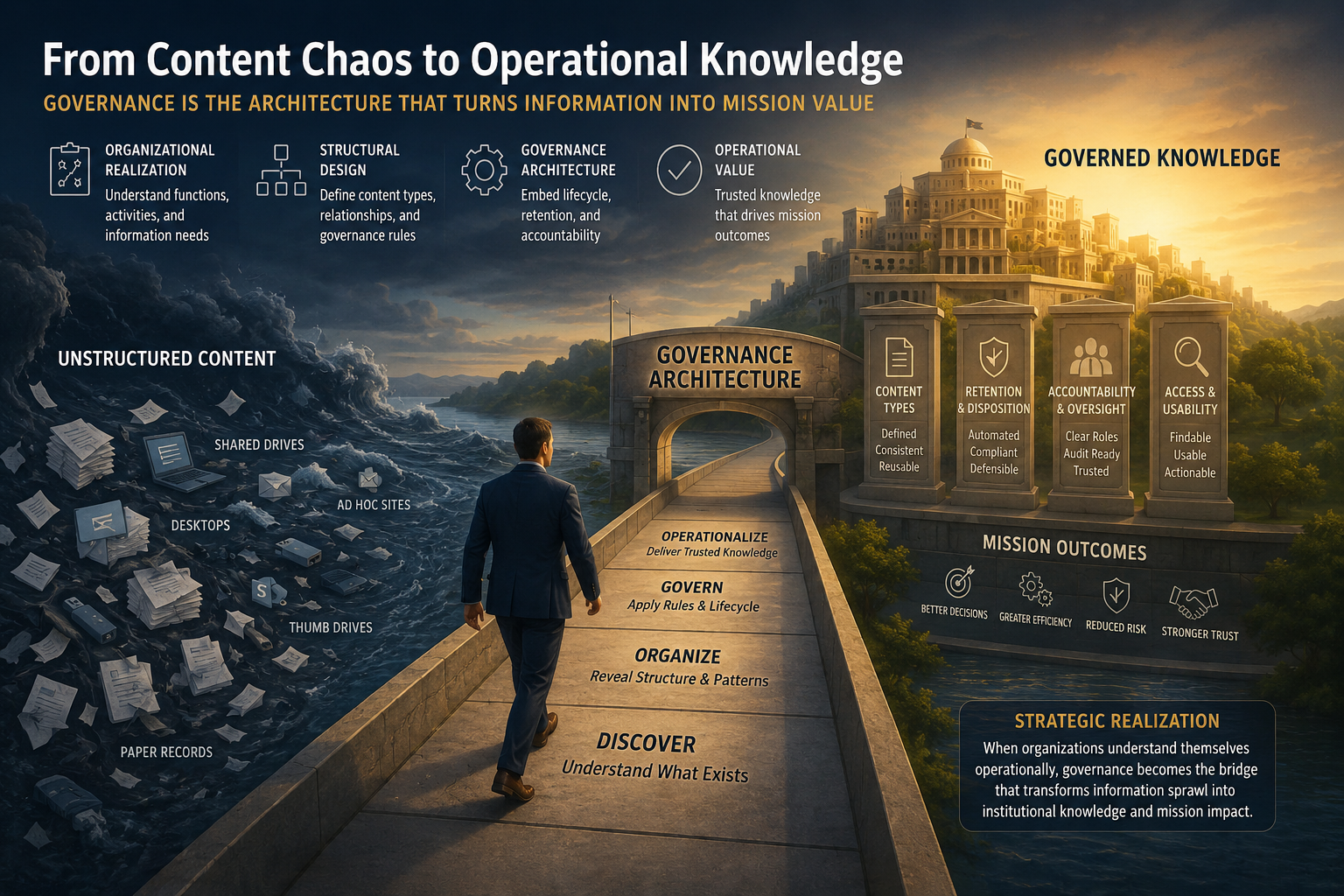
The true governance challenge has always existed outside enterprise systems.
Shared drives.
Email repositories.
Desktop storage.
Personal folders.
Legacy paper digitization.
Ad hoc SharePoint sites.
Detached cloud storage.
This is where governance collapses.
Not because the content cannot be managed.
But because agencies rarely establish the structural architecture necessary to govern it consistently.
Most modernization programs attempt to solve this through technology-first initiatives:
- AI classification,
- automated tagging,
- metadata extraction,
- intelligent search,
- or retention engines.
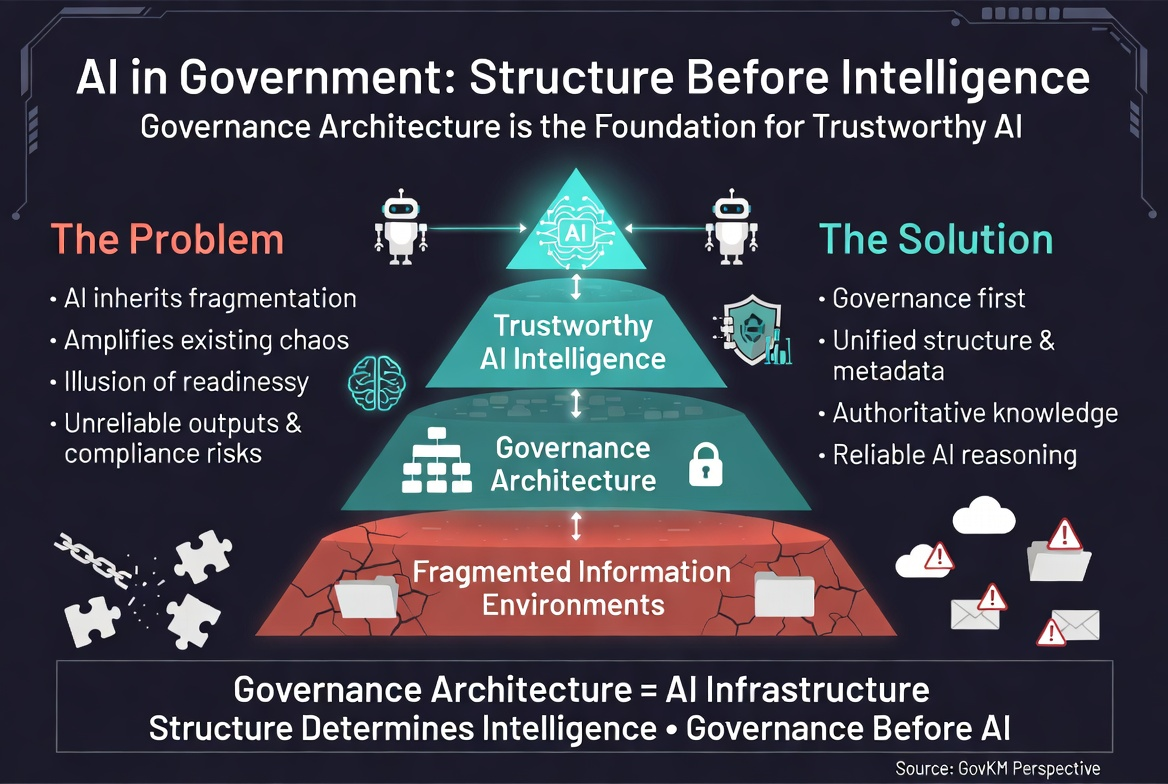
But automation without structure simply accelerates disorder.
An AI engine cannot reliably classify content when the organization itself cannot clearly define:
- what content types exist,
- why they exist,
- where they belong,
- or which business functions produced them.
Governance cannot emerge from ambiguity.
It requires architecture.
Governance Begins with Organizational Realization
The strategic realization for modern government knowledge management is this:
Records management is not a records problem.
It is an organizational design problem.
Before automation can function, agencies must first understand themselves operationally.
That means identifying:
- organizational functions,
- recurring business activities,
- content generation patterns,
- operational workflows,
- and authoritative repositories.
Only then can governance become systematic.
This is why mature enterprise systems succeed. They are built around clearly defined operational purposes.
Unstructured environments fail because agencies attempt to impose governance onto repositories that evolved organically without governance architecture.
The issue is not SharePoint.
The issue is not metadata.
The issue is not AI.
The issue is the absence of a unified knowledge governance framework.
Why Most Metadata Strategies Fail
Many agencies still approach modernization as a metadata exercise.
They create:
- massive taxonomy initiatives,
- endless metadata fields,
- complex tagging requirements,
- and governance committees designed to maintain them.
But metadata without structural alignment becomes administrative overhead rather than operational intelligence.
Users stop populating fields.
Taxonomies drift.
Repositories fragment.
Search quality deteriorates.
Governance becomes performative rather than functional.
This is why folder structures often become surrogate metadata systems inside government environments.
Users naturally create structure where governance frameworks failed to provide one.
The organizational instinct for structure is always present.
The architecture simply failed to formalize it.
The Hidden Insight Inside Shared Drives
Ironically, agencies already possess the blueprint for governance modernization.
It exists inside their shared drives.
Buried within years of accumulated organizational content are the actual operational patterns of the agency:
- recurring document types,
- functional groupings,
- operational rhythms,
- reporting cycles,
- mission activities,
- and business workflows.
Most agencies attempt to replace these environments before understanding them.
That is backwards.
The path toward governance maturity begins with operational analysis of existing organizational behavior.
The structure already exists.
It simply has not been formalized into governance architecture.
SharePoint Was Never the Failure
Government organizations often blame SharePoint for governance collapse.
But SharePoint was never intended to magically create governance on behalf of an agency.
It is a platform.
Governance must be architected into it.
The systems described in the original enterprise examples succeed because:
- content types are defined,
- workflows are understood,
- retention rules are mapped,
- and operational context is known in advance.
SharePoint can absolutely support this same model.
But only if agencies first establish:
- standardized content architectures,
- reusable governance patterns,
- authoritative content types,
- and operationally aligned information structures.
Without that foundation, no platform will succeed.
Not SharePoint.
Not AI.
Not any future technology.
Governance Before Automation
The future of government knowledge management is not more tagging.
It is not more metadata.
And it is not blindly applying AI to chaotic repositories.
The future is governance architecture.
Agencies that succeed in modernization will be the ones that:
- operationally model their organizations,
- define governance structurally,
- align content to mission and business functions,
- and embed lifecycle management directly into the architecture of knowledge itself.
Only then does automation become reliable.
Only then does AI become trustworthy.
Only then does records management stop being reactive compliance and become operational intelligence.
The government already proved this model works.
The next phase is extending that realization beyond enterprise systems into the broader unstructured knowledge environment that now defines modern government operations.
Continue Exploring
The Agent Was Asked to Fix the App. It Changed the Model.
The Government Email Was Real. The Authority Wasn’t.