The Real Government Knowledge Problem Is Not Mission Data — It Is Corporate Operational Content
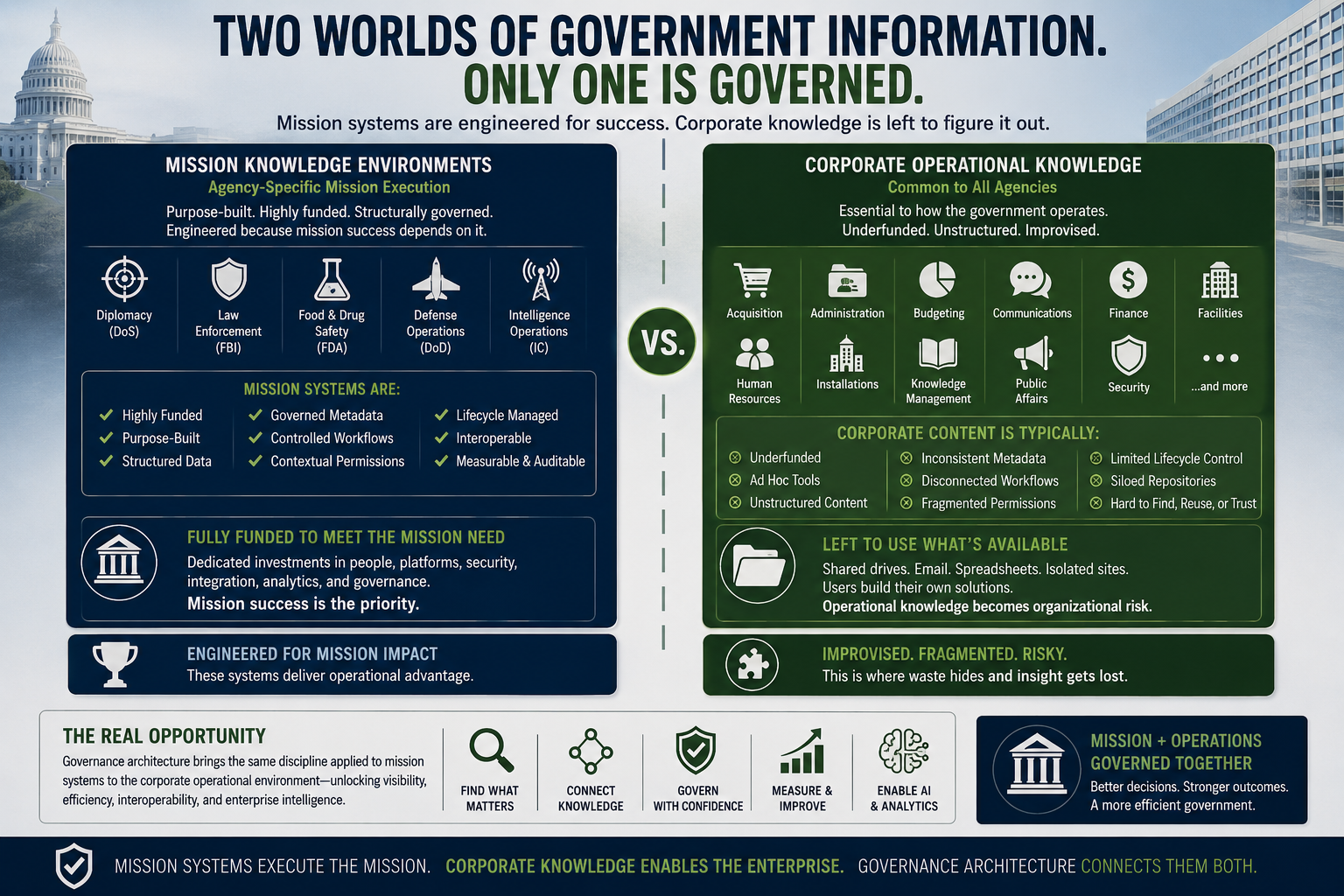

One of the most misunderstood aspects of government knowledge management is the assumption that all government information suffers from the same governance problems.
It does not.
In reality, government information exists within two very different operational domains:
- mission knowledge environments,
- and corporate operational knowledge environments.
Understanding the distinction between these two ecosystems is essential to understanding where the government’s real knowledge management crisis exists.
Mission Knowledge Is Already Highly Structured
Every federal agency exists to execute a specific mission.
For the Department of State, the mission involves diplomacy.
For the FBI, law enforcement and national security.
For the FDA, food and drug oversight.
For the Department of Defense, military operations.
For intelligence agencies, intelligence collection and analysis.
Mission systems are designed specifically to support these agency-specific operational requirements.
As a result, mission-related information environments are typically:
- highly funded,
- purpose-built,
- operationally mature,
- and structurally governed.
Mission systems are engineered because mission success depends on them.
Within these environments:
- data structures are predefined,
- metadata standards are enforced,
- workflows are controlled,
- permissions are contextual,
- lifecycle management is governed,
- interoperability is planned,
- and operational accountability is measurable.
Mission information receives serious architectural attention because agencies understand the operational consequences of mission failure.
Therefore, mission systems are rarely the true knowledge-management problem.
The Real Problem Exists in Corporate Operational Knowledge
The actual governance crisis exists elsewhere.
Every government agency also operates a second ecosystem:
the corporate operational environment.
These are the organizational functions common across nearly all agencies:
- Acquisition,
- Administration,
- Budgeting,
- Communications,
- Finance,
- Facilities,
- Human Resources,
- Installations,
- Knowledge Management,
- Public Affairs,
- Security,
- and countless other internal business operations.
Unlike mission systems, these corporate operational environments are rarely treated as strategic knowledge ecosystems.
Yet these functions generate enormous volumes of organizational content every day:
- reports,
- spreadsheets,
- presentations,
- taskers,
- schedules,
- meeting notes,
- acquisition packages,
- organizational charts,
- policy drafts,
- communications products,
- briefings,
- workflows,
- analyses,
- and collaborative operational knowledge.
This information represents the daily operational intelligence of the enterprise itself.
And it is overwhelmingly unstructured.
Mission Systems Are Funded. Corporate Knowledge Is Improvised.
Mission systems receive dedicated funding because they are visibly tied to agency mission execution.
Agencies invest heavily in:
- specialized mission platforms,
- engineering support,
- system integration,
- operational analytics,
- workflow automation,
- structured databases,
- cybersecurity,
- and mission-specific governance architecture.
Corporate operational environments rarely receive the same treatment.
Instead, agencies often expect corporate operational knowledge to function using whatever tools already exist inside the organization:
- shared drives,
- email,
- disconnected collaboration spaces,
- unmanaged SharePoint sites,
- spreadsheets,
- local repositories,
- and ad hoc workflows built by users themselves.
Mission environments are engineered.
Corporate environments are improvised.
This distinction is critical.
Because while mission systems are structured intentionally, corporate operational knowledge often evolves organically with little enterprise governance.
The Corporate Knowledge Ecosystem Became Fragmented by Default
Over time, users adapted to the lack of governance structure by creating their own organizational paradigms.
Folders became surrogate metadata.
Email became a workflow engine.
Shared drives became records repositories.
Local teams created isolated collaboration environments.
Operational knowledge became fragmented across disconnected systems.
As organizations grew, this fragmentation multiplied.
The result today is a sprawling ecosystem of:
- duplicated content,
- inconsistent structures,
- unmanaged permissions,
- unreliable discoverability,
- fragmented lifecycle management,
- and disconnected organizational knowledge.
Ironically, this operational content may represent the largest body of information generated inside government.
Yet it remains one of the least governed.
Why Corporate Operational Knowledge Matters
Historically, organizations tolerated this fragmentation because corporate operational information was viewed as secondary administrative overhead rather than strategic infrastructure.
That assumption no longer works.
Modern government operations increasingly depend on:
- enterprise search,
- interoperability,
- workforce analytics,
- automation,
- AI-readiness,
- operational continuity,
- institutional memory,
- and digital collaboration ecosystems.
All of these capabilities depend far more heavily on corporate operational knowledge than on mission systems alone.
Because corporate knowledge represents the connective tissue of the enterprise itself.
It governs how organizations:
- coordinate,
- communicate,
- plan,
- budget,
- acquire,
- report,
- collaborate,
- and operate internally.
Without structured governance of this operational ecosystem, organizations cannot achieve enterprise intelligence.
Governance Architecture Must Move into the Corporate Environment
The next phase of government modernization will not be focused primarily on mission systems.
Mission systems already receive investment, structure, and governance.
The real modernization challenge is the corporate operational ecosystem.
This requires:
- governance architecture,
- authoritative metadata models,
- operational content typing,
- lifecycle automation,
- permissions governance,
- discoverability,
- interoperability,
- and machine-readable organizational knowledge structures.
The goal is not merely electronic storage.
The goal is operational intelligence.
The Future Government Enterprise
Government organizations already understand how to build sophisticated mission systems.
The next realization is understanding that the same governance discipline must now be applied to corporate operational knowledge.
Because the future enterprise will not succeed merely through mission execution alone.
It will succeed through its ability to structurally govern the operational knowledge ecosystem supporting the mission itself.
Mission systems execute the mission.
Corporate operational knowledge enables the enterprise to function.
And increasingly, the effectiveness of one depends entirely on the governance of the other.
Continue Exploring
A Malformed Image Became a Pull Request.
The Agent Deleted the Evidence of Its Own Failure.