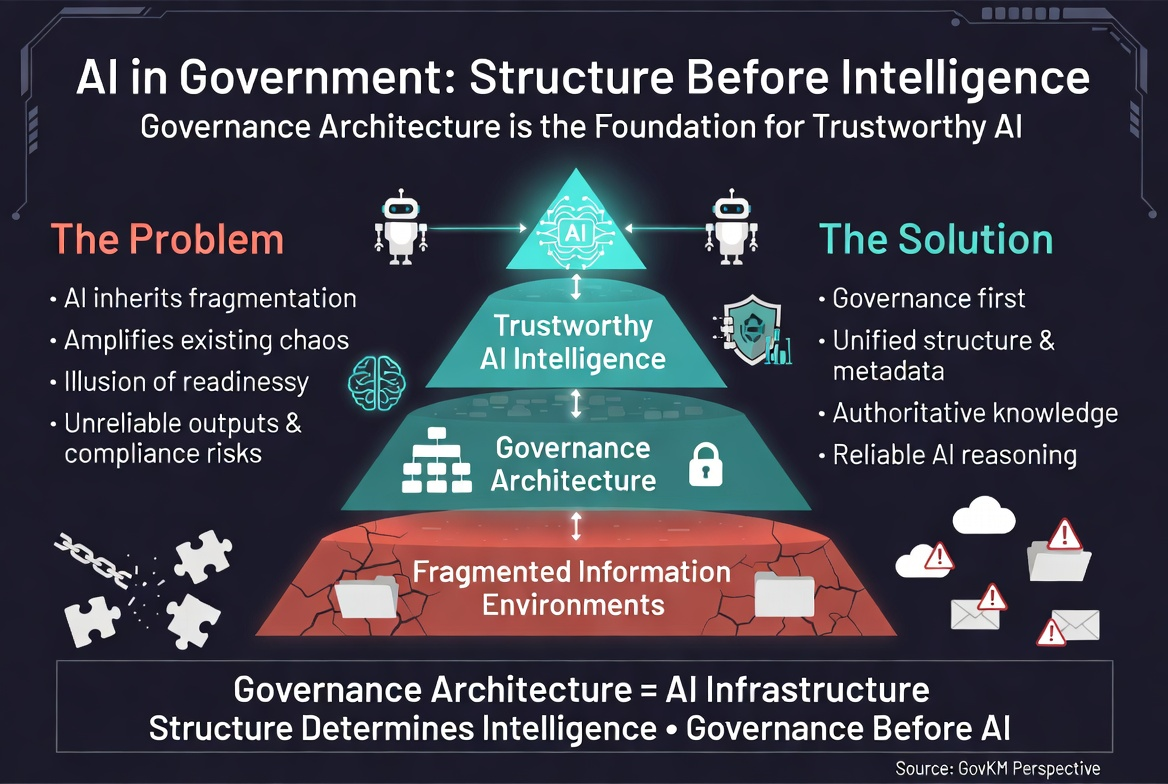
The Separation of Information and Technology: Why Governance Must Lead Infrastructure
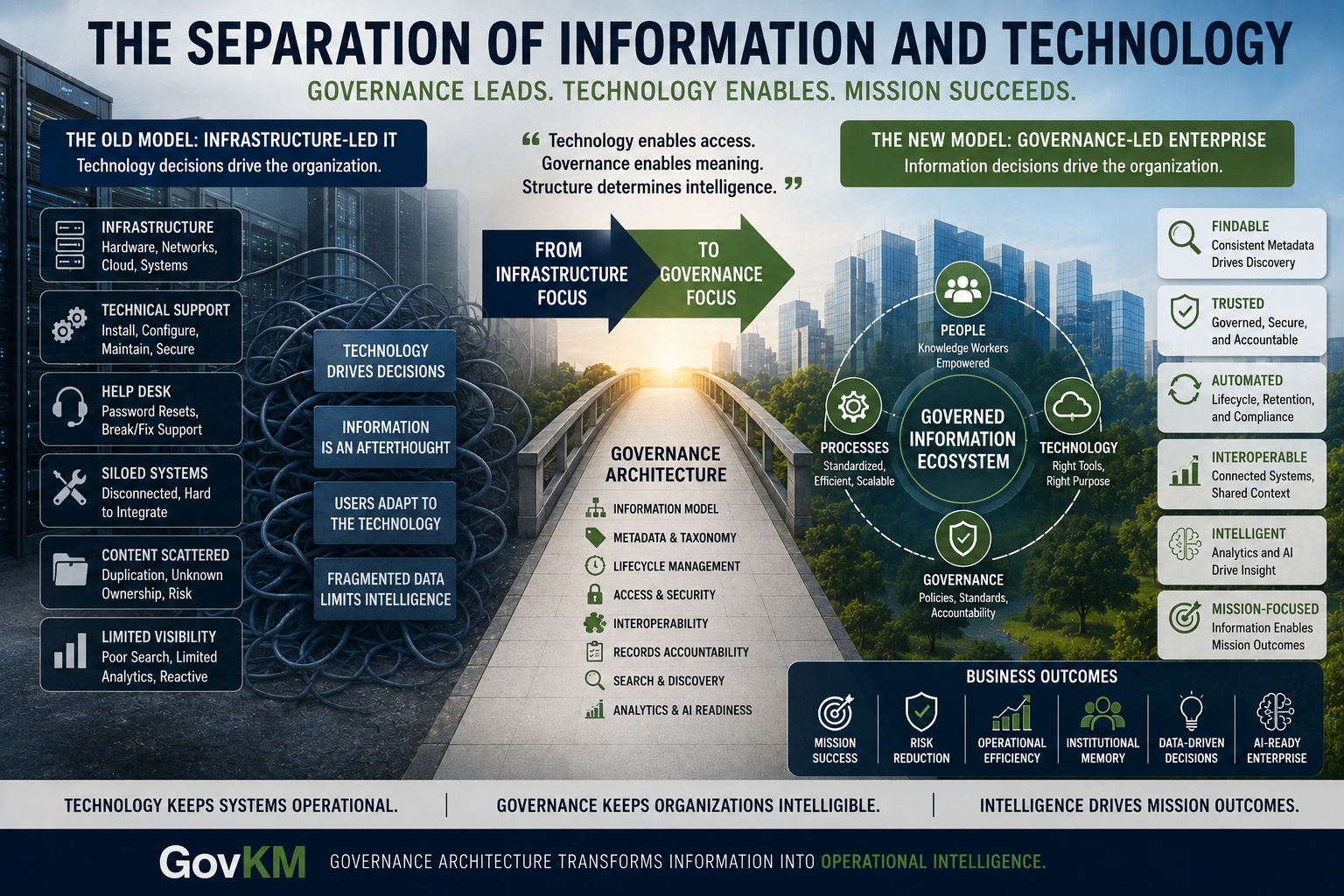

For decades, organizations treated Information Technology as a single unified discipline.
But beneath the surface, two fundamentally different operational domains have always existed:
- the management of technology,
- and the management of information.
These are not the same function.
One governs infrastructure.
The other governs organizational intelligence.
As digital environments became more complex, these responsibilities were grouped together under the modern IT organization. Over time, infrastructure operations, hardware lifecycle management, networking, cloud administration, cybersecurity, application support, training, content management, process automation, analytics, governance, records accountability, and knowledge operations all became compressed into a single organizational construct.
The result was not operational convergence.
It was conceptual confusion.
The modern enterprise is now reaching the point where this distinction can no longer remain blurred.
Technology Supports Systems. Information Supports Mission.
Technology infrastructure exists to provide operational capability:
- networks,
- servers,
- cloud platforms,
- endpoints,
- security architecture,
- system availability,
- infrastructure resilience.
These functions are essential.
But infrastructure alone does not create organizational intelligence.
Information governance performs a fundamentally different role.
Information governance determines:
- how knowledge is structured,
- how content is governed,
- how systems interoperate,
- how organizational memory is preserved,
- how metadata is standardized,
- how enterprise search functions,
- how lifecycle management operates,
- how automation is enabled,
- and how intelligence becomes operationally usable.
Technology enables access.
Governance enables meaning.
This distinction is becoming increasingly important as organizations modernize toward AI, analytics, automation, and distributed enterprise ecosystems.
The Enterprise Already Revealed the Divide
In practice, organizations have long operated with two different support realities.
One group maintains systems.
Another group helps organizations use information operationally.
These functions often became collectively labeled as “IT support,” but the work itself remained fundamentally different.
Infrastructure teams focus on:
- uptime,
- patching,
- connectivity,
- security,
- migrations,
- deployments,
- hardware,
- platform stability.
Information-focused operational teams support:
- business processes,
- content architecture,
- workflow design,
- collaboration governance,
- application utilization,
- taxonomy,
- training,
- process automation,
- enterprise search,
- records accountability,
- and organizational knowledge flow.
One is infrastructure-centric.
The other is mission-and-information-centric.
Historically, infrastructure priorities dominated enterprise decision-making because infrastructure was easier to measure:
- uptime percentages,
- bandwidth,
- incident counts,
- patch cycles,
- compliance metrics.
But the modern organization no longer succeeds merely because systems remain operational.
It succeeds because knowledge remains operational.
Governance Is Becoming More Important Than Infrastructure
The next phase of enterprise modernization is not being driven by hardware evolution.
It is being driven by information complexity.
Organizations now operate within distributed ecosystems where enterprise knowledge exists across:
- cloud platforms,
- collaboration environments,
- SaaS applications,
- content repositories,
- messaging systems,
- mobile environments,
- AI platforms,
- and external operational networks.
As this complexity increases, the strategic challenge shifts away from maintaining infrastructure toward governing information across infrastructure.
This changes the hierarchy entirely.
Technology becomes downstream from governance.
Infrastructure decisions increasingly depend on:
- data structure,
- metadata consistency,
- interoperability requirements,
- governance standards,
- lifecycle requirements,
- auditability,
- discoverability,
- and machine-readability.
The future enterprise will not primarily optimize for infrastructure convenience.
It will optimize for operational intelligence.
The Cost of Infrastructure-Led Governance
For years, many enterprise decisions affecting organizational knowledge were made primarily through infrastructure priorities rather than governance priorities.
Software migrations occurred because platforms reached end-of-life.
Systems were consolidated because hosting contracts changed.
Collaboration tools were deployed because licenses existed.
Cloud migrations occurred because infrastructure strategy demanded it.
Meanwhile, little consideration was often given to:
- the continuity of organizational knowledge,
- metadata preservation,
- governance consistency,
- search degradation,
- taxonomy alignment,
- records accountability,
- or long-term operational discoverability.
The result is visible across countless organizations today:
- fragmented repositories,
- duplicated content,
- inconsistent structures,
- failed enterprise search,
- broken institutional memory,
- and increasingly ungovernable information ecosystems.
The issue was never technological inadequacy.
The issue was governance absence.
Governance Architecture Is Emerging as Its Own Discipline
Organizations are beginning to recognize that governance cannot remain subordinate to infrastructure administration.
Governance architecture is evolving into its own operational discipline because modern enterprises require dedicated leadership focused on:
- enterprise information models,
- taxonomy and ontology,
- metadata governance,
- lifecycle governance,
- interoperability,
- search architecture,
- AI readiness,
- records accountability,
- analytics enablement,
- and organizational knowledge continuity.
These responsibilities extend far beyond traditional infrastructure operations.
The enterprise increasingly requires a leadership model where:
- technology enables systems,
- but governance enables intelligence.
This does not diminish the importance of infrastructure teams.
It clarifies their purpose.
Infrastructure keeps systems operational.
Governance keeps organizations intelligible.
The Future Enterprise Will Be Governed Structurally
The organizations that succeed in the next era of modernization will not simply deploy more technology.
They will establish governance architectures capable of organizing enterprise knowledge structurally across distributed ecosystems.
This is the evolution already underway.
The shift from:
- file management to governed ecosystems,
- isolated repositories to interoperable knowledge environments,
- disconnected platforms to structured intelligence architectures,
- and infrastructure-centric operations to governance-centric enterprises.
Artificial intelligence accelerates this transformation even further.
AI cannot generate reliable intelligence from fragmented, duplicated, unstructured repositories lacking governance architecture.
Structure determines intelligence.
The future enterprise therefore requires a new operational understanding:
Technology is infrastructure.
Governance is cognition.
And increasingly, cognition will drive the enterprise.
Continue Exploring
The Agent Was Asked to Fix the App. It Changed the Model.
The Government Email Was Real. The Authority Wasn’t.