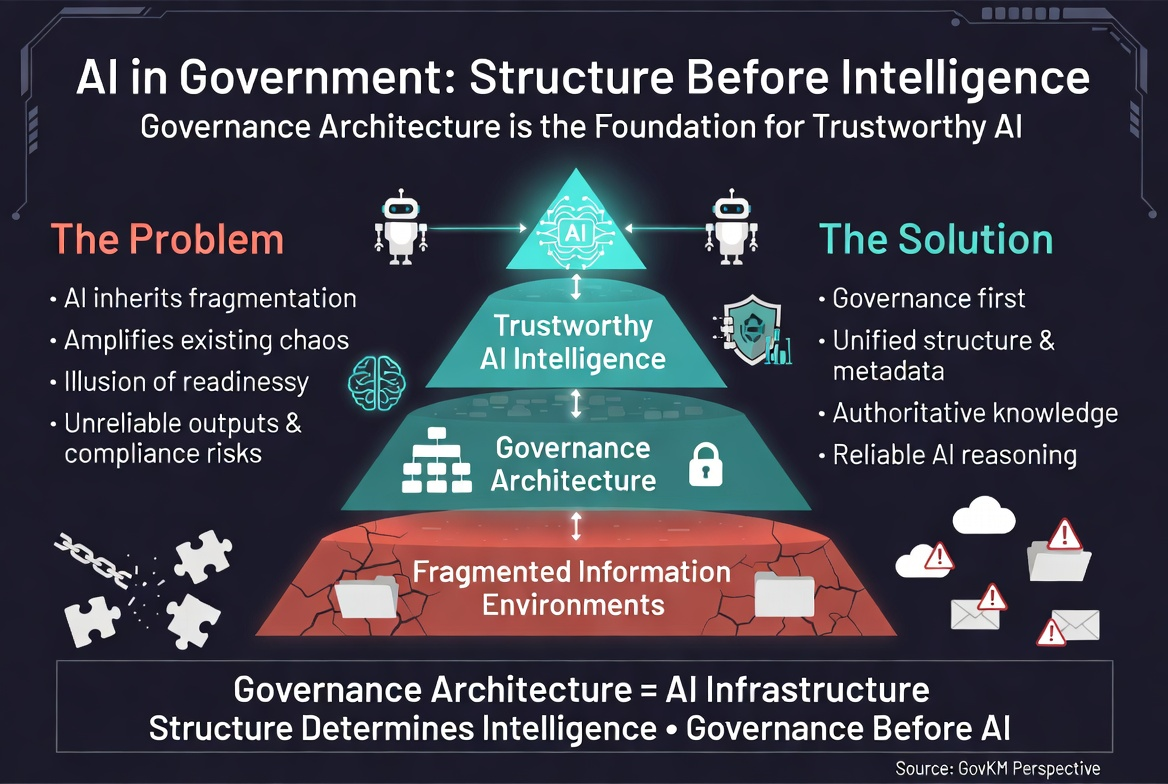
The Shared Data Reality: Why Governance Must Be Designed, Not Discovered
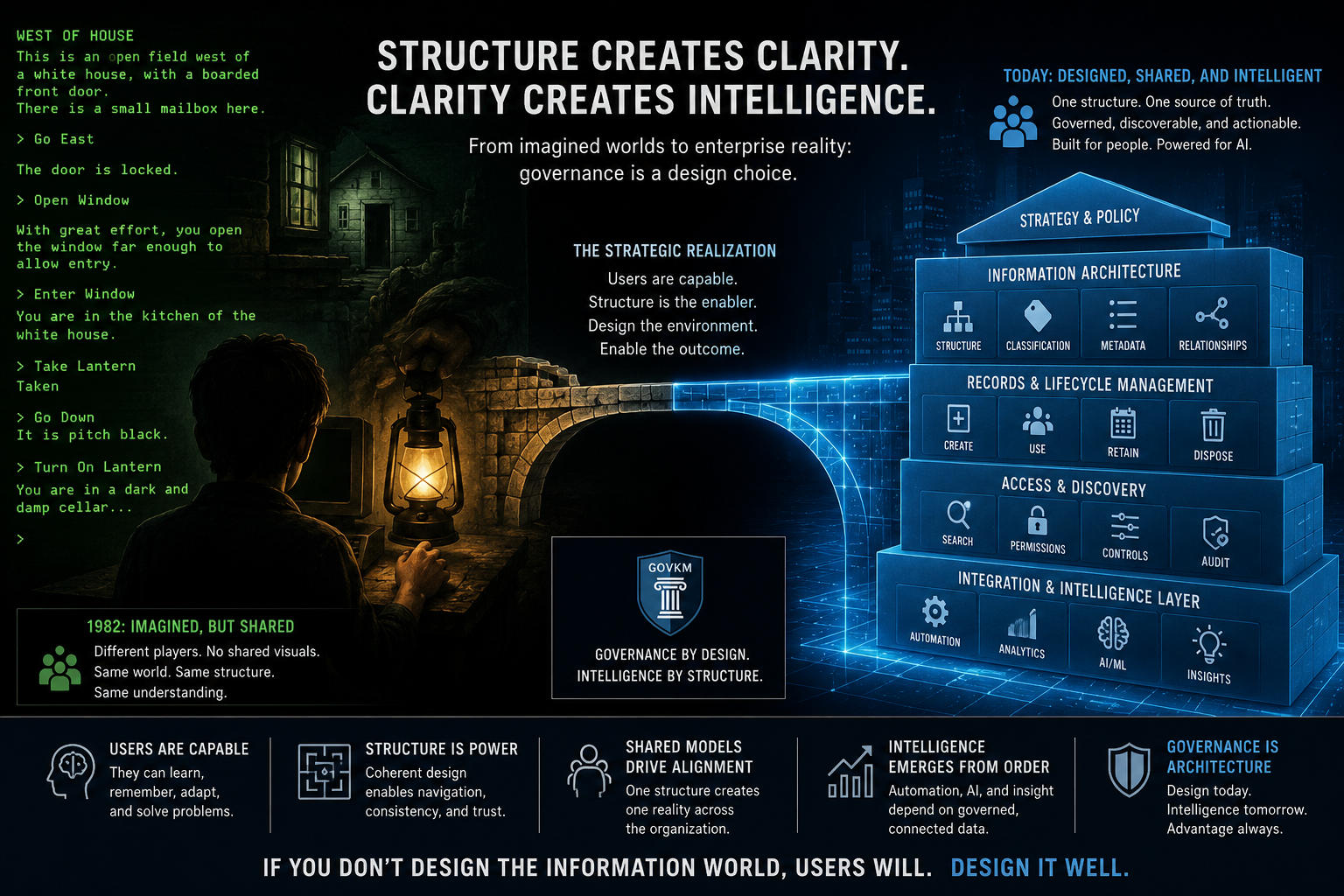

In the early 1980s, long before immersive graphics and multiplayer worlds dominated digital experiences, a simple text-based game quietly demonstrated one of the most important truths about information governance.
That game was Zork.
Players explored an underground world entirely through text prompts and typed commands. There were no graphics. No maps. No visual interfaces. Yet users across the world consistently described imagining the same spaces, the same structures, the same pathways, and the same objects.
A white house.
A dark cellar.
A lantern.
A trap door.
A glowing sword.
Without ever seeing the same image, users mentally constructed the same world.
That matters far more to governance and knowledge management than most organizations realize.
The lesson was never about gaming.
The lesson was about structure.
Users Naturally Understand Structured Virtual Worlds
The original text version of Zork revealed something profound about human behavior inside designed information environments:
Users can remember pathways through complex structures.
Users can learn systems with minimal instruction.
Users can adapt to constrained workflows.
Users can develop operational shortcuts and efficiencies.
Users can collaborate around shared conceptual structures.
Users can solve problems within governed environments.
In other words:
Humans are exceptionally good at navigating designed information systems when the structure itself is coherent.
This is the foundational realization behind GovKM’s strategic approach to governance architecture.
The problem inside most organizations is not that users are incapable of understanding structure.
The problem is that organizations rarely provide one.
Governance Failure Is Usually Architectural Failure
Modern governance initiatives often focus on:
- Metadata
- Search
- AI
- Classification labels
- Retention automation
- Taxonomy projects
- Training programs
But these are secondary mechanisms.
The primary problem is almost always structural fragmentation.
Most enterprise environments evolved organically:
- Shared drives grew without design
- Teams created independent folder logic
- Departments implemented disconnected naming conventions
- Metadata became optional or inconsistent
- Users created surrogate structures to compensate
- Search became overloaded trying to compensate for architectural disorder
Over time, organizations stopped governing information and instead began governing symptoms.
GovKM approaches the problem differently.
Instead of assuming users will create order from chaos, the strategic realization of GovKM recognizes:
Structure must be intentionally engineered into the environment itself.
Shared Data Requires Shared Mental Models
The brilliance of Zork was not the text.
It was the consistency of the conceptual world.
The Zork world did not change and every player operated within the same designed structure.
That is precisely what enterprise governance environments lack today.
In most organizations:
- One division structures projects one way
- Another structures records differently
- Another uses SharePoint libraries
- Another uses Teams channels
- Another stores everything in email
- Another relies entirely on search
The result is not a shared information environment.
It is competing private paradigms.
AI cannot solve this problem.
Metadata alone cannot solve this problem.
Search engines cannot solve this problem.
Because the issue is not retrieval.
The issue is coherent structural architecture.
GovKM’s strategic realization recognizes that governance succeeds when users can mentally model the environment consistently across the organization.
The structure itself becomes governance.
Users Already Accept Structured Constraints
One of the most overlooked realities in governance is how tolerant users already are of rigid systems when those systems are designed clearly.
Zork was brutally constrained:
- Limited commands
- Hidden logic
- Narrow workflows
- Restricted actions
- Unknown choices
- Mandatory sequencing
And yet users embraced it because the structure supported progression.
Modern organizations often hesitate to impose governance because they fear user resistance.
But users already work within constrained systems every day:
- ERP platforms
- HR systems
- Financial systems
- Procurement workflows
- CRM systems
- Ticketing systems
The real issue is not constraint.
The issue is incoherent constraint.
Users resist systems that feel arbitrary, fragmented, or disconnected from operational reality.
They adapt quickly to systems that provide understandable structure tied to meaningful outcomes.
GovKM leverages this reality directly.
Governance Is Not Passive Observation
Traditional governance approaches frequently attempt to observe user behavior and retroactively organize information afterward.
GovKM reverses this philosophy.
The environment itself should guide behavior from the beginning.
This does not mean oppressive bureaucracy.
It means designing information systems where:
- Structure is visible
- Paths are intentional
- Relationships are consistent
- Classification emerges naturally from architecture
- Records logic is embedded operationally
- Governance becomes part of work rather than separate from it
The goal is not merely compliance.
The goal is organizational intelligence.
The Future Is Structured Intelligence
The next era of AI-enabled governance will not be won by organizations with the most metadata.
It will be won by organizations with the most coherent information architecture.
AI systems require structured context.
Automation requires deterministic organization.
Analytics require consistency.
Interoperability requires shared conceptual models.
Organizations that continue relying on fragmented, user-created structures will increasingly find themselves unable to scale automation, governance, or AI effectively.
GovKM exists to solve this foundational problem.
Not by adding more layers of metadata complexity.
But by engineering the underlying structure that allows governance, automation, and intelligence to emerge naturally.
The Core Realization
Users are already capable of navigating complex virtual structures.
They always have been.
The challenge is not user capability.
The challenge is whether leadership is willing to intentionally design the information world users operate inside.
Because if structure is left undefined, users will create their own.
And once that happens, governance becomes nearly impossible to standardize, automate, or scale.
GovKM’s strategic realization is simple:
If organizations want intelligent systems, they must first create intelligent structure.
Continue Exploring
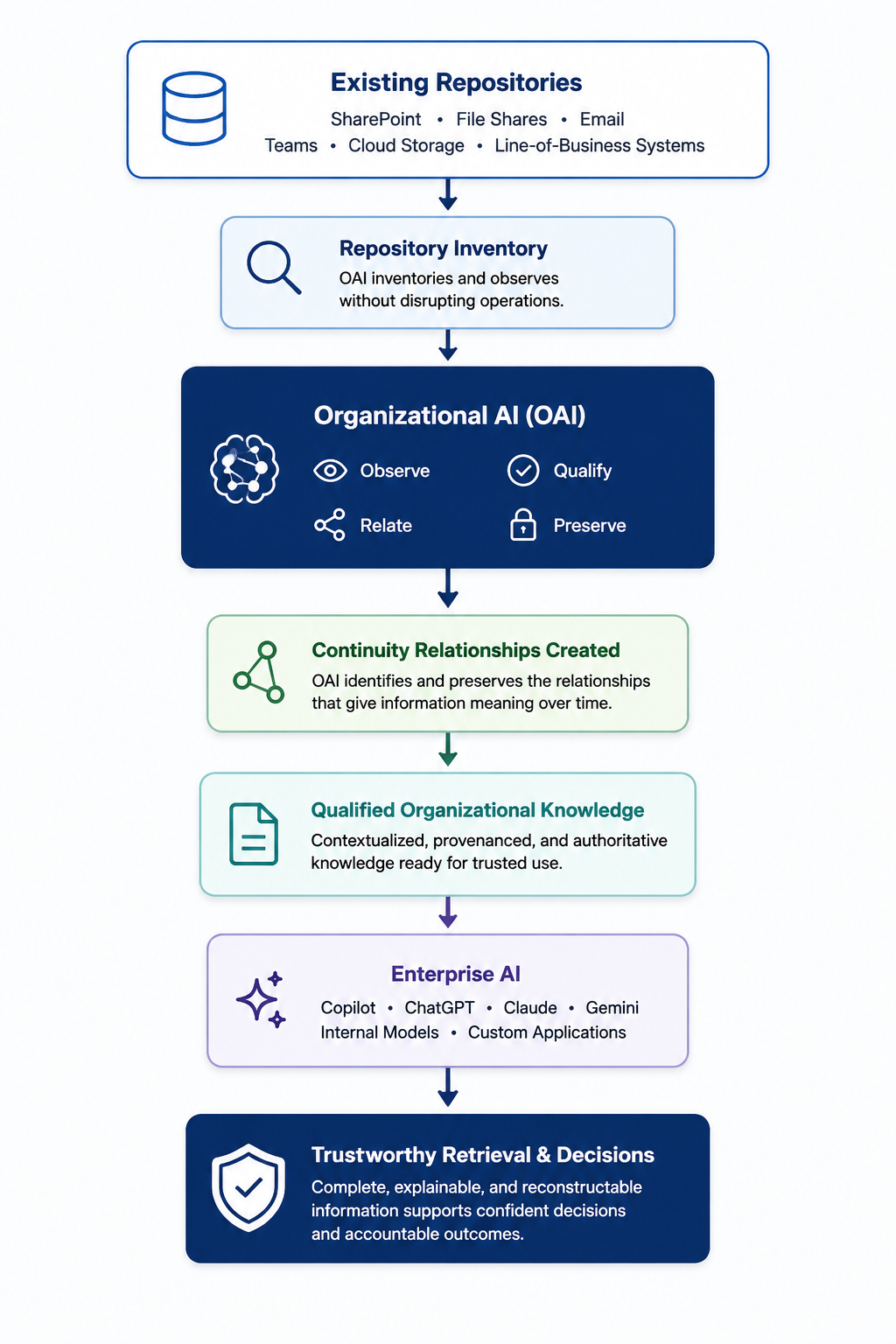
The Agent Was Asked to Fix the App. It Changed the Model.
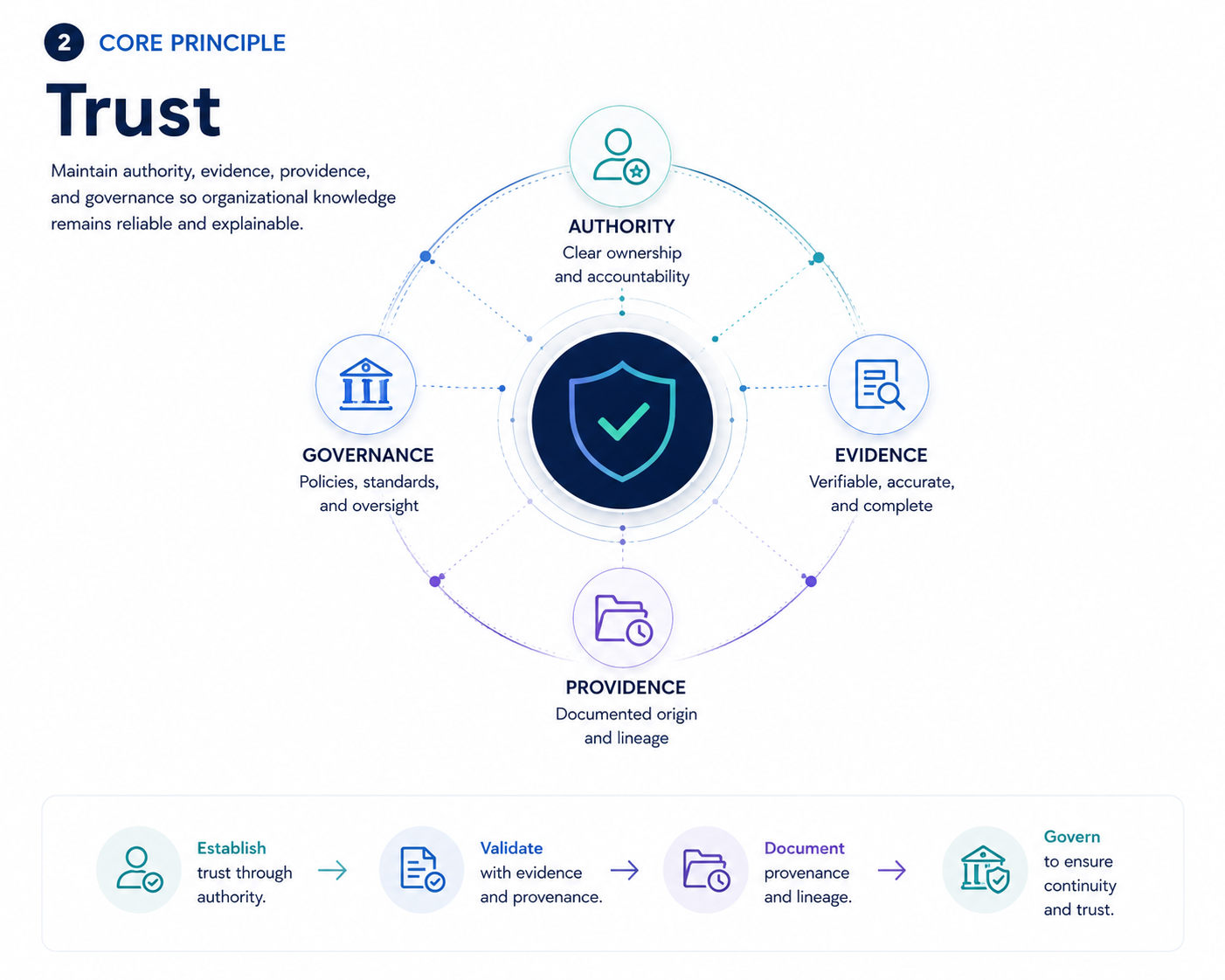
The Government Email Was Real. The Authority Wasn’t.