The Unseen Structure: Why Folder Paths Become Surrogate Metadata
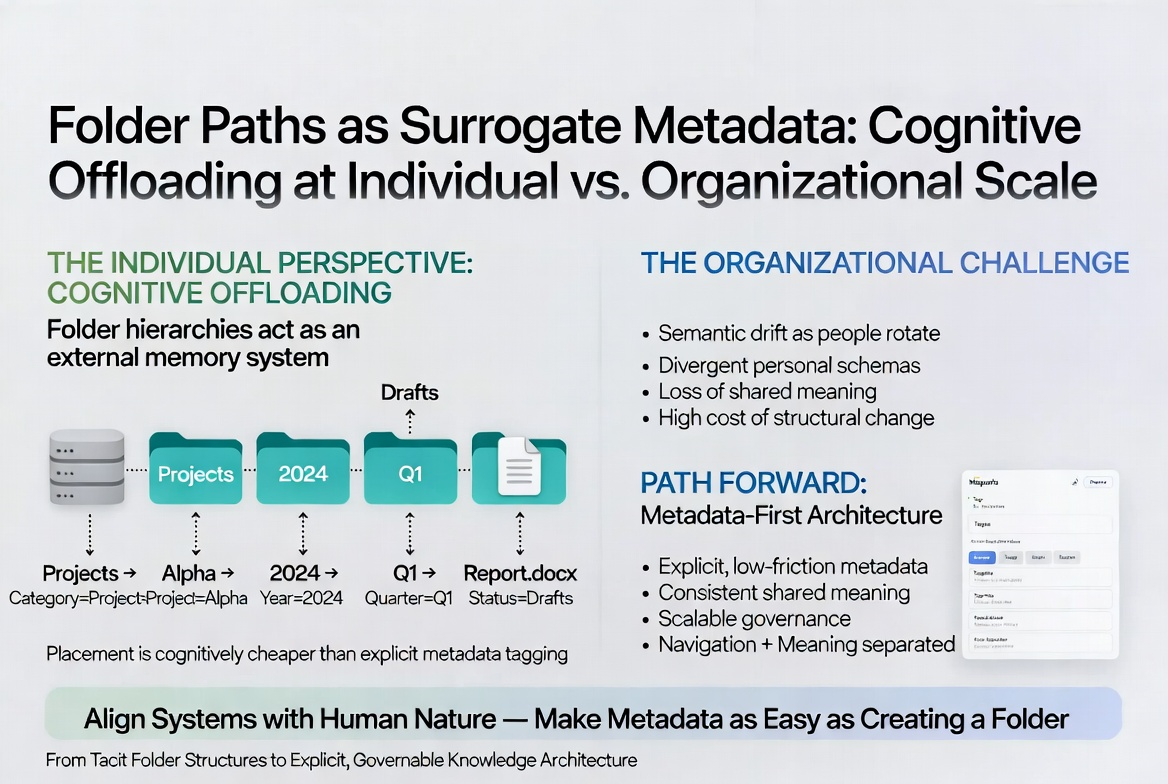

In the digital workplace, a curious and widespread phenomenon occurs: the folder path, a simple navigational tool, takes on the role of a complex metadata system. This transformation, often dismissed as user error or a failure of governance, is in fact a deeply ingrained and rational response to the cognitive demands of information management.
This article delves into the cognitive science behind this behavior, exploring why individuals instinctively embed meaning into folder structures and why this elegant personal solution often unravels at an organizational scale.
The Individual's Advantage: Cognitive Offloading and the Path of Least Resistance
Decades of research in Personal Information Management (PIM) and Human-Computer Interaction (HCI) reveal that users are not simply organizing files for efficient retrieval. Instead, they are engaging in a process of “cognitive offloading” and “reminding.” Folder names and their locations in a hierarchy serve as powerful external memory cues.
Creating a folder named “Q1-Drafts” is cognitively cheaper and more immediate than opening a file’s properties, navigating to a “Status” field, and selecting “Draft” from a dropdown menu.
This behavior is rooted in fundamental cognitive principles:</p>
- Placement is Cheaper than Abstraction: It is easier to place a file in a location that represents a category than to abstract its attributes into metadata fields.
- Location is Memorable: Humans are spatially oriented. We are better at remembering where something is than what its specific attributes are.
- Implicit Schemas: Folder hierarchies naturally mirror how we break down problems. A path like \Reports\2024\Q1\Pending is a sequential representation of faceted thinking, where each folder level acts as an implicit column header and the folder name is the value.
This is not a misuse of the system; it is the path of least cognitive resistance. For the individual, the folder path is a brilliantly efficient, self-created metadata schema.
The Organizational Challenge: The Breakdown of Shared Meaning
The problem arises when these personal, cognitively efficient systems are scaled to a shared, distributed environment. A shared network drive is a form of “distributed cognition,” where meaning must be consistently interpreted across people, roles, and time.
Here, the very features that make folder paths effective for individuals lead to systemic failure.
- Tacit Knowledge and Semantic Drift: The meaning of a folder is often dependent on the creator’s tacit knowledge, which is not explicitly available to others. As teams change and personnel rotate, this context decays, leading to semantic drift where the original meaning is lost or misinterpreted.
- Divergent Schemas: Each user brings their own cognitive model to the shared drive, resulting in multiple, conflicting private schemas coexisting in the same space. One user’s \Projects\Alpha\Invoices is another’s \Clients\Alpha\Billing, leading to confusion and duplicated information.
- The High Cost of Change: In a distributed system, changing a folder name or location can have cascading and disruptive effects on others who rely on that path for their own work.
This is the central conflict: folder paths are optimized for individual sensemaking, not for collective interpretation.
Why Training and Governance Fall Short
Many organizations attempt to solve this problem with stricter governance policies and user training. However, these efforts often fail because they work against, rather than with, inherent cognitive tendencies.
Users will consistently gravitate toward the most cognitively efficient solution. When faced with a choice between the immediate, tangible action of creating a folder and the abstract, delayed benefit of applying metadata, the folder will almost always win.
Studies comparing folder use to tagging systems have shown that even when explicit metadata tools are available, users prefer the simplicity of folders. The cognitive cost of deciding on and applying multiple attributes is simply too high, especially when the payoff is not immediately apparent.
The Path Forward: From Misalignment to a Metadata-First Approach
The solution lies not in forcing users to abandon their natural cognitive strategies, but in providing systems that align with them. The encoding of metadata into folder paths is not a sign of user error, but a clear signal of a system’s failure to provide a low-friction, explicit way to capture meaning.
Effective information architecture recognizes this distinction and provides tools that are designed for their specific cognitive purpose:
- Structure for Navigation: Folder hierarchies should be used for their intended purpose: providing a navigable structure.
- Metadata for Meaning: Explicit, field-based metadata should be the primary tool for capturing the semantic meaning of information.
- Governance for Memory: Controlled vocabularies, content types, and inheritance rules provide the long-term, stable framework necessary for organizational memory.
By embracing a metadata-first approach, organizations can create information systems that are both individually intuitive and organizationally scalable.
The goal is to make applying metadata as cognitively effortless as creating a folder, thereby bridging the gap between individual and distributed cognition. When systems are designed to work with, rather than against, human nature, the result is a more organized, efficient, and intelligent digital workplace.
Continue Exploring
The Agent Was Asked to Fix the App. It Changed the Model.
The Government Email Was Real. The Authority Wasn’t.