When Working Intelligence Becomes Institutional Evidence
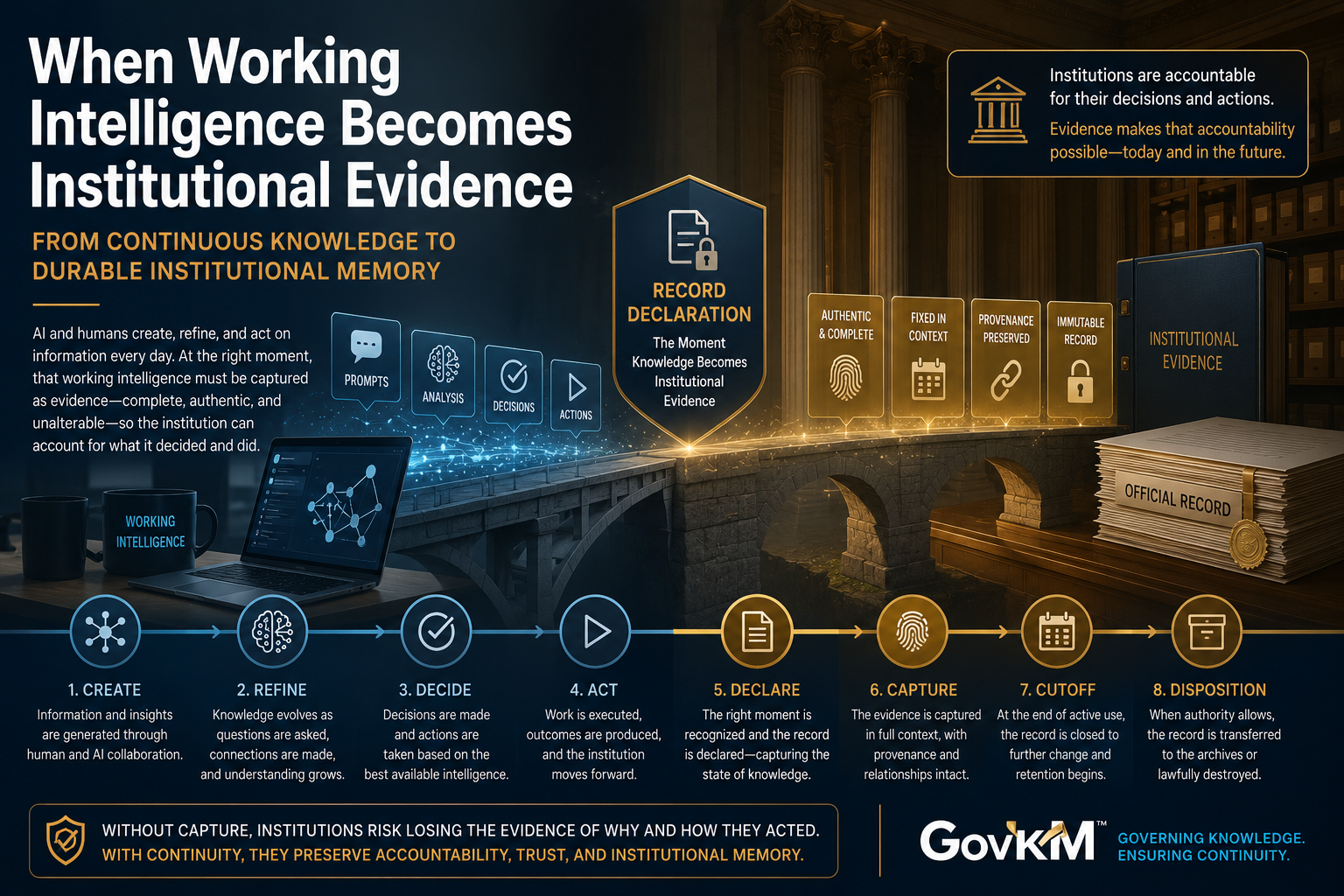

Working Knowledge and Institutional Evidence Are Not the Same State
AI-assisted work is often iterative by design. A question changes. New evidence arrives. An analysis is refined. Alternatives are compared. A recommendation is corrected. The working body of knowledge evolves as the institution learns.
That mutability is useful—until the institution relies on a particular state to make a decision, take an action, establish an obligation, or preserve evidence of what occurred.
At that point continuity needs something working systems often do not make explicit: an evidentiary boundary.
The institution must be able to distinguish what was still being worked from what was relied upon.
The Record Boundary Is Not the Same as Cutoff or Disposition
Federal records-management terminology is useful because it prevents several lifecycle events from being collapsed into one.
NARA defines cutoff as the point at which records are no longer in active use and the retention or transfer period begins. Disposition is the final stage of the lifecycle, encompassing actions such as destruction of temporary records or transfer of permanent records.
Those events answer different questions from record capture.
Record capture asks: what state of information must now be preserved as evidence of institutional activity?
Cutoff asks: when does active use end and the retention clock begin?
Disposition asks: what happens when the authorized lifecycle reaches its final stage?
A continuity architecture should preserve those distinctions rather than make “record,” “cut off,” “immutable,” and “disposed” synonyms.
Integrity Is Stronger Than a Simplistic Immutability Rule
Institutional evidence needs integrity, but integrity does not necessarily mean that no authorized change can ever occur.
NARA guidance describes integrity as completeness and protection against unauthorized alteration. It also recognizes that policies may permit additions or annotations after a record is created, provided those changes are authorized and explicitly identified.
That produces a more useful continuity rule: the historical evidentiary state must not be silently overwritten.
If a correction, annotation, superseding decision, or lawful amendment occurs later, the institution should be able to distinguish the later change from the state that existed when the original decision or action occurred.
Continuity depends on preserved lineage, not merely technical write-protection.
Why AI Makes the Boundary More Important
Traditional documents often signal their own state. A signed memorandum looks different from a draft. A final order differs from working notes. A transaction produces a record in a system of record.
AI-assisted work can blur those cues. The same interface may contain exploratory reasoning, retrieved evidence, synthesized text, revisions, recommendations, and final action support. Without a governed transition, later users may be unable to determine which state the institution actually relied upon.
That is a continuity failure even when every interaction was technically retained.
Retention without an evidentiary boundary preserves activity but may not preserve institutional meaning.
The Continuity Topology Defines What Must Cross the Boundary
Source → Evidence: The source material that informed the working analysis must remain distinguishable from summaries, transformations, and generated interpretation.
Evidence → Authority: The institution must preserve which evidence was accepted and which authority permitted it to support official action.
Authority → Context: The relevant policy, role, delegation, time, constraints, and organizational circumstances must remain associated with the evidentiary state.
Context → Decision: The institution needs an identifiable decision state—not merely a continually editable workspace from which a decision once emerged.
Decision → Action: The action must remain traceable to the decision state that authorized or justified it.
Action → Record: The resulting record captures durable evidence of what occurred and preserves the lineage necessary to reconstruct it.
Record → Institutional Memory: Later personnel should be able to recover the historical state without confusing subsequent revisions with the original basis of action.
Institutional Memory → Future Reuse: Future reuse can incorporate later learning while retaining the ability to distinguish precedent, correction, supersession, and current authority.
The Failure Mode Is Silent Historical Rewriting
A continuously editable knowledge environment creates value while the work is active. The danger appears when later edits erase the state the institution actually used.
If a recommendation changes after approval and the prior state cannot be recovered, the record may no longer explain the decision. If new evidence is inserted into an old analytical chain without temporal distinction, future users may believe the institution knew something earlier than it did. If a correction silently replaces the original result, an audit can reconstruct only the corrected present—not the historical event.
These are failures of institutional memory.
Continuity Requires a Governed State Transition
The design principle is straightforward even though implementations will differ.
Working intelligence may remain mutable while the institution is learning. When a particular state becomes evidence of an official decision, action, transaction, obligation, or other recordkeeping event, that state and its provenance need durable protection. Later authorized changes should remain visible as later changes. Cutoff then governs the end of active use. Retention governs how long the record is kept. Disposition governs its final authorized treatment.
This approach preserves both capabilities an institution needs: the freedom to continue learning and the ability to prove what it knew, decided, and did at the time.
Continue Exploring
The Answer Was Correct. The Evidence Could Not Prove It.
The Model Hadn't Answered Yet. Its Memory Was Already Wrong.