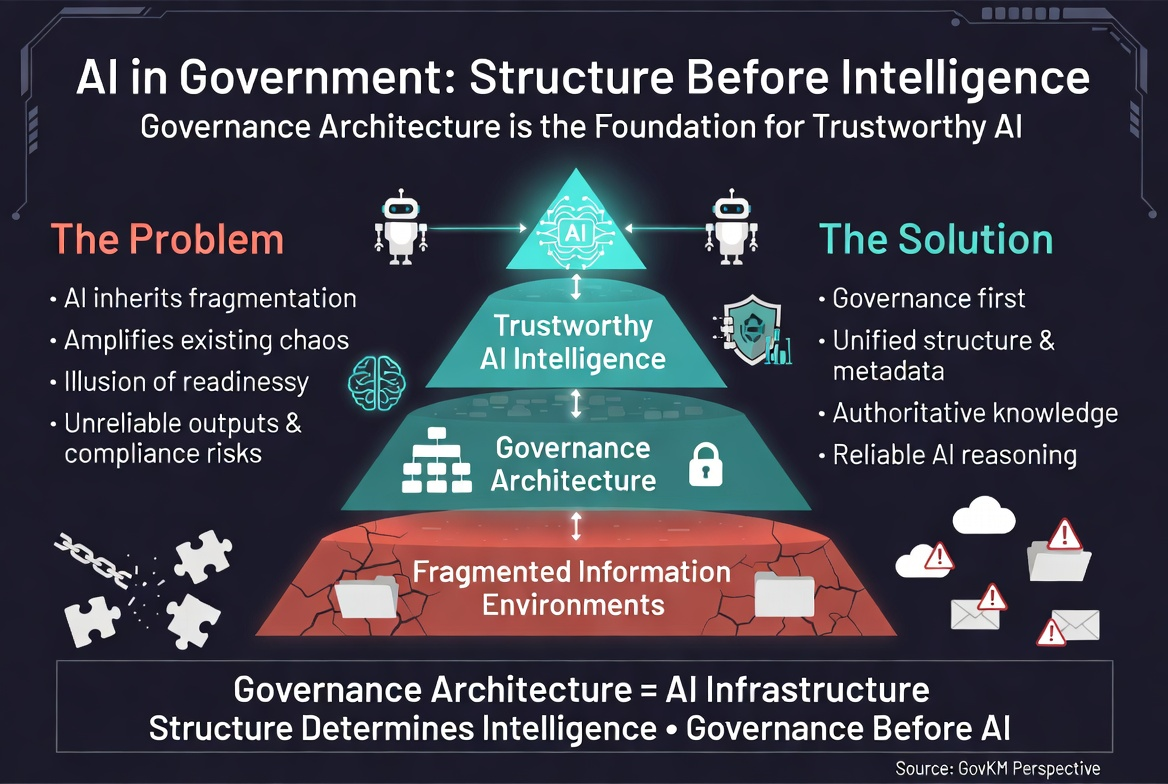
Where Government Knowledge Goes to Disappear — And How Governance Prevents the Loss
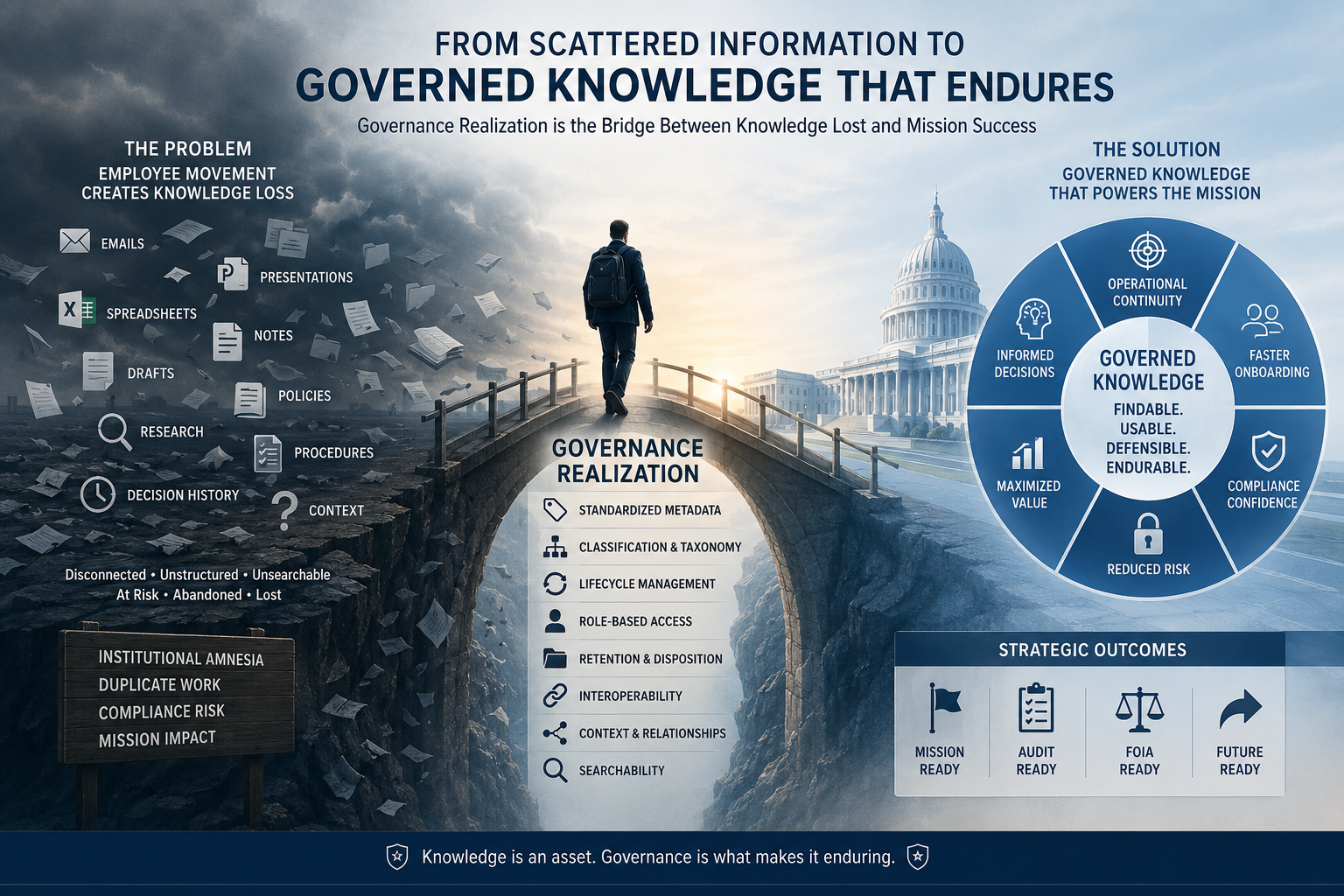

For decades, organizations have focused on storing documents while largely ignoring the far more important challenge: preserving the operational knowledge created by employees every day.
Government agencies, military organizations, and even private industry all face the same growing problem — knowledge is constantly being created, scattered, abandoned, and lost as employees move between roles, offices, agencies, duty stations, or employers.
The issue is not simply document storage. The real challenge is the absence of governance architecture capable of organizing knowledge in a structured, interoperable, and survivable way.
The Hidden Cost of Employee Movement
Modern careers are increasingly fluid. In industry, employees frequently move laterally between organizations, carrying expertise with them while leaving fragmented digital information behind. In government and defense environments, personnel rotations, promotions, transfers, and Permanent Change of Station (PCS) moves create the same effect on a larger scale.
Every move leaves behind:
- Emails
- Spreadsheets
- Presentations
- Notes
- Draft policies
- Research
- Operational procedures
- Decision history
- Contextual knowledge
Most of this information remains buried inside disconnected repositories, personal folders, shared drives, email accounts, or abandoned collaboration spaces.
The result is a form of institutional amnesia.
Organizations do not lose knowledge because employees leave. They lose knowledge because knowledge was never structurally governed in the first place.
The Real Problem Is Not Storage
Most organizations already possess enormous storage capability. Cloud migration has only expanded that capacity.
But storage without governance simply scales disorder.
For years, employees have been given tools to create content without being given standardized methods for organizing it. The result is predictable: every employee invents their own filing logic, folder structure, naming conventions, and retention habits.
This creates several strategic failures simultaneously:
Knowledge Becomes Unsearchable
Critical operational knowledge becomes effectively invisible because it exists in inconsistent locations and formats.
Records Become Unmanageable
Government agencies must satisfy FOIA requests, litigation discovery requirements, audit obligations, and records retention mandates. When knowledge is scattered, these responsibilities become expensive, slow, and risky.
Context Is Lost
Documents without governance lose their operational meaning. A file may survive, but the surrounding context — why it existed, who used it, what process it supported, and how it connected to mission execution — disappears.
Institutional Memory Erodes
Every unmanaged departure forces organizations to rediscover knowledge they already once possessed.
Why Folders Failed
Many organizations attempted to solve knowledge management by centralizing storage into portals, shared drives, or cloud repositories. The Department of Defense introduced systems such as Army Knowledge Online (AKO), Air Force portals, MarineNet, and Navy Enterprise platforms to improve accessibility across duty stations.
These systems improved availability.
But availability is not governance.
Most enterprise platforms still rely heavily on folder-based organization models, allowing users to create their own structures with minimal standardization or lifecycle controls.
Folders create several long-term governance problems:
- Information silos
- Duplicate content
- Inconsistent classification
- Broken retention
- Weak interoperability
- User-dependent organization
- Loss of contextual relationships
Folders are not governance architecture. They are merely containers.
Without structural governance standards, cloud systems simply become larger versions of the same unmanaged environments organizations already struggled with on-premises.
Governance Must Exist Before Knowledge Can Scale
The future of government knowledge management is not dependent on better storage platforms.
It depends on governance realization.
True governance realization means organizations establish:
- Standardized metadata structures
- Records classification architecture
- Lifecycle governance
- Role-based organizational models
- Interoperable taxonomies
- Automated retention controls
- Searchable contextual relationships
- Enterprise-wide configuration standards
When governance is established first, knowledge becomes portable, discoverable, defensible, and reusable regardless of where employees move.
This transforms knowledge management from passive storage into operational continuity.
Governance Is About Survivability
The strategic question is no longer:
“Where are the files?”
The real question is:
“Can the organization still function intelligently after people leave?”
If knowledge depends on individuals remembering where things are stored, the organization has already failed structurally.
Government modernization efforts, AI initiatives, cloud transformations, and digital workplace strategies will continue to underperform until governance architecture becomes the foundational layer beneath them all.
Because unmanaged knowledge does not disappear immediately.
It slowly becomes unusable.
And unusable knowledge is operationally equivalent to lost knowledge.
The organizations that succeed in the next era of digital government will not be the ones that store the most information.
They will be the ones that govern it structurally from the beginning.
Continue Exploring
The Agent Was Asked to Fix the App. It Changed the Model.
The Government Email Was Real. The Authority Wasn’t.