Why Metadata Fails Without Governance
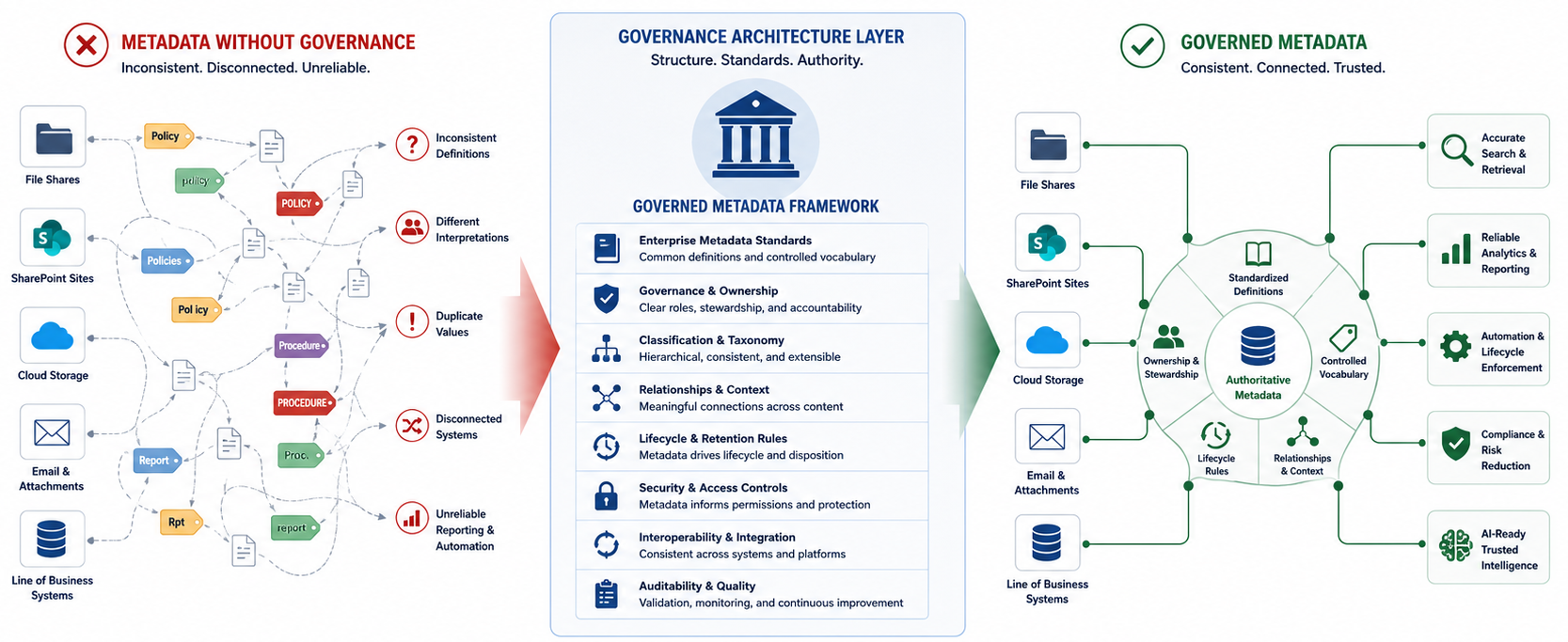

Metadata Is Not Governance by Itself
Metadata is often treated as the answer to information disorder. When content becomes difficult to find, classify, manage, retain, or interpret, organizations frequently respond by adding more metadata fields.
But metadata alone does not solve structural confusion.
A metadata field is only useful when its meaning is stable, its values are controlled, its use is consistent, and its relationship to governance decisions is understood. Without those conditions, metadata becomes another layer of inconsistency added to an already fragmented environment.
The problem is not that metadata is unimportant.
The problem is that metadata without governance becomes noise.
Why Metadata Programs Break Down
Most metadata initiatives begin with good intentions. Organizations want to improve search, support records management, enable automation, and create better visibility into their information environment.
But at scale, several predictable problems emerge:
- Different teams interpret fields differently
- Users apply values inconsistently
- Required fields become compliance burdens
- Metadata values drift over time
- Duplicate terms emerge
- Field definitions become unclear
- Systems enforce structure differently
- No one owns semantic consistency
The result is a metadata environment that appears structured but is not actually authoritative.
The organization may have fields, tags, categories, and labels, but those elements do not form a coherent knowledge system.
Users Resist Metadata for Rational Reasons
Organizations often assume metadata fails because users are careless, poorly trained, or unwilling to follow rules.
That explanation is incomplete.
Users resist metadata when the system imposes cognitive effort without immediate value. Creating a folder, naming a document, or saving content in a familiar location often feels faster and more intuitive than selecting abstract values from a form.
This is not irrational behavior. It is a rational response to system friction.
If metadata entry feels disconnected from the user’s work, users will treat it as administrative overhead. If values are unclear, users will guess. If fields seem redundant, users will ignore them. If the benefit is delayed or invisible, compliance will decay.
Metadata programs fail when they ask users to carry the burden of governance manually.
The Difference Between Labels and Architecture
A label describes something.
An architecture defines how things relate.
This distinction is critical.
A metadata field may say that a document is a policy, a report, a draft, or a record. But unless those values are connected to governance rules, retention logic, authority structures, and lifecycle states, the labels remain shallow.
Effective metadata architecture defines:
- What categories exist
- Who controls them
- How values are selected
- Which systems inherit them
- What governance rules attach to them
- How lifecycle actions depend on them
- How relationships are maintained over time
Without this architecture, metadata becomes descriptive but not operational.
It may help describe content, but it does not reliably govern content.
Metadata Drift Is a Governance Failure
Metadata drift occurs when values, definitions, and usage patterns gradually diverge from their original meaning.
This happens naturally in large organizations.
As teams reorganize, systems change, programs evolve, and personnel rotate, the context behind metadata decisions begins to decay. A category that once had clear meaning may become ambiguous. A field that was once useful may become redundant. A term used by one office may conflict with the same term used elsewhere.
Over time, metadata loses its authority.
The system may still contain fields and values, but the organization no longer shares a consistent understanding of what they mean.
Metadata drift is not merely a data quality issue.
It is a governance failure.
Governed Metadata Requires Ownership
Reliable metadata requires clear ownership.
Someone must be responsible for:
- Defining metadata fields
- Controlling vocabularies
- Resolving semantic conflicts
- Retiring obsolete values
- Maintaining relationships
- Aligning metadata with records requirements
- Ensuring consistency across systemsements
Without ownership, metadata becomes decentralized by default. Each office, system, or team begins making local decisions that may solve immediate needs but weaken organizational coherence.
Governance does not mean every value must be centrally controlled.
It means the organization must know which structures are authoritative, which variations are allowed, and how meaning is maintained over time.
Metadata Must Connect to Lifecycle Rules
Metadata becomes operationally powerful when it connects to lifecycle governance.
For government environments, metadata should not merely describe content. It should help determine how content is managed over time.
That includes:
- Retention requirements
- Record status
- Disposition rules
- Access restrictions
- Legal holds
- Review cycles
- Publication status
- Archival value
When metadata is disconnected from lifecycle rules, it remains informational.
When metadata is connected to governance logic, it becomes executable.
This is the difference between metadata as description and metadata as infrastructure.
Metadata Must Be Designed for Systems, Not Just People
Historically, metadata was often designed to help people find, sort, and identify content.
That is still important.
But modern government information environments must also support automation, interoperability, analytics, and AI-assisted interpretation. This means metadata must be understandable not only to humans, but also to systems.
Poorly governed metadata creates downstream risk:
- Search returns inconsistent results
- Records automation applies rules incorrectly
- AI systems retrieve unreliable context
- Reporting reflects incomplete classifications
- Access controls become harder to enforce
- Lifecycle workflows require manual correction
In an AI-enabled environment, metadata quality becomes intelligence quality.
If metadata is inconsistent, machine interpretation becomes unstable.
The GovKM Approach
GovKM treats metadata as part of a broader governance architecture.
Metadata should not be designed in isolation. It should be connected to:
- Classification structures
- Knowledge relationships
- Records schedules
- Content types
- Governance roles
- Lifecycle rules
- Automation requirements
- AI interpretation needs
This approach changes the purpose of metadata.
Metadata is no longer just a set of fields attached to documents.
It becomes a structural layer that allows information to be governed, automated, searched, analyzed, and trusted across systems.
Conclusion
Metadata fails when it is treated as a labeling exercise.
It succeeds when it is governed as architecture.
Government organizations do not need more disconnected fields, more inconsistent tags, or more manual metadata burdens. They need authoritative structures that define meaning, preserve context, support lifecycle governance, and enable reliable automation.
Metadata must be governed before it can be trusted.
And trusted metadata is one of the foundations of government knowledge architecture.
Continue Exploring
A Malformed Image Became a Pull Request.
The Agent Deleted the Evidence of Its Own Failure.