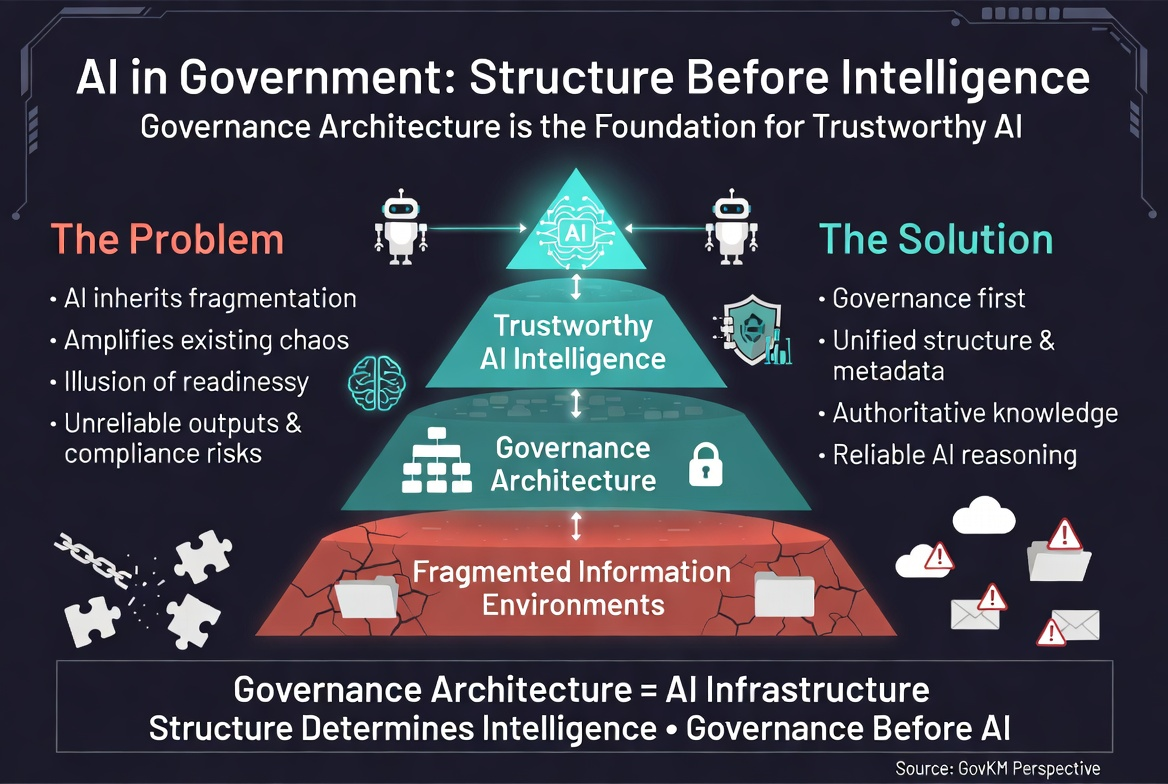
Why Metadata Fails Without Governance Architecture


Why Metadata Fails Without Governance Architecture
Organizations often treat metadata as the solution to information governance problems. New metadata fields are created. Taxonomies are expanded. Labels are added. Governance teams standardize terminology and publish guidance intended to improve consistency across repositories.
Yet despite these efforts, metadata environments continue to deteriorate over time.
Definitions diverge. Classifications drift. Duplicate values emerge. Automation becomes unreliable. Search quality degrades. AI systems inherit conflicting contextual information from disconnected repositories.
The problem is not metadata itself.
The problem is that metadata without governance architecture cannot remain authoritative.
Metadata Is Not Self-Governing
Most metadata strategies assume that consistency can be achieved simply by defining fields and assigning values. But metadata does not maintain itself.
Every metadata value depends on organizational decisions that evolve over time:
- what terms are allowed
- who owns definitions
- how classifications are applied
- which repositories inherit values
- what lifecycle rules attach to content
- how relationships are maintained across systems
Without structural authority governing these decisions, metadata gradually fragments as different business units reinterpret standards according to local operational needs.
This process is natural. Metadata reflects organizational behavior. If governance is decentralized, metadata becomes decentralized.
Metadata Drift Is a Governance Failure
Metadata drift occurs when values, definitions, and usage patterns gradually diverge from their original meaning.
One department may classify a document as a policy. Another may classify nearly identical content as guidance. A third may create an entirely new category to support local workflows.
Over time:
- taxonomies duplicate
- labels lose precision
- lifecycle rules conflict
- search results become unreliable
- automation logic breaks
- reporting becomes inconsistent
Organizations often respond by creating more metadata standards, more guidance documentation, or more governance committees.
But metadata drift is not fundamentally a metadata problem.
It is a governance architecture problem.
Metadata Without Structure Cannot Support Automation
Modern automation depends on trusted contextual structure.
Lifecycle enforcement, retention scheduling, records classification, AI analysis, enterprise search, and knowledge retrieval all require metadata that is predictable, authoritative, and interoperable across repositories.
Without governance architecture:
- automation becomes probabilistic
- retention actions become inconsistent
- classification logic becomes unreliable
- AI systems inherit conflicting semantics
- search relevance deteriorates
- auditability weakens
Metadata may still describe content, but it no longer reliably governs content.
This distinction is critical.
Descriptive metadata alone cannot create operational trust.
Governance Architecture Creates Authoritative Metadata
Metadata only becomes trustworthy when connected to governance architecture.
Governance architecture establishes the structural authority metadata depends upon to remain operational over time. This includes:
- unified classification standards
- controlled vocabularies
- authoritative taxonomy governance
- metadata inheritance rules
- lifecycle enforcement policies
- repository interoperability standards
- ownership and stewardship models
- auditability and validation controls
In this model, metadata is no longer treated as isolated labels attached to documents.
Instead, metadata becomes part of a governed operational system that connects information, policy, lifecycle, automation, and organizational accountability.
Metadata Is an Operational System
Many organizations still approach metadata as a tagging exercise. Fields are added to forms. Users are asked to classify content manually. Governance is reduced to naming conventions and dropdown values.
But metadata is not merely descriptive.
Metadata is operational infrastructure.
It determines:
- how information is discovered
- how automation behaves
- how records are retained
- how systems interoperate
- how AI interprets content
- how governance policies are enforced
When metadata lacks structural governance, organizations lose the ability to reliably automate or govern information at scale.
AI Inherits Metadata Maturity
Organizations increasingly expect artificial intelligence systems to solve longstanding information management problems.
But AI systems do not create authoritative structure.
They inherit the metadata quality, governance maturity, classification consistency, and architectural integrity of the environments they operate within.
If metadata is fragmented, AI reasoning becomes fragmented.
If classifications are inconsistent, AI interpretation becomes inconsistent.
If governance authority does not exist, AI systems amplify organizational ambiguity rather than resolve it.
Structure Determines Trust
Metadata only becomes authoritative when governed by structure.
Without governance architecture, metadata gradually becomes inconsistent, disconnected, and operationally unreliable regardless of how many standards, fields, or policies are introduced.
The future of intelligent government knowledge management will not be determined by who creates the most metadata.
It will be determined by who establishes governance architecture capable of making metadata trustworthy, interoperable, and operational at enterprise scale.
That is the transition GovKM is designed to support.
Continue Exploring
The Agent Was Asked to Fix the App. It Changed the Model.
The Government Email Was Real. The Authority Wasn’t.