Why Shared Drives Became the Default Knowledge System — And Why That Model Is Failing
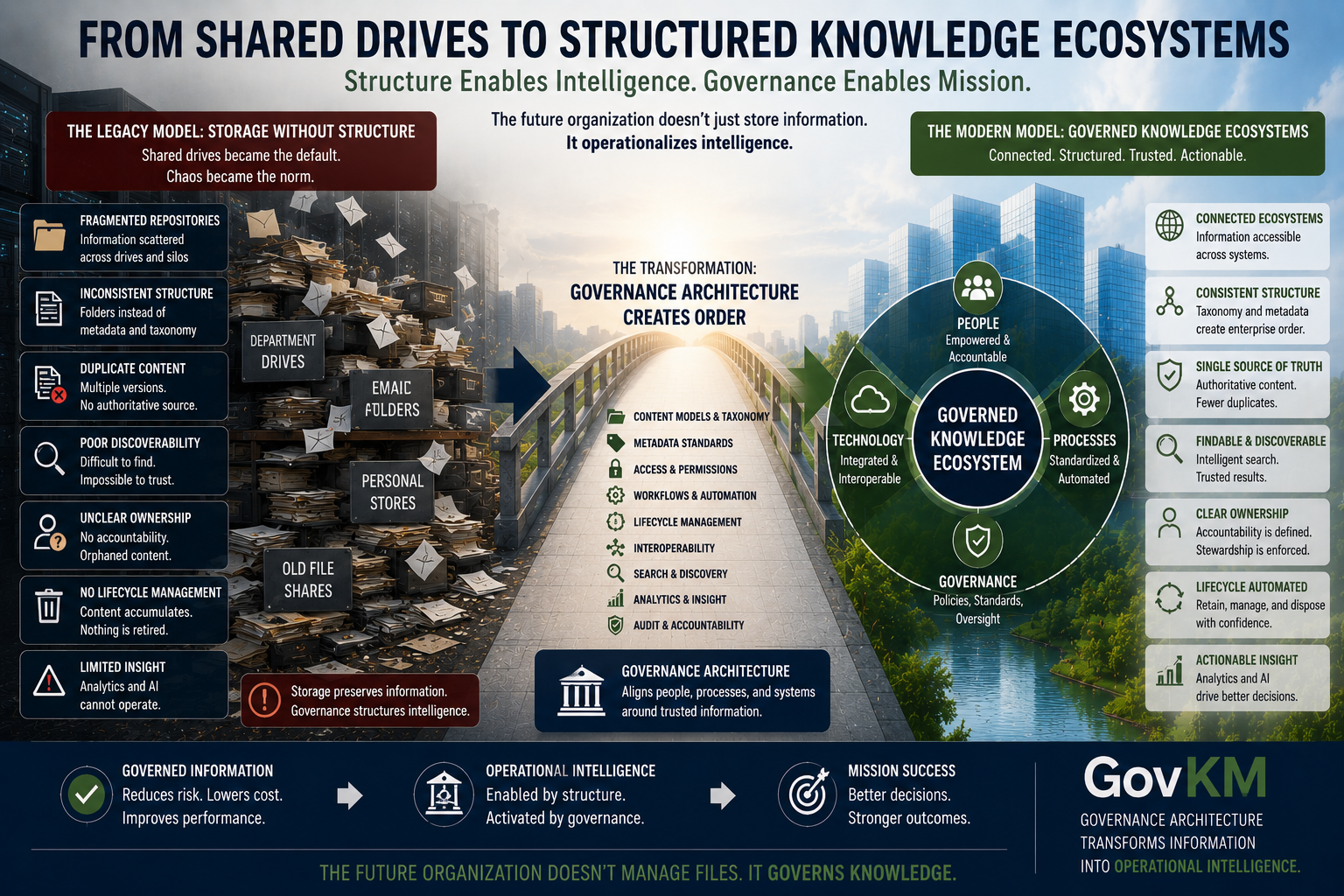

Government organizations already operate some of the most sophisticated structured information systems in existence.
Across the enterprise, highly specialized operational platforms govern:
- acquisition,
- finance,
- human resources,
- logistics,
- security,
- mission operations,
- investigations,
- intelligence,
- and countless other agency-specific functions.
These systems are not accidental collections of files.
They are engineered operational ecosystems.
Within them:
- data structures are predefined,
- metadata is governed,
- workflows are controlled,
- permissions are contextual,
- lifecycle management is automated,
- and organizational accountability is measurable.
These systems succeed because governance architecture exists before information enters the environment.
Yet outside these structured systems, a very different reality emerged.
The Rise of the Shared Drive
Most enterprise operational knowledge does not originate inside mission applications.
Employees continuously generate:
- reports,
- briefings,
- strategies,
- meeting notes,
- schedules,
- taskers,
- planning documents,
- presentations,
- evaluations,
- analyses,
- newsletters,
- spreadsheets,
- and collaborative operational content.
Historically, much of this information lacked a formally governed destination.
So organizations defaulted to the simplest available solution:
the shared drive.
At the time, this appeared practical.
Shared drives allowed:
- rapid collaboration,
- decentralized storage,
- local organization,
- and operational flexibility.
Users created folders that made sense to them personally or within their immediate organizational context. Over time, these local storage habits evolved into sprawling enterprise repositories composed of:
- nested folder structures,
- duplicated content,
- abandoned drafts,
- disconnected project spaces,
- inconsistent naming conventions,
- and fragmented operational knowledge.
What began as convenient storage slowly became the organization’s de facto knowledge management system.
Without anyone intentionally designing it that way.
Folder Structures Became Surrogate Metadata
As shared drives expanded, organizations unintentionally attempted to solve governance problems through folder structures.
Folders inside folders inside folders became manual attempts to simulate:
- taxonomy,
- metadata,
- ownership,
- operational context,
- and information relationships.
But folder paths were never designed to carry enterprise meaning at scale.
One office organized content by customer.
Another by fiscal year.
Another by project.
Another by organizational hierarchy.
Another by individual employee preference.
Over time, the enterprise accumulated thousands of isolated organizational paradigms operating simultaneously across the same ecosystem.
This created an environment where:
- discoverability deteriorated,
- duplicate content multiplied,
- ownership became unclear,
- lifecycle management became inconsistent,
- and organizational memory became increasingly fragile.
The problem was not storage capacity.
The problem was structural fragmentation.
The Enterprise Already Built Better Systems
Ironically, organizations already possess platforms designed to solve these exact problems.
Modern content management platforms are capable of:
- metadata governance,
- lifecycle automation,
- contextual permissions,
- workflow integration,
- auditability,
- interoperability,
- search optimization,
- analytics,
- and structured content relationships.
Yet many organizations implemented these platforms while carrying forward legacy file-management behaviors.
Instead of redesigning governance architecture, agencies frequently recreated shared-drive folder structures inside modern platforms.
Chaos was migrated rather than transformed.
This revealed a critical realization:
Technology alone does not modernize information environments.
Governance architecture does.
The Problem Was Never Shared Drives Alone
Shared drives themselves are not the true issue.
The deeper issue is that organizations treated storage systems as governance systems.
Storage and governance are not the same thing.
A storage platform preserves information.
Governance architecture structures intelligence.
This distinction matters because modern enterprises no longer operate in the era of file management.
They operate in the era of operational knowledge ecosystems.
Today, organizations require information environments capable of supporting:
- enterprise search,
- interoperability,
- automation,
- analytics,
- lifecycle governance,
- operational continuity,
- and artificial intelligence.
None of these capabilities function reliably against fragmented repositories lacking authoritative governance structure.
AI cannot reason effectively against unmanaged operational chaos.
Search cannot become intelligent without governed metadata.
Analytics cannot produce trustworthy insight from structurally inconsistent ecosystems.
Structure determines intelligence.
Why Operational Content Matters Most
One of the largest misconceptions in enterprise governance is the belief that only mission-critical systems require structured oversight.
In reality, the overwhelming majority of enterprise information exists within operational business content:
- planning materials,
- briefings,
- schedules,
- reports,
- administrative records,
- communications,
- collaborative artifacts,
- and organizational knowledge objects generated daily across the enterprise.
This operational content forms the connective tissue of the organization itself.
Without governance architecture, this knowledge becomes:
- difficult to discover,
- impossible to analyze consistently,
- vulnerable to duplication,
- operationally fragmented,
- and increasingly disconnected from enterprise intelligence efforts.
This is why governance modernization is no longer optional.
The operational cost of unmanaged knowledge has become too large.
The Future Enterprise
The future organization will not be defined by the number of systems it deploys.
It will be defined by how structurally those systems organize operational knowledge.
This requires moving beyond:
- storage-centric thinking,
- unmanaged collaboration,
- and folder-based organizational behavior.
And toward:
- governed knowledge ecosystems,
- authoritative metadata architecture,
- lifecycle automation,
- interoperability,
- contextual information relationships,
- and machine-readable enterprise environments.
Shared drives may continue serving transitional purposes:
- temporary collaboration,
- staging,
- legacy storage,
- or interoperability support.
But they can no longer remain the primary operational knowledge architecture of the enterprise.
Because the future organization is not attempting merely to store information.
It is attempting to operationalize intelligence.
Continue Exploring
A Malformed Image Became a Pull Request.
The Agent Deleted the Evidence of Its Own Failure.