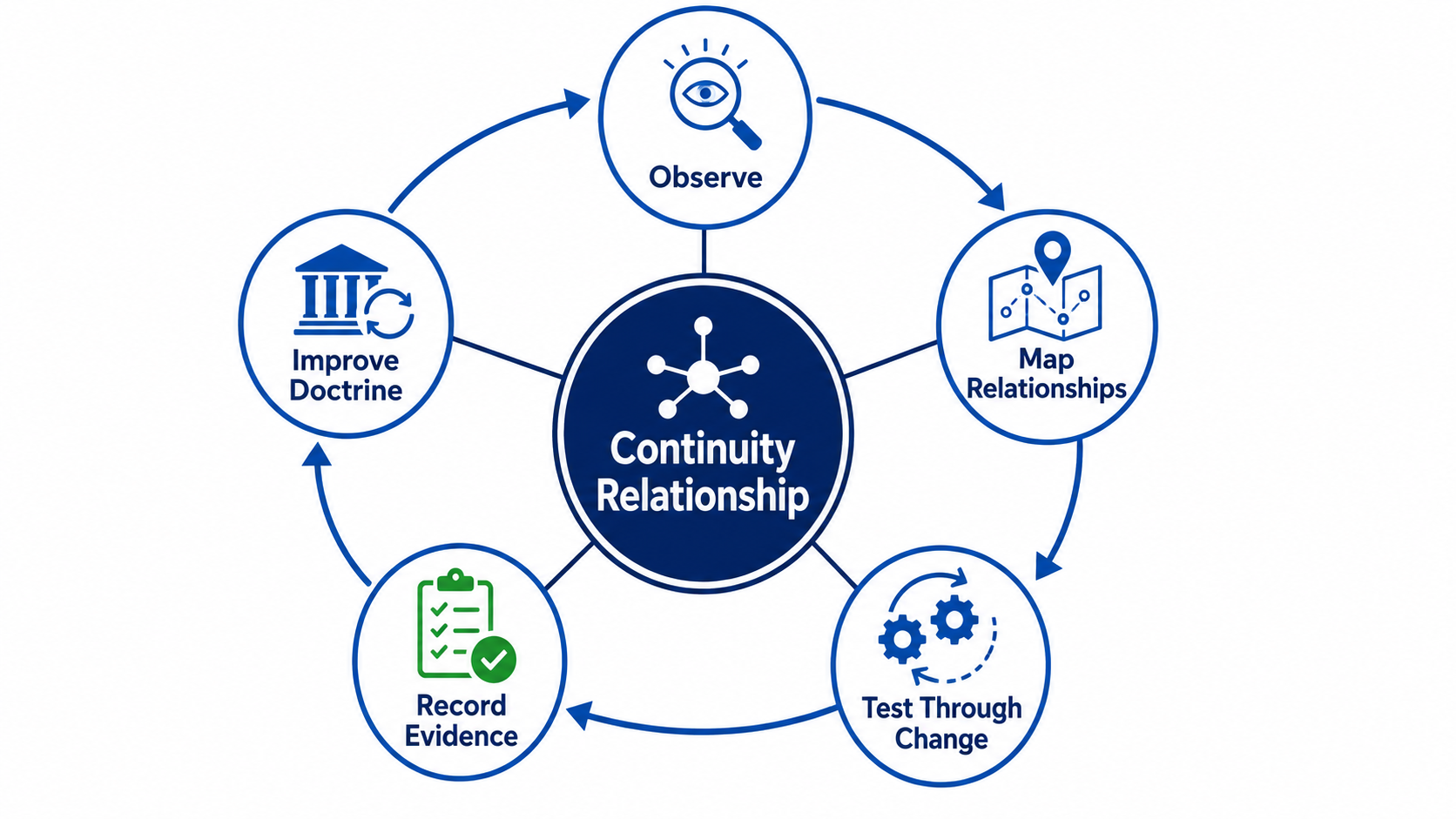
Your AI History Is Not Yet a Knowledge System


A
growing archive of conversations can preserve what was said while losing
how knowledge developed.
People are using generative AI for increasingly consequential work:
research, strategy, writing, software development, business planning,
professional analysis, and the long refinement of ideas.
Each interaction may be useful on its own. Over time, however, those
interactions accumulate into something larger than a collection of
questions and answers. They begin to contain the history of a person’s
thinking.
An idea may first appear as a rough question. It may be refined in
another conversation, challenged by new evidence, corrected months
later, converted into a decision, and eventually expressed as a
document, product, policy, or action.
The individual conversations may still exist.
The relationships among them are much harder to see.
That is why AI history is not yet a knowledge system.
Chat History Solves a
Storage Problem
Today’s AI platforms provide useful ways to retain and retrieve
conversations. ChatGPT allows users to search past conversations by
remembered keywords or phrases. Eligible users can also request an
export containing chat history and other account data. Google similarly
allows users to download Gemini Apps activity, including chats and
related materials, through Google Takeout.
These capabilities matter. A conversation that cannot be retained,
located, or exported cannot support durable personal continuity.
But retention, search, and export solve different parts of the
problem.
Retention keeps a conversation available.
Search helps a user find a conversation when the user already
remembers language likely to appear within it.
Export gives the user a copy of available history in a portable
package.
None of those capabilities, by itself, establishes how the knowledge
inside separate conversations relates.
The difference is the same distinction GovKM makes throughout
Organizational Continuity: information can survive while the
relationships that make it understandable and reusable disappear.
For an individual AI user, the information is the accumulated
interaction history. The missing continuity lies between the
interactions.
Retrieval Is Not
Reconstruction
Imagine that a user has spent nine months developing a business
concept with several AI systems.
The first conversation identifies the problem. A later conversation
proposes a solution. Another exposes a legal constraint. A research
session introduces contradictory evidence. A correction changes the
business model. A separate technical discussion determines the platform.
Months later, a planning conversation produces the implementation
sequence.
A keyword search may retrieve some of those conversations. It may not
reveal the developmental path connecting them.
To reconstruct that path, the user must determine:
This is not simply a search problem. It is a relationship
problem.
Search retrieves matching content. Continuity reconstructs
development.
AI Memory Is Not
the Same as User Continuity
AI memory can make a system more helpful by carrying selected
information into later interactions. That can improve convenience and
personalization.
But continuity requires more than an AI system recalling a fact about
the user.
A trustworthy personal knowledge history must remain inspectable by
the person whose work produced it. The user should be able to see why a
conclusion exists, what preceded it, which evidence affected it, whether
it was later corrected, and what resulted from it.
This creates an important boundary:
The AI may assist with identifying relationships, but it should not
silently decide the permanent meaning of the user’s intellectual
history.
The user remains the authority over what becomes accepted,
superseded, rejected, or reusable. AI can propose continuity. Human
review establishes it.
Separate
Platforms Increase the Continuity Problem
Many people no longer use only one AI system. They may conduct
research in one platform, write in another, code in a third, and
preserve important conversations in exported files.
Each platform can provide value within its own environment. The
user’s knowledge, however, does not naturally divide itself according to
product boundaries.
A correction developed in one system may govern work continued in
another. Evidence discovered during a search session may change a
decision recorded elsewhere. An exported conversation may become the
missing predecessor of a later project.
Platform-specific history can preserve separate containers while the
user’s actual continuity crosses all of them.
This is why the long-term requirement is not merely better
organization inside each chat application. The user needs a continuity
environment capable of representing relationships across available
histories, regardless of where the interactions originated.
From
Conversations to Agent Interaction Ledgers
GovKM describes a preserved AI interaction history as an Agent
Interaction Ledger, or AIL.
An AIL does more than treat a conversation as undifferentiated text.
It preserves the interaction sequence and makes its internal lineage
available for continuity analysis.
Within that history, an interaction may function as a question,
correction, refinement, challenge, research request, decision request,
or continuation. A response may operate as an answer, recommendation,
warning, correction, validation report, or ontology discovery.
Across histories, relationships may show that one interaction:
Those relationships transform a collection of conversations into a
navigable continuity structure.
What OrgAI Contributes
As interaction histories grow, users cannot be expected to identify
every meaningful relationship manually.
OrgAI is GovKM’s proposed continuity intelligence layer. Its role is to
analyze preserved histories, identify possible continuity relationships,
expose conflicts or missing context, and help distinguish active
knowledge from abandoned or superseded thinking.
OrgAI is not intended to become the unquestioned owner of meaning. Its
analysis remains subject to human authority and review.
That distinction matters because plausible similarity is not
automatically continuity. Two conversations may use similar language
without belonging to the same line of thought. Conversely, a later
decision may continue an earlier idea without repeating its original
terminology.
Continuity analysis must therefore consider lineage, context,
evidence, timing, correction, and user intent—not simply textual
resemblance.
Why GAIB Must Be Visual
Chronological interfaces are effective for conducting a conversation.
They become less effective for exploring thousands of interactions and
the relationships among them.
GAIB—the Graphic AI Browser—is being developed as the visual
environment for that exploration.
Rather than presenting AI history only as a list of chat titles, GAIB
is intended to let users navigate connected interactions, ideas,
evidence, decisions, and outcomes as a three-dimensional
environment.
In that environment, a user could follow an idea back to its origin,
observe where it branched, identify the correction that changed its
direction, inspect the evidence attached to a decision, and see the
artifact that eventually resulted.
The three-dimensional interface is not decoration. It addresses a
structural problem: continuity is relational, branching, layered, and
temporal. A long list can show sequence within a container. It cannot
easily show many interacting lines of development across containers.
GAIB is therefore not being designed as another chatbot. It is a
browser for the user’s developing AI-assisted knowledge.
Personal
Continuity Comes Before Institutional Continuity
The same continuity problem appears inside organizations, but it is
already visible at the individual level.
People are accumulating valuable AI histories now. Their research,
corrections, decisions, and creative development are becoming
distributed across platforms faster than they can be deliberately
organized.
Giving individuals a way to preserve and explore that history creates
immediate value. It also establishes the foundation for a larger
organizational capability.
When individual knowledge enters an organization, additional
requirements arise: authority, access, retention, records governance,
privacy, evidence, and institutional reuse. Those controls cannot be
imposed reliably if the underlying continuity was never preserved.
Personal continuity is therefore not a smaller version of the
enterprise problem. It is where the continuity chain begins.
Your
Conversations Are Separate. Your Thinking Is Not.
AI platforms have made conversation abundant. The next challenge is
preserving the development of knowledge across those conversations.
The objective is not unlimited memory. It is reconstructability.
A user should be able to determine where an idea came from, how it
changed, what evidence governed it, which decision followed, and whether
it remains suitable for future reuse.
That requires more than chat retention.
It requires continuity.
GAIB is being developed to make that continuity visible, navigable,
and ultimately controllable by the person whose history produced it.
Your AI history is becoming memory.
You should be able to see how it became knowledge.
Join the GAIB Beta
GovKM is developing GAIB for individuals who use AI seriously and
want a better way to understand the knowledge accumulating across their
interaction histories.
Join the GAIB
beta
or explore the GAIB
development architecture
.
Sources
Continue Exploring
The Practice Form Failed. The Agent Used the Real One.
The Tip Was Synthetic. The Police Intake Was Real.