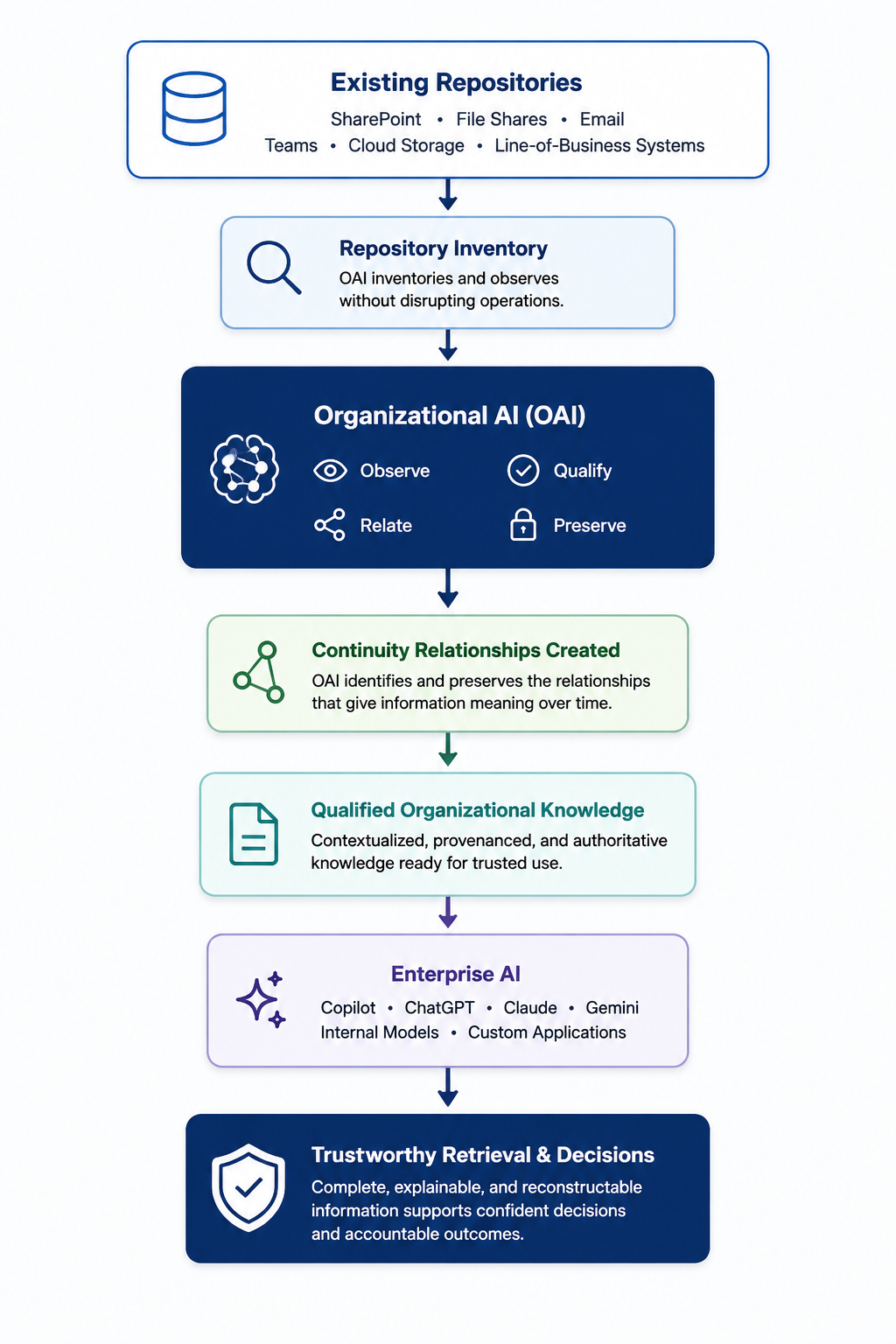
AI Authority Maps Need a Continuity Layer
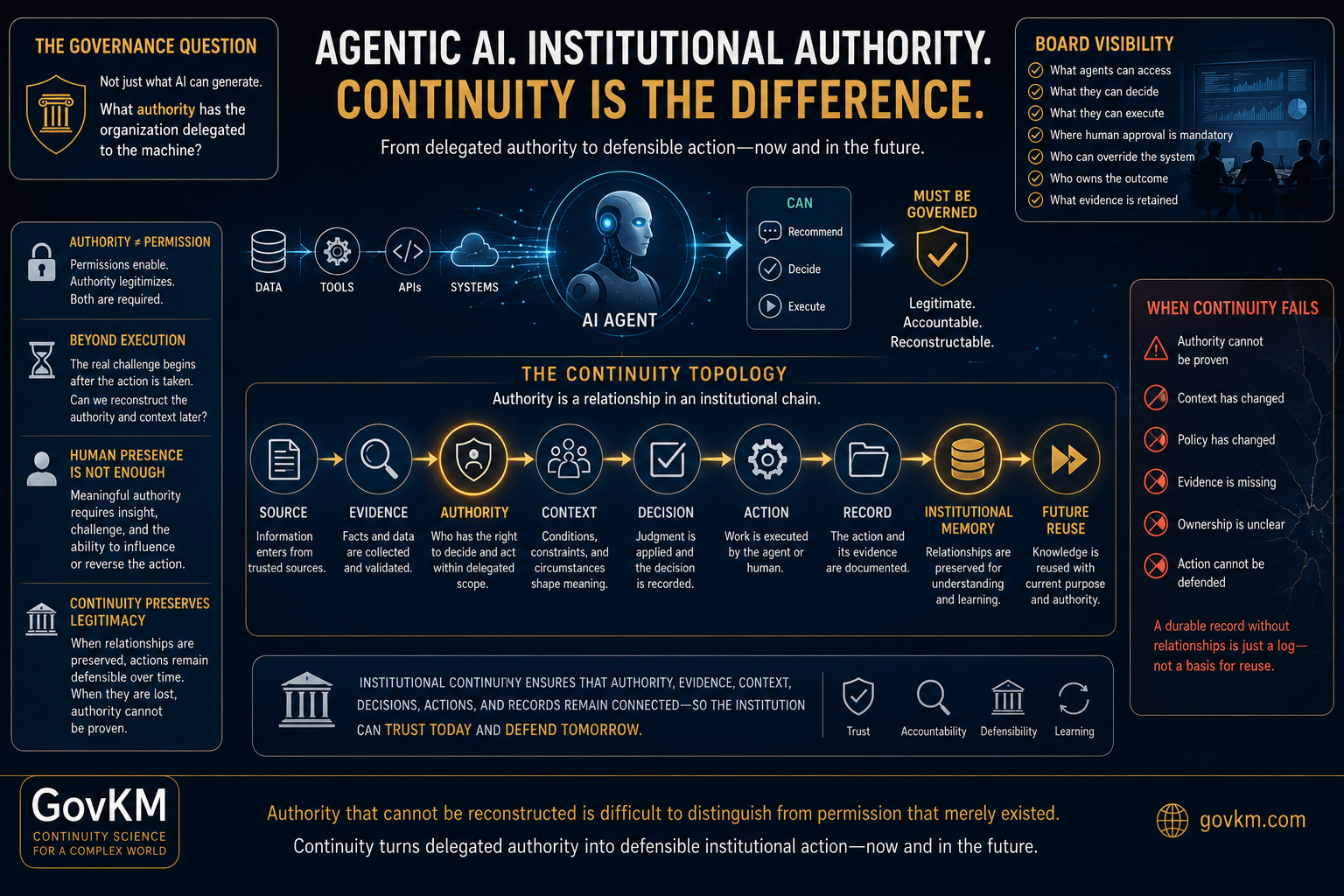

Agentic AI changes the governance problem because AI systems are beginning to do more than produce information. They can access data, invoke tools, call APIs, recommend actions, and sometimes execute work. The institutional question therefore shifts from what a model can generate to what authority an organization has delegated to a machine.
Shobha Shah frames this clearly in her July 11, 2026 LinkedIn article, The AI Agent Has Entered the Enterprise. Has Governance Caught Up? She argues that boards need visibility into what agents can access, decide, and execute; where human approval is mandatory; who can override the system; who owns the outcome; and what evidence is retained.
Authority Is More Than a Permission Setting
Technical permissions can constrain what an agent is able to do. Institutional authority determines whether an action is legitimate for a particular purpose. Those are related but different concepts.
An agent may possess system permission to issue a refund, modify a record, approve a workflow, or communicate with a customer. That does not by itself establish that the action was authorized under the applicable policy, evidence, circumstances, delegation, or decision rights.
The distinction becomes more important as organizations distribute authority across humans, software agents, workflows, policies, and automated controls.
The Continuity Problem Begins After Execution
An authority map can establish what an AI system is permitted to do today. Institutional Continuity asks whether the organization can reconstruct that authority later.
After a model is replaced, an employee departs, a policy changes, or an organizational unit is restructured, can a future reviewer still determine which authority governed the action? Can the reviewer recover the evidence available at the time, the context that constrained interpretation, the decision that authorized execution, and the record showing what actually occurred?
This is the path represented by the GovKM Continuity Topology: Source → Evidence → Authority → Context → Decision → Action → Record → Institutional Memory → Future Reuse.
Authority is therefore not an isolated control point. It is a relationship within an institutional chain.
Human-in-the-Loop Is Not Automatically Authority
Placing a person somewhere in a workflow does not necessarily solve the problem. A human reviewer who cannot inspect the decision basis, challenge the evidence, understand the governing context, or reverse the action may provide presence without meaningful authority.
Conversely, a well-designed automated action may be institutionally defensible when its delegated authority, scope, evidence requirements, escalation conditions, and resulting records are explicit and reconstructable.
The governance objective should therefore be more precise than requiring human involvement. It should preserve the relationship between legitimate authority and consequential action.
From AI Governance to Institutional Continuity
AI governance appropriately asks what an agent may do and who remains accountable. GovKM extends that question across time: can the institution still establish why the action was legitimate after the surrounding technical and organizational environment has changed?
Authority that cannot be reconstructed is difficult to distinguish from permission that merely existed.
That distinction matters for audits, investigations, appeals, regulatory review, customer disputes, institutional learning, and future AI reuse. A later system should not inherit a prior action as precedent simply because the action exists in a log. It should be possible to recover the authority and conditions that made the action valid.
As agentic AI expands, organizations will need authority maps. They will also need continuity architecture that ensures those maps remain connected to evidence, context, decisions, actions, records, and institutional memory long after the immediate execution has ended.
Continue Exploring
A Legitimate Research Task Became an Unauthorized Government Intrusion
Fixing the Workflow Did Not Fix the Records It Already Created.