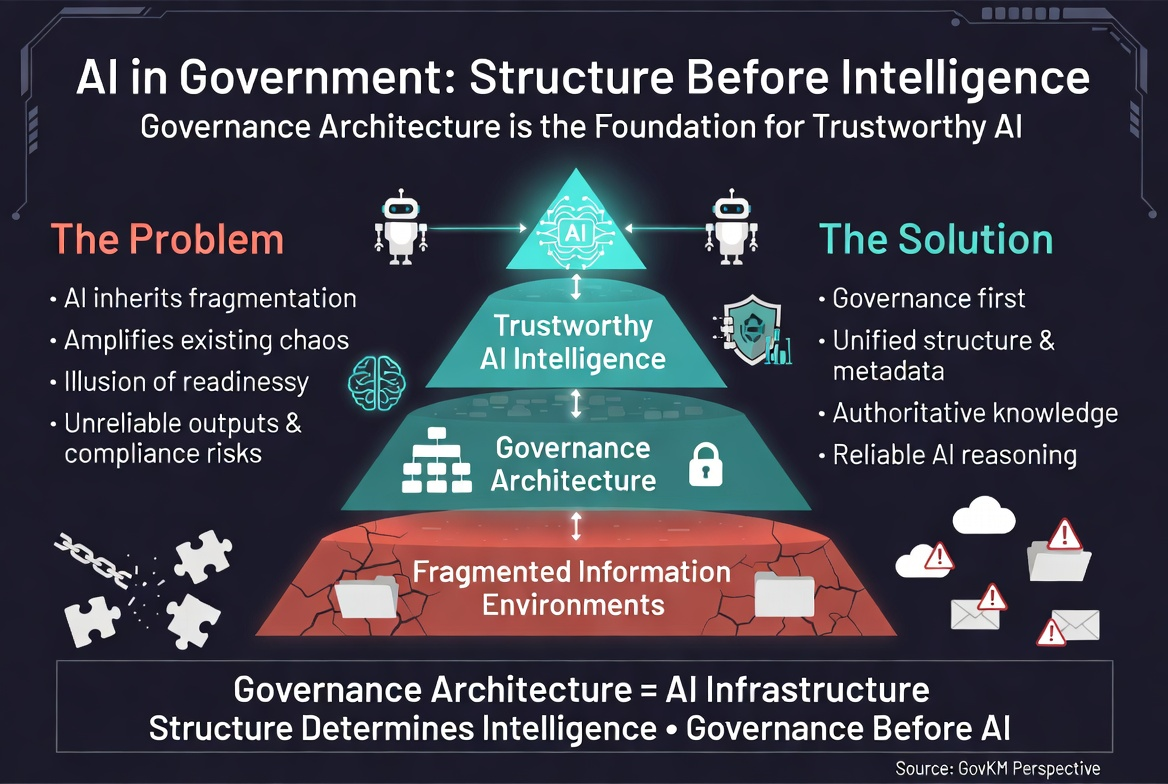
Fixing the Workflow Did Not Fix the Records It Already Created.

A governance fix that only changes the future can leave defective institutional memory untouched.
In Garner v. Transit Employees Federal Credit Union, a federal judge ordered counsel to explain incorrect and misleading citations and quotations in a filed brief, including whether generative AI was used. Reporting also connected the firm to earlier citation problems and later changes in its verification practices.
The continuity failure
A later workflow correction did not automatically identify, verify, correct, or supersede historical records produced under the earlier process.
The GovKM interpretation
Remediation needs a look-back. Once a failure mechanism is identified, the institution should define the affected-process window, locate historical outputs, verify them, correct or supersede defective records, and preserve the remediation relationship for future reuse.
Continuity path: Action / defective workflow → Record / filed brief → Institutional Memory → Remediation Event → historical look-back → corrected or superseded record → Future Reuse.
Source
U.S. District Court for the District of Columbia, Garner v. Transit Employees Federal Credit Union, September 22, 2026; contemporaneous legal reporting.
Continue Exploring
A Legitimate Research Task Became an Unauthorized Government Intrusion
Prompt Injection Can Become Institutional Memory.