VA ERP Modernization: Preserve Continuity Without Migrating Every Legacy Record

GovKM Practical Continuity Implementation Series | Finance
VA's latest notice: acquisition strategy and requirements remain under review
Source status verified November 11, 2026. On November 5, 2026, VA issued an ERP/System Integrator RFI Loopback update under 36C10B27Q0032 stating that the agency is reassessing its acquisition strategy and requirements. VA is evaluating existing capabilities against operational needs including integration, AI and automation, migration feasibility and cost. Previously published draft requirements remain subject to revision. VA requested no response to the November 5 notice and said future industry participation or schedule updates would be announced separately through SAM.gov.
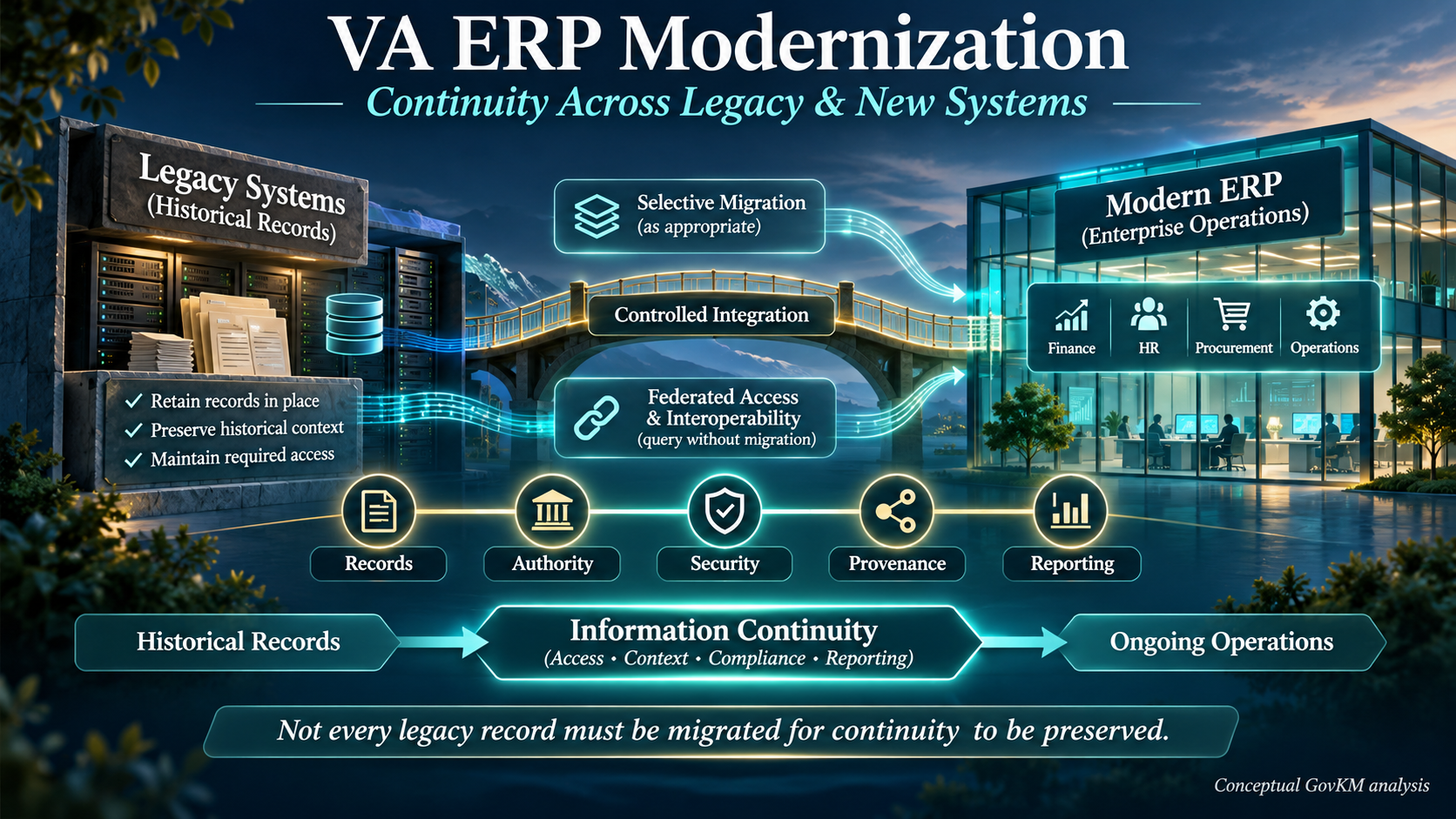
Earlier draft requirement: full legacy migration need not be mandatory
The October 9, 2026 VA ERP System Integrator Information/Discovery notice described potential approaches other than full legacy-data migration, including federated access, APIs, and incremental or selective migration. Its conditions included NARA retention compliance, production reporting, and documented risks, limitations and long-term support implications. Those were draft market-research parameters, not settled requirements or an awarded solution. This independent GovKM analysis takes that earlier option as a useful scenario to examine, while treating the November 5 reassessment as authoritative for the current procurement status.
Why this is a continuity problem
Moving fewer records can reduce transformation effort, yet the modern ERP may need to interpret legacy approvals, obligations, amendments and adjustments that remain in an older system. A record's location must not silently change whether it governs a transaction. GovKM's independent objective is to make evidence, governing authority, access rights, provenance and historical reporting reconstructable across the approved architecture.
1. Define authoritative business functions
Inventory the successor ERP functions and decisions: reporting, obligations, payments, approvals, reconciliation, auditing and historical research where applicable. For each function determine the required source evidence, owning office, governing policy, retention and permitted users. Output: signed function-to-evidence matrix.
2. Inventory legacy records and dependencies
Identify data stores, reports, metadata, supporting attachments, application workflows, approval history, identities, integrations and documentation. Capture extraction completeness, source IDs, retention schedules and unknowns. Inaccessible or unscheduled records are exceptions; they are not assumed disposable. Output: verified inventory and exception register.
3. Choose migration or federated access per record class
For each class compare full migration, read-only archives, API lookup, federation or selective extraction. Evaluate retrieval reliability, latency, semantic fidelity, security, historical context, provider dependency and future support. Test the proposed approach in the real authorized environment before acceptance. Output: decision matrix and source-by-source support plan.
4. Preserve identities, timing and provenance
Define consistent identifiers and links from successor transactions and reports to original evidence, amendments and approving authority. Preserve event dates separately from effective dates. Distinguish superseded versions from current instructions. Output: reference mapping, temporal rules and reconciliation evidence.
5. Retain secure and usable access
Implement least-privilege retrieval across both environments, including employee separations, changed delegations, guest access and privileged accounts. Test authorized and unauthorized retrieval and record audit events. Ensure fallback access when a legacy interface fails. Output: permission mapping, positive/negative access tests and recovery runbook.
6. Govern records through their full legal lifecycle
Use actual VA-approved records schedules, NARA requirements and legal holds for each series. Do not retire source platforms when doing so makes records inaccessible or untrustworthy before disposition. Maintain formats and technical documentation necessary to use them throughout the authorized retention period. Output: approved retention mapping and retirement gates.
7. Reconcile reporting and financial history
Test transaction-level drill-downs from ERP reports to original obligations, corrections, reversals, approval steps and supporting evidence, including mismatched time periods. Count exceptions; do not hide failed joins behind successful report totals. Output: independently checked report-to-source reconciliations.
8. Run a falsifiable continuity diagnostic
Use a wholly synthetic packet with an original obligation, a later authorized amendment, a payment, a correction and a superseded approval threshold. Ask a human analyst or authorized AI to determine the amount and approving authority at two historical dates. Observe whether cited records were actually delivered to the test subject; an indexed record alone does not prove model grounding. Repeat with the legacy archive interface unavailable. Output: test transcript, source evidence, failure conditions and accepted remediation.
Records authority: preservation is independent of ERP platform choice
NARA's records regulations identify 36 CFR Part 1236 as governing electronic records management. In particular, 36 CFR Part 1236 requires records-management controls and preservation of usable electronic records for the authorized retention period, with protections against technological obsolescence. NARA's Scheduling Records in Electronic Systems guidance explains that system and record lifecycles need not be identical. The proposed federal ERP implementation should therefore verify the specific VA-approved schedules, including agency-specific records and any legal holds, rather than assume that a system shutdown authorizes disposal or that every legacy system must remain active indefinitely.
9. Establish operational stewardship
Assign owners for the retained systems, integration services, source records, metadata, approval rules and reporting definitions. Monitor failing links, stale permissions, policy changes, vendor exits and archive outages. Revalidate after system updates. Output: continuity operations plan and signed handover.
Acceptance checklist
- Approved scope and every legacy record class accounted for or qualified as an exception
- Reporting and transactions reconstructable across historical and current boundaries
- Correct legal retention, preservation and access controls across environments
- Documented infrastructure and vendor dependencies with tested fallback
- Operative and superseded approval requirements distinguishable by effective date
- Independent technical and continuity acceptance, not mere file or index counts
Official authorities and limitations
VA November 5 RFI Loopback (latest); VA October 9 draft notice; VA Enterprise Directive 6300; NARA record scheduling; NARA electronic technology records guidance. The subsequent November 5 VA notice confirms the agency is reassessing acquisition strategy and draft requirements; it does not request an industry response. This guide is not official VA direction or a representation that an agency system failed. The implementation and synthetic diagnostic are GovKM-authored standards-aligned proposals that do not disclose proprietary OrgAI processes.
Continue Exploring

Finance Data Governance: Preparing Retail Information for Enterprise AI

Joint Training Knowledge Governance: Preparing Defense Information for AI