Answering Oregon DOJ's SharePoint GCC Migration Need with Information Continuity

GovKM Practical Implementation Guide | Information Technology
A migration can transfer every document into a modern platform yet still leave staff uncertain which version governs, who can see it, whether it remains a protected record, and how a historical decision was supported. For the organization, successful delivery means preserving not only content but the information relationships required for responsible use.
This practical guide analyzes the Oregon Department of Justice (DOJ) SharePoint Migration Request for Information, solicitation S-13700-00017089, published June 1, 2026. The RFI is an official statement of agency information needs—not a job posting, final statement of work, contract award, or proof that a migration has taken place. GovKM independently translates those published requirements into an illustrative implementation approach. No Oregon DOJ review, approval, sponsorship or endorsement is claimed.
The published migration need
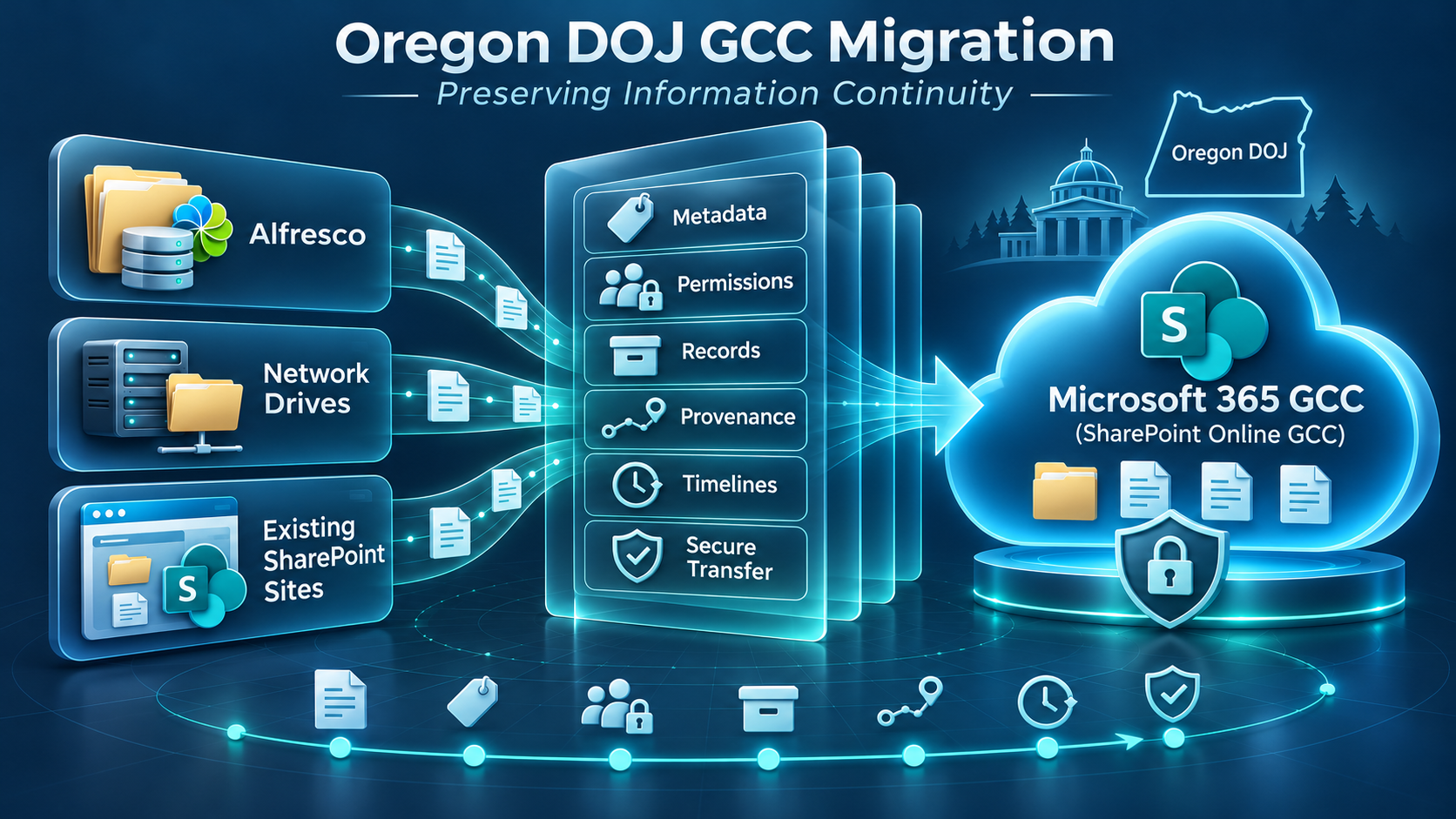
The DOJ initiative describes replacing Alfresco for relevant enterprise content and migrating in-scope administrative content from Alfresco, shared drives and selected existing SharePoint libraries to SharePoint Online in Microsoft 365 Government Community Cloud (GCC). It calls for sites and hubs, an enterprise metadata and taxonomy model, governance and retention controls, and preparation for a JusticeNexus-connected environment supporting legal case documents. The official RFI differentiates the administrative program from aspects of the Legal Tools Program and excludes certain content, including existing Teams-connected SharePoint-site migration beyond tenant-level policies. Actual scope must be reconciled with the awarded contract and approved source-owner instructions.
How the originating agency defines the challenge
Job advertisements can expose continuity-related work, but the originating organization's published requirements should govern the analysis whenever available. The source for this article is Oregon DOJ's June 1, 2026 RFI (S-13700-00017089), not any recruiter interpretation. The RFI asked the market for implementation approaches and related information; it was not an award, an authorized work order, or evidence that migration had been completed. Its response deadline has passed.
Read as an enterprise information-management objective, the agency's need is to establish a governed SharePoint Online GCC environment, replace or integrate selected legacy content sources, preserve required metadata and access controls, and support reliable use of content as functions and systems change. GovKM's continuity interpretation adds a bounded acceptance question: after migration, can authorized staff reconstruct which document and approval applied at a particular time, without losing provenance, legal controls or contradictory context? That question is a GovKM analytical proposal, not a quoted DOJ acceptance requirement.
The proposed continuity-preserving response
Successful implementation should deliver a governed information environment with clear source ownership, preserved record obligations, authorized access, version and temporal lineage, and demonstrable readiness for future reuse. The following nine stages translate the agency's described needs into implementation activities and independent completion evidence. Specific scope, tools, and procurement acceptance gates must be approved by the responsible agency officials under any subsequent agreement.
The nine stages below are a reusable practitioner roadmap. Each stage identifies work, governance dependencies and independently reviewable completion evidence; the actual project sponsor must approve tool selection, scope and acceptance criteria.
1. Establish authority, scope and the source inventory
Obtain approval from the project sponsor, security, records and repository owners before touching content. Record which Alfresco sites, network shares and SPO libraries are included or excluded, their responsible owners, volumes, permissions, formats, versions, custom properties, retention/hold statuses, workflows, and connected systems. Capture the inventory collection time and errors; inaccessible folders must remain explicit exceptions rather than being counted as empty.
Evidence of completion: approved scope baseline, complete-or-qualified source inventory, source ownership register and unresolved-source exception log.
2. Classify information and reconstruct operative authority
Identify active working content, records, archival evidence, duplicates, drafts, obsolete instructions, and content under retention or legal hold. Record where approved documents supersede earlier versions and the effective dates of each policy. Where a source system contains approval history or revision context that SharePoint cannot represent natively, establish a controlled provenance manifest and documented retrieval path. The candidate must not equate an old modification date with an obsolete legal authority or assume every inactive file may be deleted.
Evidence: document-classification matrix, approved record and hold mapping, version/authority relationship inventory and disposition exceptions.
3. Design the GCC destination as a governed information environment
Define sites and hub relationships around organizational responsibilities rather than simply copying legacy directories. Establish site owners, metadata dictionary, content types, taxonomy, libraries, access boundaries, retention settings, versioning, auditability and search. Map the source IDs, path, fields, ACL and version history to target fields or approved supplemental records. Preserve distinctions between administrative content and sensitive JusticeNexus-linked legal workflows. Obtain independent confirmation of the actual Dynamics 365 integration specifications before implementing any integration.
Evidence: target architecture, approved information architecture, mapping workbook, security model and records controls.
4. Validate tools against government-cloud and source limitations
Microsoft Migration Manager government-cloud guidance describes file-share migration support in government environments. The SharePoint Migration Tool supports specified on-premises SharePoint and file-share sources, subject to the GCC settings and prerequisites. Neither establishes a lossless native Alfresco migration: assess supported Alfresco exports, APIs or qualified third-party tools for metadata, versions, security, records, fidelity, US-government cloud support and approved data residency.
For existing SPO sites, distinguish in-tenant restructuring from cross-tenant movement. Microsoft's cross-tenant SharePoint migration FAQ expressly says its feature does not currently support GCC or GCC High. Do not plan around unsupported functionality. Select and demonstrate each tool against the actual source/destination configuration, not marketing claims.
Evidence: approved tool-capability matrix, data-flow/security assessment, pilot prerequisites and unsupported-feature register.
5. Map permissions, identities and retention
Resolve users, service accounts, groups, inherited and uniquely assigned ACLs, disabled or removed actors, guest privileges and sharing links. Validate that a person authorized to upload a file is not automatically authorized to read it. Handle inaccessible membership lists as incomplete evidence, not as a reason to grant everyone access or silently revoke legitimate rights. Map holds and retention schedules with records officers; no cleanup should bypass authorized disposition.
Evidence: identity/ACL crosswalk, negative-access tests and signed retention/hold treatment.
6. Execute representative pilots and reconcile every outcome
Use permitted pilot content representing large files, several versions, unusual metadata, unique permissions, broken links, a legal hold and a synthetic policy succession. For each item, preserve a source ID, target ID, migration timestamp, transformation, result and exception. Validate hashes where meaningful, metadata, version counts, permissions and retrieval from the target. An upload success message is not evidence that a file is searchable, properly accessible or preserved as a record.
Evidence: reconciled pilot inventory, source-to-target manifest, independent checks and owner approval.
7. Schedule waves, deltas, cutover and rollback
Group waves by organizational function, operational criticality and dependencies. During coexistence establish which system is authoritative, how changes are captured, and how moves, deletions and permission revocations are reconciled. Use a documented cutover authorization and contingency procedure, including a decision point for abandoning a wave without leaving competing authoritative copies. Inform and train users before the legacy write path is retired.
Evidence: wave schedule, delta reports, signed cutover checklist, exception handling and rollback conditions.
8. Apply two independent acceptance tests
Technical migration acceptance: inventory counts, file integrity, versions, metadata, source-to-target references, identity permissions, holds, search, links and record lifecycle must match approved expectations or have formally accepted exceptions.
Information-continuity acceptance: give an authorized analyst or an AI a synthetic record packet: policy A operative January–September, amendment B operative from October, and a limited delegation C. Ask which rule applied on each date and who was authorized to approve an exception. A passing response identifies the applicable source, date, authority and conflicts without inventing missing evidence. A complete search index alone does not prove what evidence was delivered into an AI model's actual request; record that delivery separately where testing is authorized.
Evidence: acceptance report with technical reconciliations, current-and-historical decision reconstruction, model-input evidence where actually audited and unresolved issues.
9. Stabilize the environment and prepare it for enterprise AI
Assign durable information owners, records officers and stewards. Establish procedures for metadata correction, authoritative policy revision, supersession, revocation, disposition, audit and exception management. Retain reconciliation manifests and source records according to approved obligations. Make future enterprise AI retrieval permission-aware and traceable, with explicit distinctions between the available source inventory, retrieved candidate evidence, actual model-visible material and the model's own answer. Organizational officials retain decision authority.
Evidence: owner register, stewardship procedures, training and knowledge-transfer receipts, production acceptance and controlled handoff.
Practical acceptance checklist
- Scope and exclusions documented against the authoritative work order.
- Source inventory completeness or known gaps disclosed.
- Target architecture, security, taxonomy and retention approved.
- Every tool and Alfresco export path validated for the actual GCC environment.
- Versions, operative dates, owners and provenance preserved or reconciled.
- Unauthorized retrieval denied without mistakenly suppressing authorized material.
- Migration deltas and deletes reconciled; holds never silently discarded.
- At least one current-versus-historical authority scenario passed with attributable evidence.
- Exception disposition and cutover signed by authorized owners.
Why this approach begins with the originating organization
The public Oregon DOJ RFI is stronger evidence of the agency's objectives than a staffing intermediary's derivative description. Where a hiring listing leads to a first-party solicitation or program record, GovKM should use that original record to establish scope, distinguish explicit requirements from its own continuity recommendations, and cite applicable technical and regulatory sources. Recruitment language may be useful for discovery and a separate workforce discussion, but should not overwrite official scope or imply an active vacancy.
Official authorities and source limitations
Oregon DOJ SharePoint Migration RFI, S-13700-00017089; Microsoft Migration Manager government-cloud settings; SharePoint Migration Tool configuration; Cross-tenant SharePoint migration limitations; NARA records-management resources (relevant as reference only; Oregon-specific rules must be evaluated separately). These sources do not endorse GovKM, and implementation requirements may change with procurement terms, current product support, or applicable state policy.
This article contains no proprietary OrgAI architecture and describes no completed GovKM-native migration or AI evaluation. It is not an Oregon DOJ instruction or procurement response, and it is not represented as endorsed or reviewed by Oregon DOJ. Official publication of the underlying RFI permits accurate analysis of public requirements; it does not confer permission to reproduce agency logos or imply agency endorsement. The RFI closed for responses in June 2026; no current hiring vacancy or open solicitation is implied.
Conclusion
The agency's stated modernization need calls for more than a cloud file transfer. The proposed outcome is a governed GCC information environment in which authorized personnel can locate the right evidence, establish its authority, understand its historical context, preserve its obligations and reconstruct the decisions it supports.
Continue Exploring

Finance Data Governance: Preparing Retail Information for Enterprise AI

Joint Training Knowledge Governance: Preparing Defense Information for AI