
GovKM Practical Continuity Implementation Series | Defense
The organizational need
Serco's own careers listings identify requisition 34921 for a Senior Information Management / Knowledge Management Specialist supporting Joint Staff J-7 Deputy Directorate for Joint Training and Exercises in Suffolk, Virginia. The original contractor listing establishes a specialist support need; it does not independently establish an agency information failure, official Joint Staff requirements document, or any new GovKM engagement.
GovKM's independent continuity interpretation is that training knowledge must remain authoritative, accessible to permitted users, historically reconstructable and accurately scoped as people, exercises, systems and instructions change. An approved AI tool is only as dependable as the governed knowledge corpus it actually receives.
1. Establish the approved knowledge baseline
Inventory authorized training procedures, exercise products, lessons, after-action evidence, working repositories, records schedules and designated custodians. Explicitly identify records whose owner or authority cannot yet be verified. Use no classified or restricted materials in a public demonstration. Deliverable: owner-approved inventory and custody/authority register.
2. Define operative versions and delegation
Associate approved guidance with responsible authority, function, effective date, change approval, expiration or superseding directive. Record transfer and revocation of delegations where they affect decisions. Deliverable: effective-dated authority matrix and change log.
3. Preserve records and supporting evidence
Connect decisions, exercise products and records to their underlying permitted sources and subsequent corrections. Maintain source IDs, provenance and chain of custody across any SharePoint, collaboration or archival changes. Validate all required material against approved records controls. Deliverable: reconstruction samples and source-to-target reconciliation, including failures.
4. Secure access and records lifecycle
Identify the specific applicable DoD and Joint Staff policies, Federal Records Act obligations, NARA regulations, classification instructions, approved schedules, legal holds and security authorities. Verify least privilege and personnel/contractor handoffs; do not assume authority from organizational title or document location. Deliverable: approved classification, retention and ACL map with positive/negative tests.
5. Prepare approved content for AI retrieval
Structure current and historical authorized material so a retrieval system can distinguish operative guidance from superseded records and determine whether the user may see it. Validate what the AI was actually given, not just what was stored or indexed. Missing authorization or source evidence must trigger an explicit exception. Deliverable: source-to-model receipts, citations, authorization evidence and documented abstentions.
6. Institutionalize maintenance
Set continuing ownership, periodic authority checks, user training, document amendment workflows, contractor transition controls and approval gates for consequential updates. Deliverable: stewardship agreement, exception register and handoff verification.
Falsifiable synthetic Text–Graph–Text–Graph diagnostic
Use a fictional unclassified exercise with a directive valid at time A, an authorized revision at time B, an after-action record and a revoked reader entitlement. PASS only if an authorized model answers historical and current questions with the proper respective authority, identifies the sources actually supplied to it, avoids disclosing revoked material and states uncertainty where evidence is absent. No Serco or Joint Staff production systems are tested.
Official authorities and limitations
Starting authorities include the Federal Records Act, 36 CFR Chapter XII, Subchapter B for federal records management, applicable DoD issuances and authorized DoD records schedules, and the voluntary NIST AI RMF Playbook. The actual controlling directives, access policies and schedules must be determined by the authorized program owner; this public guidance neither describes classified architecture nor asserts that a particular military system is noncompliant.
The GovKM advantage
Migration, collaboration and better search are valuable, but none alone establishes which guidance currently governs or whether a model received complete permissible evidence. Preparing the corpus for compliance, clear ownership, source lineage, correct historical authority and safe AI retrieval creates a model-independent foundation for enterprise AI decision support.
Independent GovKM educational analysis grounded in a Serco-originated specialist listing, not a Joint Staff endorsement, verified operational deficiency or completed GovKM-native test.
Continue Exploring

Finance Data Governance: Preparing Retail Information for Enterprise AI
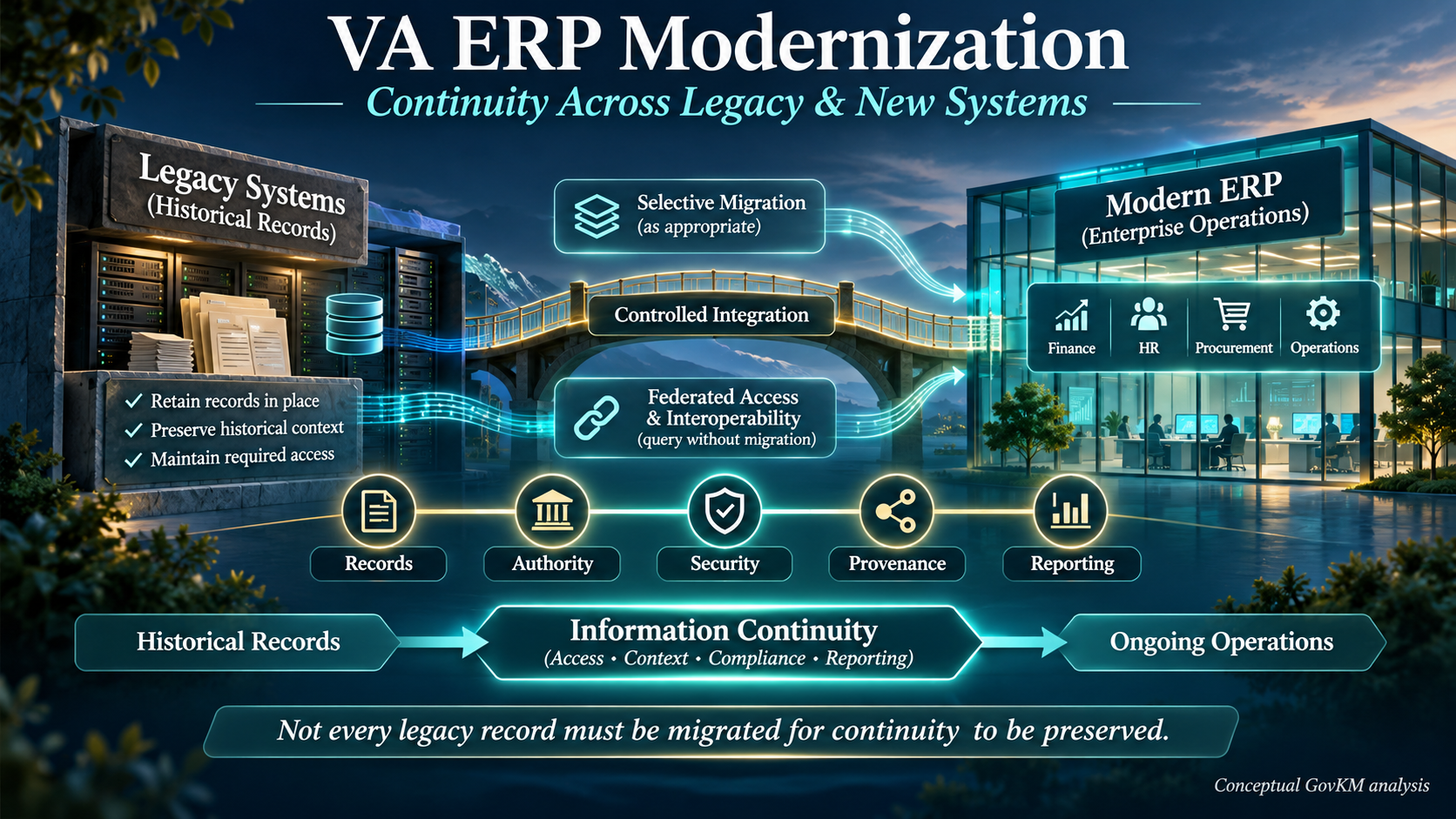
VA ERP Modernization: Preserve Continuity Without Migrating Every Legacy Record