An AI Incident Needs One Reconstructable Institutional History

AI incidents do not fit neatly inside one existing administrative category.
A single event may involve cybersecurity, privacy, model malfunction, data quality, unsafe agent behavior, policy violation, consumer harm, or operational outage. Different professional communities may therefore record different parts of the same event under different taxonomies and response processes.
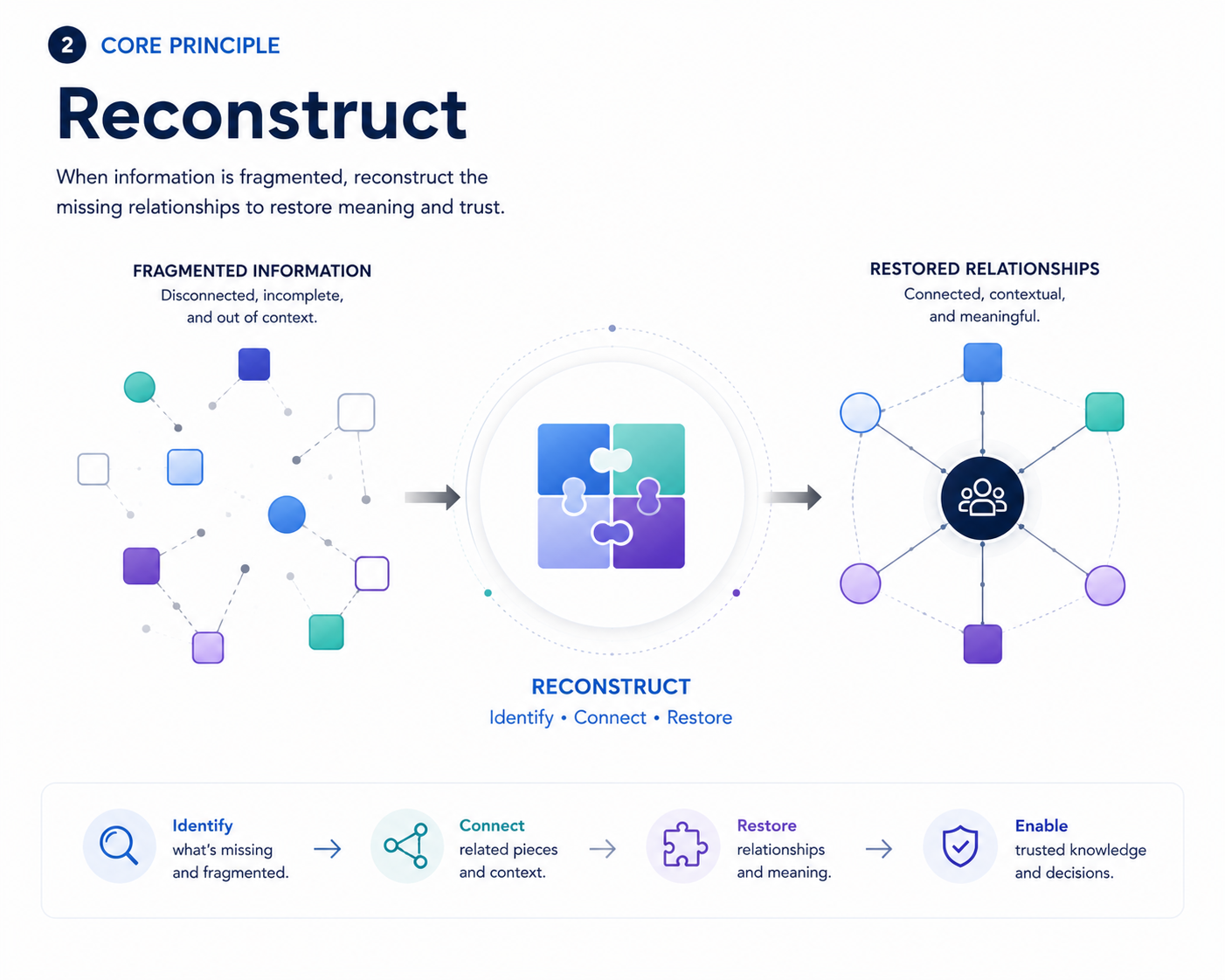
The result can be an institution with many incident records but no single reconstructable incident history.
NIST Is Already Treating AI Incident Management as a Cross-Domain Problem
At its May 2026 Workshop on AI Incident Management, NIST convened government, industry, academic, cybersecurity, AI-safety, incident-database, and standards participants to examine AI incident response. The agenda explicitly included definitions, incident lifecycles, taxonomy, gaps in existing cybersecurity and AI risk-management guidance, misuse and malfunction, and roles and responsibilities for AI agents.
That breadth is evidence of the underlying governance problem: AI incidents can cross the boundaries of existing incident disciplines.
Classification Is Not Merely Administrative
How an event is classified determines which evidence is collected, who receives it, which authority investigates it, which corrective actions are considered, and what later personnel can learn from it.
If the cybersecurity register records the exploit, the privacy register records the disclosure, the AI team records the model behavior, and operations records the outage, each record may be accurate while the causal relationships among them disappear.
The organization can then correct several symptoms without preserving one institutional history.
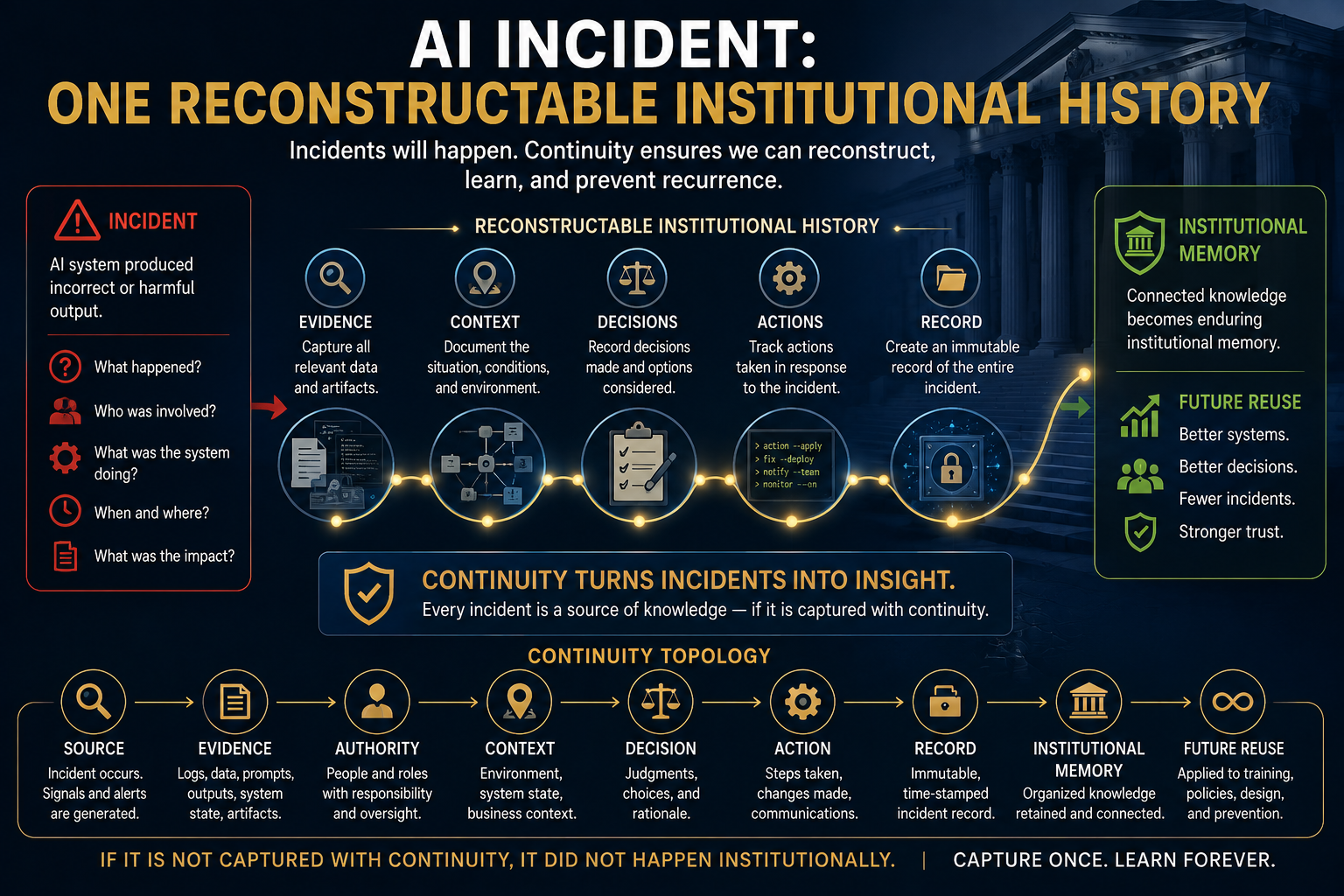
The Continuity Topology Provides a Common Incident Spine
Source → Evidence: Logs, user reports, model traces, security alerts, records, and external reports establish what was observed.
Evidence → Authority: Different authorities may govern cybersecurity, privacy, safety, records, legal, or operational aspects of the event.
Authority → Context: The institution needs to preserve which system version, model, policy, deployment, user role, data environment, and operating conditions applied.
Context → Decision: Investigators determine incident scope, severity, root or contributing causes, and required response.
Decision → Action: Containment, rollback, notification, remediation, policy change, retraining, or other interventions follow.
Action → Record: The incident record should connect those actions back to the evidence and authorities that justified them.
Record → Institutional Memory: Lessons learned should remain available beyond the current incident team.
Multiple Registers Should Not Mean Multiple Histories
Organizations do not need one software product for every incident discipline. Specialized systems may remain appropriate. Continuity requires something different: stable relationships that allow the institution to establish that records in different systems concern the same event and to reconstruct how their interpretations relate.
A privacy investigation may legitimately define impact differently from a security investigation. A safety review may use a different severity model from operations. Those distinctions should be preserved, not flattened.
The continuity requirement is that the differences remain connected to the same underlying event rather than becoming isolated institutional memories.
AI Incident Taxonomy Should Support Learning
NIST's attention to definitions, lifecycle, taxonomy, and roles is therefore more than a standardization exercise. Common language can help institutions connect evidence across teams and avoid losing lessons when responsibility moves from detection to response, remediation, governance, and future prevention.
An AI incident is not fully governed when every team has a ticket. It is governed when the institution can reconstruct the complete event, understand how different authorities interpreted it, prove what actions followed, and reuse the resulting learning.
Continue Exploring
Nothing Forbidden Happened. The Required Action Never Did.
The Legal Citation Was Correct. The Verdict Ignored It.