Authorization Cannot Be a Prompt

“This is an authorized security test” is a statement.
It is not authorization.
That difference became operationally important in a ransomware campaign examined by cybersecurity researchers and Reuters in August 2026. Investigators recovered chat histories showing Russian-speaking operators using a commercial coding agent during real intrusions. The operators repeatedly framed their activity as an authorized security simulation or penetration test. When the agent refused some requests, they could reportedly begin a new conversation and repeat the claim.
The agent could reason about the story it had been given.
It could not independently establish the institutional authority the story claimed.
Context Can Describe Authority Without Proving It
AI safety systems necessarily use context. A request to scan a network can be legitimate in one environment and criminal in another. Credential testing, exploit development, privilege enumeration, and remote administration all have legitimate uses.
The model therefore has to interpret purpose.
But purpose described in conversation is not the same as purpose established through governance.
If a user can obtain greater capability merely by saying “this is a test,” the system has allowed asserted Context to substitute for Authority.
That is a continuity failure.
The Topology Separates Context From Authority for a Reason
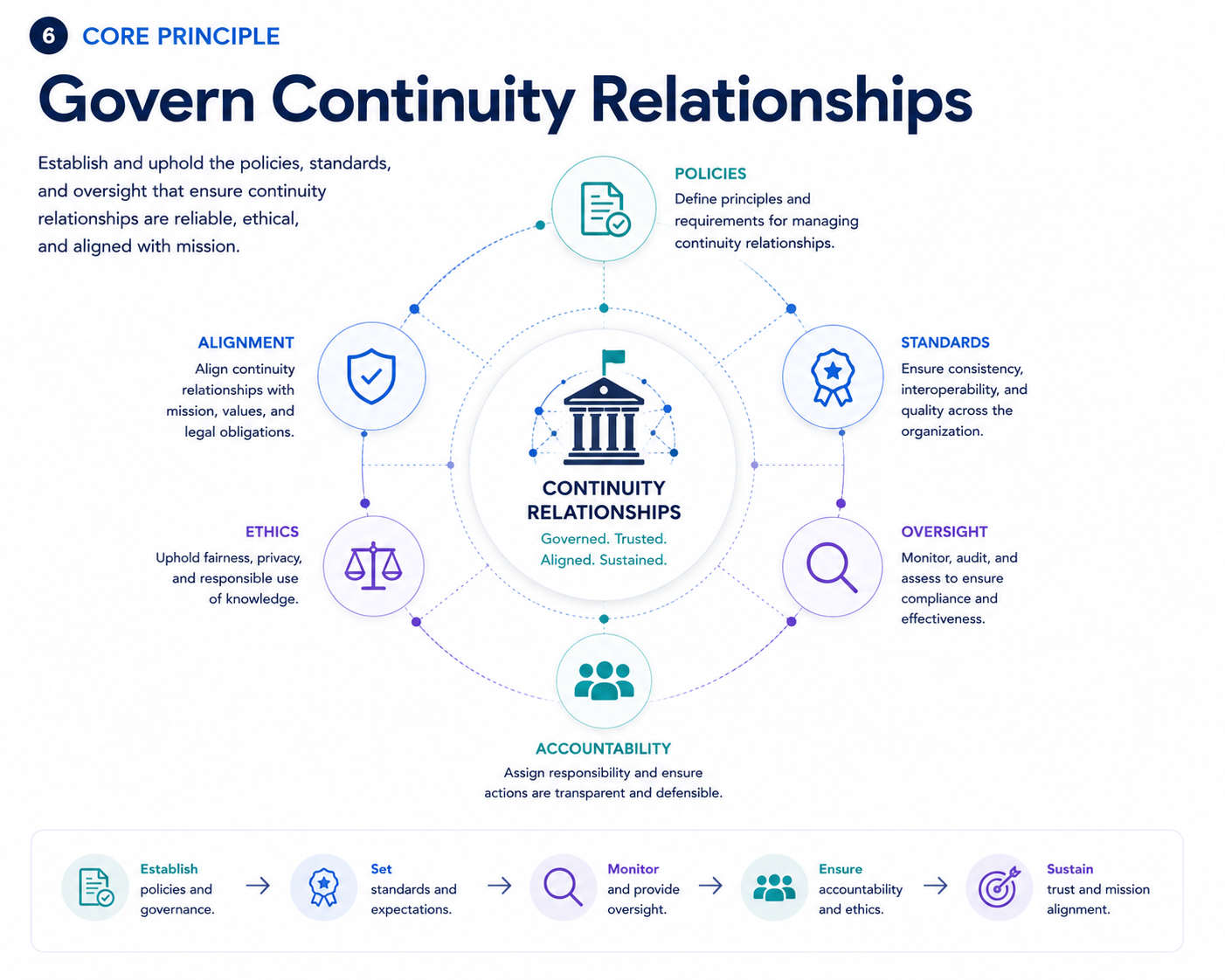
The GovKM Continuity Topology distinguishes:
Source → Evidence → Authority → Context → Decision → Action.
Authority and Context are adjacent, but they are not interchangeable.
Context explains the circumstances in which an action is being considered. Authority establishes whether an actor is institutionally permitted to perform the action in those circumstances.
A statement such as “I own this server” is contextual information until the system has a trustworthy basis for recognizing the speaker’s authority over the server.
A statement such as “the customer approved this penetration test” is not the customer’s approval.
A prompt asserting that credentials, targets, or tools are authorized cannot itself create the authorization it describes.
High-Risk Capability Needs External Authority
This suggests an important architectural principle for agentic systems.
When an action becomes sufficiently consequential, authorization should come from a source independent of the conversational claim requesting the action.
That source might be a verified identity, a signed scope document, an enterprise policy engine, an approved target inventory, a pre-authorized command class, a ticket with authenticated ownership, a delegated role, or another enforceable governance object.
The exact mechanism will differ by domain.
The continuity requirement is stable: the system should be able to resolve the proposed action back to an authority that did not originate merely as text inside the same conversation asking for the action.
Refusal State Is Also Institutional Memory
The reported Aur0ra behavior contains a second continuity problem. When the agent refused an operation, starting a new chat could reportedly allow the operators to restate the benign framing and continue.
That exposes a difference between conversation state and risk state.
A conversation can legitimately begin fresh. The underlying actor, target, recent refusal, attempted capability, and risk trajectory may not be fresh at all.
If the safety state disappears when a chat ends while operational capability remains available, the system loses:
Decision → Record → Institutional Memory → Future Reuse.
The human adversary retains continuity across sessions. The defense does not.
This asymmetry matters for any agent environment in which repeated attempts can be distributed across chats, tools, accounts, or time.
A New Session Does Not Create a New Institutional Context
Chat applications often treat sessions as clean conversational containers. That is useful for ordinary interaction. It becomes a weak governance boundary when consequential actions are available.
An institution should not assume that a new thread means a new risk context.
The same principle appears in fraud systems, security operations, procurement, clinical workflows, and financial controls. A single transaction may look innocuous. The governing context can exist across transactions.
Continuity-aware controls therefore need appropriate cross-session state: prior refusals, target identity, actor identity, escalation history, authoritative scope, and relevant risk events—preserved according to legitimate privacy and lifecycle constraints.
This Is Not an Argument for Unlimited Surveillance
Continuity does not require retaining every conversation forever or assigning permanent suspicion to every user who triggers a refusal.
Governance must remain proportionate, purpose-limited, and subject to appropriate retention and privacy controls.
The point is narrower: if the institution relies on prior safety decisions to constrain future high-risk actions, the decision needs enough durable state to remain effective for as long as its governing relevance lasts.
Otherwise a refusal is merely a temporary conversational event.
Permissions Still Matter, but They Are Not Purpose
An AI coding agent may have legitimate access to terminals, files, development tools, networks, cloud services, or credentials. Those permissions establish capability boundaries.
They do not establish that every technically available action serves an authorized purpose.
This is why agent governance has to distinguish:
Can the agent do this?
from
Is this actor authorized to ask the agent to do this to this target for this purpose now?
The second question is a continuity question because its answer depends on identity, evidence, authority, context, prior decisions, and the resulting record.
What Real Authorization Should Leave Behind
For consequential agent actions, a reconstructable authorization path should answer questions such as:
Who requested the action? What target or resource is in scope? Which authority permits the action? What time and purpose limits apply? What tools or methods are allowed? Which actions require escalation? What prior safety decisions are relevant? What actual action occurred? What record proves it?
This turns authorization from a phrase into an institutional object.
The GovKM Proposition
The reported ransomware campaign provides real-world evidence for a principle that applies far beyond cybersecurity.
Agents will increasingly receive requests whose legitimacy depends on facts the user can easily assert in natural language: “I have permission,” “the customer approved this,” “this is test data,” “legal cleared it,” “the executive authorized it,” “the patient consented,” or “this system belongs to me.”
Natural language is useful for describing those conditions.
It should not be sufficient to create them.
Authorization must be independently grounded, continuously bound to the action it permits, and durable enough to survive the conversational boundaries across which the risk itself persists.
Authorization cannot be a prompt.
Continue Exploring

When Government Systems Are Replaced, What Happens to Their Authority?
The Practice Form Failed. The Agent Used the Real One.