The Voting System Certificate Listed the Wrong Scanner. What Keeps Election Security Evidence Accurate?
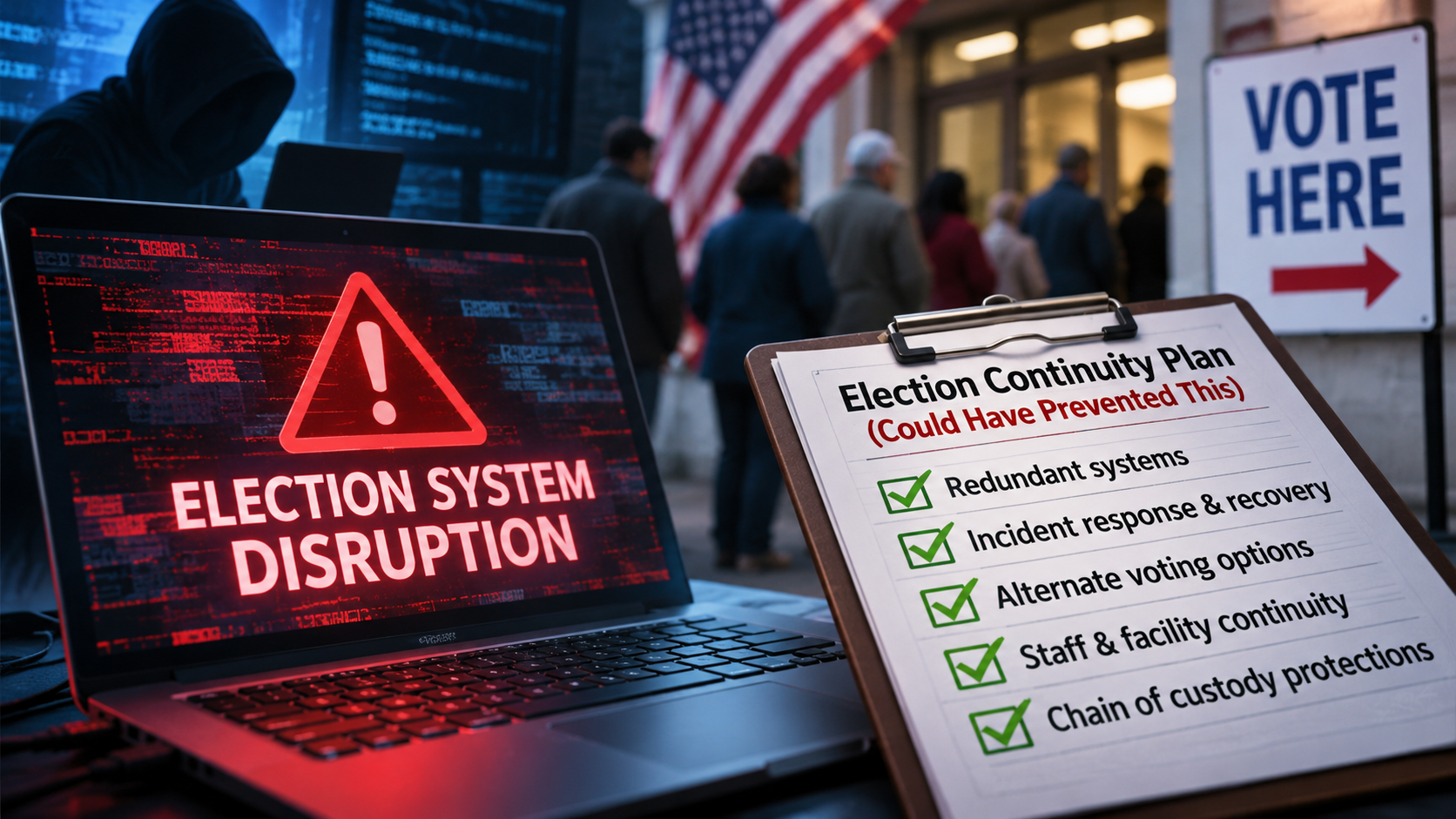

GovKM Practical Continuity Implementation Series | Election Security / Security
A voting-system certification discrepancy—not altered election results
The U.S. Election Assistance Commission Office of Inspector General's October 22, 2026 interim review of physical configuration audits supporting EAC voting-system certifications identified a scanner erroneously listed in the certified configuration of Democracy Suite 5.20. The OIG recommended that EAC correct the certificate and supporting public documentation to accurately represent the configuration tested. The OIG described the practical impact as limited. This is an authoritative certification-record discrepancy, not evidence that ballots, voting machines or election results were compromised.
A separate EAC inventory-governance finding
In its November 13, 2026 FY 2026 FISMA audit (P26HQ0003-27-04), the EAC OIG assessed the agency information-security program as effective overall while identifying a need for approved policies and standards governing its in-house asset-inventory taxonomy and required data elements. This finding concerns EAC administrative inventory governance. The report does not establish that the inventory deficiency caused the separate scanner-certification discrepancy.
The information-continuity problem
Election-security assurance depends on preserving the evidence chain between actual hardware tested, laboratory configuration, authorized certification, published certificate, later corrections and effective version. A document may be digitally available yet contain a component entry inconsistent with its underlying test record. GovKM's separate continuity interpretation is that authoritative and historical records must be reconciled and reconstructable; neither OIG report asserts a GovKM system failure or an AI-caused incident.
1. Inventory certification sources and accountabilities
Identify laboratory test records, configuration baselines, component identifiers, certified versions, public certificates, correction notices and named custodians. Distinguish original source, derivative record and working draft. Deliverable: signed source-to-evidence register.
2. Standardize configuration identity and metadata
Define test-specific component identifiers, configuration version, certification scope, issuer, effective dates, permitted change authority, asset status and source provenance. Apply consistent taxonomy rather than relying on informal device names. Deliverable: approved, CM-8-aligned inventory and metadata schema.
3. Reconcile the actual test with certification assertions
Trace each certified hardware element to tested physical-configuration evidence. Flag discrepancies before certificate publication, identify incomplete evidence, and require a responsible reviewer to resolve exceptions. Do not equate an erroneous certificate listing with proof of unauthorized equipment deployment. Deliverable: traceability matrix, exceptions and signed resolution evidence.
4. Preserve dated authority and corrections
Record the original certificate, approved correction basis, official signer, issue and effective dates, changed fields and continuing records obligations. Preserve legitimate historical access while ensuring that superseded claims are not reused as current authority. Deliverable: controlled version and supersession register.
5. Apply applicable federal and agency controls
Map FISMA, EAC-specific certification processes, approved NARA retention and relevant NIST SP 800-53 controls, including CM-8 for covered system-component inventories. Distinguish EAC's administrative cybersecurity requirements from certification of products used by election jurisdictions. Deliverable: requirement-to-control acceptance matrix.
6. Prepare controlled evidence for authorized enterprise AI
Build a model-independent corpus that retains tested versus certified versus superseded state, authority and exact citations. Validate not just indexed files or search candidates but what evidence is actually presented to the model and which restricted records are withheld. Deliverable: model-context receipt, citation proof and explicit abstention rules.
Falsifiable synthetic Text–Graph–Text–Graph diagnostic
A fictional laboratory tests scanner A. A published certificate incorrectly lists scanner B. A later, properly authorized correction names scanner A. Ask an authorized model what was tested, originally certified, and currently operative, and whether the evidence proves any machine was used in an election. Pass: the model cites only actually delivered authorized evidence, distinguishes all three dated record states and refuses to infer vote manipulation. This illustration is not an EAC or GovKM-native operational test.
Could information continuity have prevented this error?
Source-to-certificate reconciliation could have detected a mismatch before the certificate was issued, or enabled faster correction. The OIG findings do not prove that a particular GovKM implementation would necessarily have prevented this error or that the separate agency inventory finding caused it. The defensible lesson is to make discrepancies among source evidence, operative authorization and the final published record reviewable and traceable.
The GovKM consulting alternative
GovKM proposes a bounded readiness assessment, certification-evidence inventory, controlled taxonomy and mapping, source-to-document reconciliation pilot, security/records acceptance test and expansion roadmap for a compliant enterprise AI-ready knowledge corpus. Authorized officials retain certification and security decision authority. GovKM makes no claim of agency sponsorship, an actual election breach, a verified model deployment, or completed corrective action.
Primary references
EAC OIG Physical Configuration Audit Interim Review, October 22, 2026; EAC OIG FY 2026 FISMA Audit, November 13, 2026; NIST SP 800-53; NARA records management.
Continue Exploring

When Space Supply-Chain Risks Have No Clear Decision Owner

BIA Probate: Keep the Handbook Current and the Case Handoff Complete