The Failure Happened at Promotion, Not Generation.

AI hallucination is often described as a generation problem. In institutional use, the more consequential failure may occur one step later: when an unverified output is promoted into an authoritative record.
On September 3, 2026, the District of Columbia Court of Appeals issued a published order in Douglas v. Deutsche Bank National Trust Co. after identifying nonexistent authorities in an appellate brief. One attorney acknowledged using Google’s generative-AI search capability to locate authority and failing to verify the results before filing. Four cited authorities did not exist.
The law firm told the court that it had policies governing AI use and citation verification. The court nevertheless focused on the failure of the filing and on the lack of sufficiently described supervision and review surrounding the conduct at issue.
The AI output was a candidate, not authority
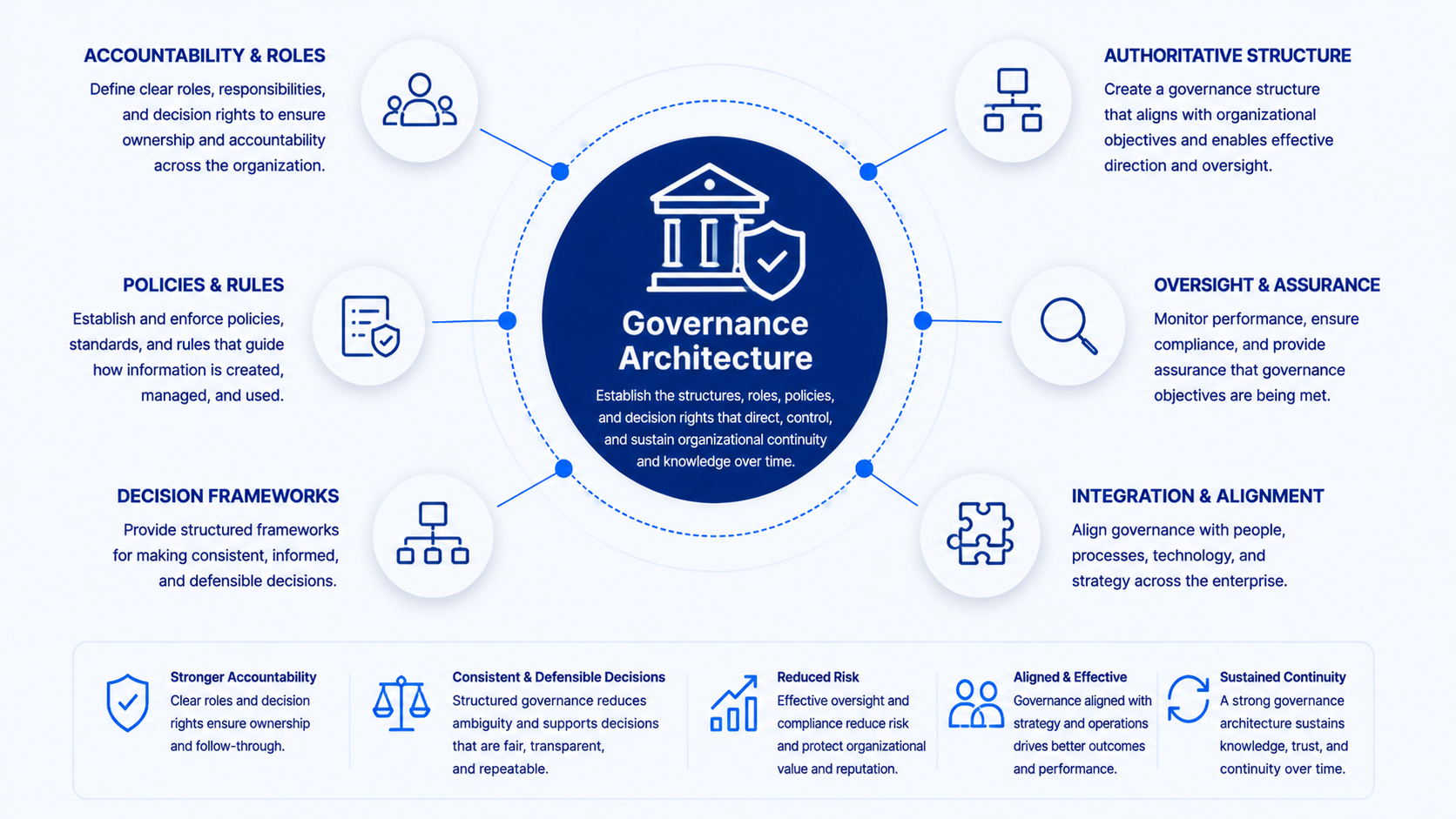
In GovKM terms, a generative-AI result should enter the institutional process as a candidate Source or potential Evidence. It does not become legal Authority merely because it resembles a citation, appears in a draft, or is incorporated into a professional work product.
The critical continuity edge is promotion: who verified the candidate, against what authoritative source, under what responsibility, and at what point did the institution accept it into the record?
The topology break can be stated plainly: Source / AI retrieval → Evidence → Authority failed before the material proceeded through Context, Decision, Action, and Record.
Why policies alone are not enough
An organization may have an AI-use policy and still lack operational governance. Governance exists when the policy is expressed through observable controls, accountable roles, verification evidence, and consequences at the point where AI-derived material becomes institutional action.
GovKM interprets this case as strong evidence for a human-authority principle: machine output should not become canonical merely through use. Promotion into an institutional record should be traceable to a responsible authority capable of verifying the evidence and accepting accountability for the resulting action.
Source
District of Columbia Court of Appeals, “Douglas v. Deutsche Bank National Trust Co.,” No. 24-CV-1099, published order filed September 3, 2026.
Continue Exploring
A Decision Memorandum Is Not Decision Provenance.
Aggregation Is Not Continuity.