
GovKM Practical Continuity Implementation Series | Acquisition
The verified government requirement
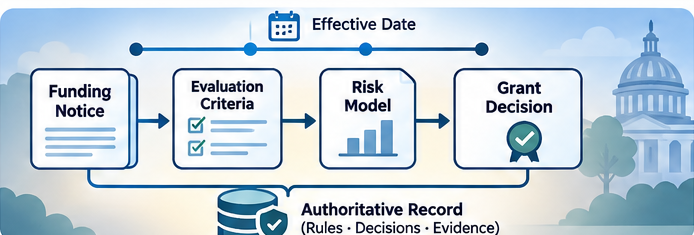
In Preparedness Grants: Improved Transparency and Communication Needed (GAO-27-109434, November 12, 2026), GAO summarizes earlier findings about incomplete evaluation criteria, scoring weights, risk-model explanation and communication of changes to National Priority Areas. The report addresses 13 FEMA preparedness grant programs totaling approximately $2.9 billion for fiscal year 2026. These are GAO oversight findings; the underlying events span earlier years and do not establish AI-caused errors.
The continuity challenge
An applicant and a reviewer may each possess genuine documents that describe different stages of a grant program. A defensible decision needs to identify the official rules in effect when an application was invited, scored, evaluated and awarded. GovKM's independent proposal is to make that authority and evidence reconstructable, including where policy is amended or litigation changes the enforceable conditions.
1. Inventory controlling documents and source systems
Identify funding notices, amendments, risk models, selection criteria, application packets, review records, awards, objections and approved retention schedules. Distinguish the published notice from internal working drafts and decisions. Deliverable: signed grant-process evidence inventory.
2. Establish versioned authority and effective dates
Associate each criterion, weight, priority area and eligibility condition with its approving official, publication date, operative period and source document. Model exceptions and court orders explicitly rather than assuming newest text always governed earlier action. Deliverable: authority-by-grant-cycle matrix.
3. Reconcile individual decisions to criteria
Record each reviewer's authorized role, scoring method, source input and actual decision basis. Make any departures or exceptions traceable to documented authority, not post hoc inference. Deliverable: sample decision-to-evidence reconstruction and exceptions register.
4. Apply records and security controls
Map the applicable 2 CFR Part 200 requirements where relevant, agency-specific grant rules, approved NARA records schedules, privacy constraints, protected information and release authority. Test that access rights and retention rules survive system or personnel transitions. Deliverable: approved records and access control matrix.
5. Prepare the decision corpus for AI use
Organize authorized current and historical criteria with durable source references, dates, and flags for incomplete evidence. A retrieval system must deliver the operative version and necessary conflicting or superseding material to the model; a successful search index is not a sufficient test. Deliverable: model-context receipt and verified policy-version citations.
6. Validate and maintain the process
Test a sample of historical cycles, train grant officers in amendment and exception handling, set change approval rules, and hand governance to accountable agency officials. Consultant analysis does not replace statutory decision authority. Deliverable: accepted traceability tests and operational stewardship plan.
Falsifiable synthetic diagnostic
Use a fictional program with an initial 40/60 scoring model, a later approved 50/50 model, and two applications submitted in different periods. Ask an authorized AI to reconstruct the basis for each decision. Pass: the answer uses the criterion actually operative at each decision, identifies the appropriate signed evidence and explains missing information instead of inventing a score. No FEMA source system or grant is tested by this illustration.
GovKM's consulting offer
A bounded GovKM engagement could conduct a continuity readiness assessment, build the records-and-authority mapping, pilot one grant cycle, verify model-ready retrieval and deliver a controlled expansion plan. It would establish a government-grade information environment that supports audit, fair process and eventual responsible enterprise AI adoption.
This article distinguishes GAO's documented findings from GovKM's recommendations. It does not represent FEMA sponsorship, a procurement request, a completed implementation or an assertion of AI misconduct.
Continue Exploring

When Space Supply-Chain Risks Have No Clear Decision Owner

BIA Probate: Keep the Handbook Current and the Case Handoff Complete