GAO Finds Navy and Marine Corps Gaps in Tracking Critical Personnel Relocations

GovKM Practical Continuity Implementation Series | Personnel / Defense
What GAO actually found
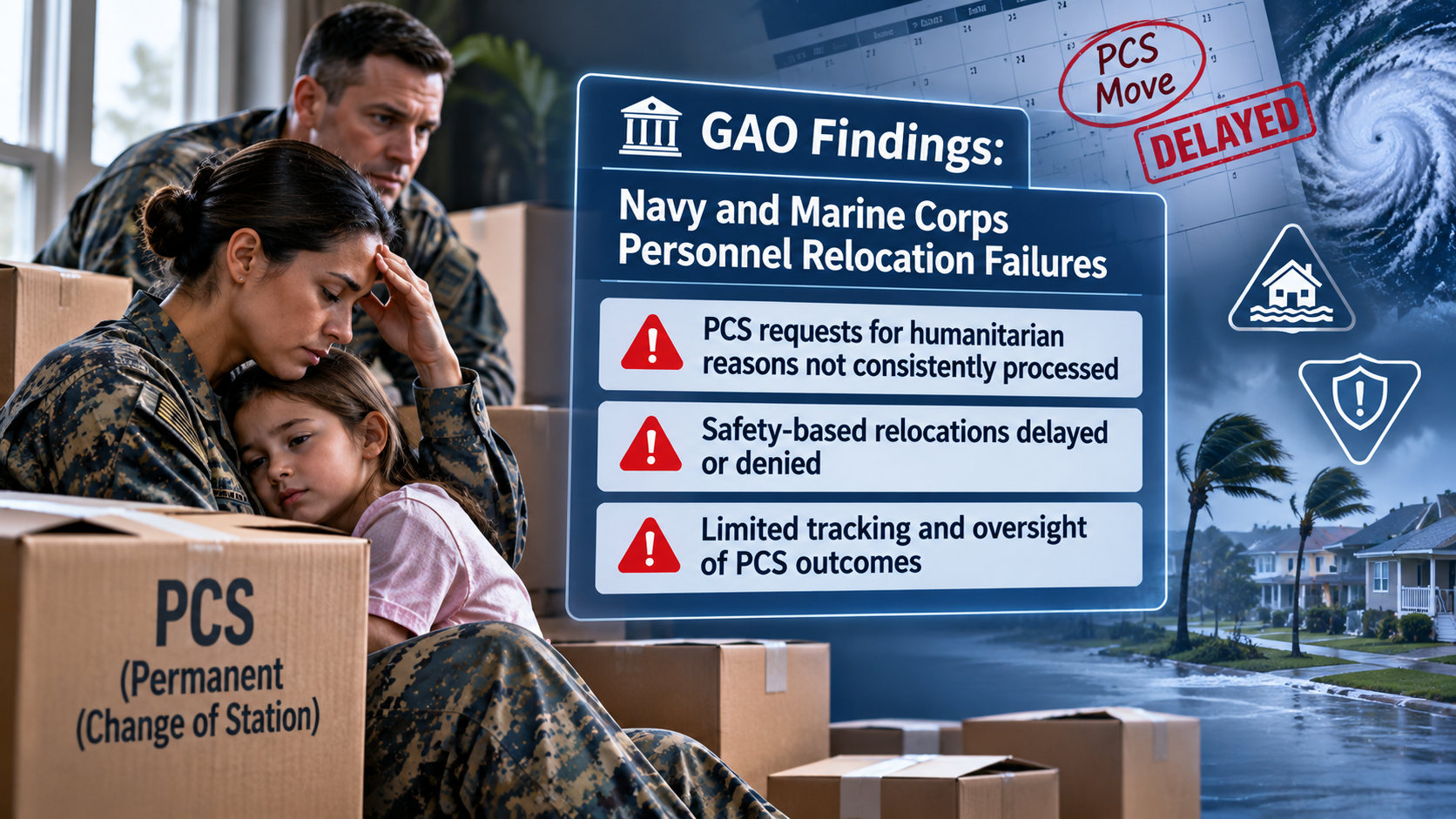
The U.S. Government Accountability Office's November 13, 2026 report, Military Personnel: More Complete Data Needed on Humanitarian Reassignments and Safety Transfers (GAO-27-108819), documents two particular gaps. The Navy centrally tracks humanitarian reassignment requests for enlisted personnel but not for officers. The Marine Corps does not clearly define safety-related relocations or centrally track those requests and outcomes. These are tracking and oversight deficiencies, not a finding that individual relocation decisions were wrongful.
Requests for humanitarian relocation concern severe family circumstances; safety transfers can address threats of bodily harm or death when local protection is insufficient. GAO analyzed available fiscal-year 2022–2025 records showing more than 15,000 humanitarian requests and nearly 400 safety-transfer requests. The gaps mean these figures cannot be treated as a complete denominator for the two affected populations. GAO made two recommendations, both OPEN; DOD concurrence is not implementation.
GovKM's separate continuity assessment
A request can be processed by an authorized local office and still remain missing from the evidence needed to reconstruct population-wide timeliness, decisions and outcomes. GovKM proposes preserving each request's source, operative policy, reviewer authority, supporting record, effective date, decision, action and later correction. This is GovKM's information-continuity interpretation, not a separate GAO conclusion or an allegation of AI-caused harm.
1. Establish approved definitions and authority
Specify covered service-member populations, what constitutes a humanitarian reassignment or safety-related relocation, decision and delegation authority, exceptions and effective dates. Archive superseded rules without treating the newest rule as governing earlier cases. Deliverable: signed eligibility, authority and policy-version matrix.
2. Inventory intake and decision sources
Identify official submission routes, local processing records, service databases, delegated offices and record custodians. Preserve gaps as unknown rather than as zero requests. Deliverable: authoritative-source inventory, lineage map and incomplete-coverage register.
3. Create a protected request-and-outcome record
Capture a stable request identifier, type, receipt date, program owner, policy version, milestone dates, authorized decision, disposition and sensitive evidence pointers. Limit personally identifiable, medical, threat and family data to the roles lawfully permitted to review them. Deliverable: approved schema, ACL requirements and accountable data stewards.
4. Reconcile historical and current states
Connect local and centrally visible requests while distinguishing pending, approved, denied, withdrawn and subsequently corrected decisions. Verify that a departure, a decision and a later status update are not mistaken for the same event. Deliverable: reproducible reconciliation, timeliness and gap evidence.
5. Govern records and security
Map actual DOD/service policy, relevant NARA-approved retention, privacy rules and federal cybersecurity requirements to source records. The person affected by a request is not automatically the actor authorized to make or disclose its determination. Deliverable: access/retention control matrix and independently verifiable positive and negative tests.
6. Prepare a compliant corpus for future AI
Organize operative and historical guidance, request facts and decisions for permission-aware retrieval. Distinguish data inventoried, indexed, selected for retrieval and text actually delivered to the model. Require citations to authoritative records and explicit acknowledgement of absent evidence. Deliverable: controlled model-input receipt and validation report. AI cannot replace legally accountable personnel authorities.
Falsifiable Text–Graph–Text–Graph diagnostic
In a synthetic scenario, a Navy officer requests humanitarian reassignment before a policy revision; separately a Marine requests a safety transfer after a documented threat. An authorized AI must reconstruct each event using the rule operative at the decision date, identify authorized actors and records, and refuse to invent absent population statistics. Pass: complete dated source-to-decision links, correct confidentiality and citations to passages actually delivered. No real service-member information or GovKM-native military execution is involved.
What GovKM would deliver
A bounded consulting engagement could conduct a readiness assessment, define the information and security architecture, implement one controlled tracking pilot, verify historical and present state, and transfer stewardship to accountable military offices. The solution improves the evidentiary foundation for oversight and eventual responsible enterprise AI without claiming GovKM could substitute for official command decisions.
Official references and limitations
GAO-27-108819 provides the primary findings. NARA records-management guidance, NIST SP 800-53 and the NIST AI RMF Playbook support control design with appropriate applicability checks. This independent article implies no DOD partnership, procurement, demonstrated harm or completed corrective action.
Continue Exploring

When Space Supply-Chain Risks Have No Clear Decision Owner

BIA Probate: Keep the Handbook Current and the Case Handoff Complete